
What Is the Best Desalination Process in 2026?
Choosing the best Desalination Process in 2026 is not a simple technology contest. The right option depends on feedwater, energy prices, local conditions, and how operators manage concentrated brine. A coastal city with reliable power faces different trade-offs from an inland facility treating brackish groundwater.
The World Bank’s 2019 report, The Role of Desalination in an Increasingly Water-Scarce World, documented roughly 16,000 desalination plants worldwide. That baseline shows the scale of deployment, but it does not identify one universal winner. Reverse osmosis is widely used because membranes can produce fresh water with comparatively low energy demand. Thermal processes may still suit sites with available heat or specific operating needs. Newer approaches are promising, but performance claims need full-scale evidence.
The details matter. A membrane’s pressure, pretreatment, cleaning schedule, and replacement cycle shape real operating costs. So do electricity sources and brine disposal. Small design choices can become large expenses.
Menachem Elimelech and William A. Phillip wrote in Science that “the production of fresh water through desalination is an energy-intensive process with significant environmental impacts.” Their 2011 review remains a useful reminder: output alone is not enough. A sound comparison should measure energy use, water recovery, reliability, and environmental performance together. No process wins everywhere. In 2026, the best choice is the one that fits its site and performs as promised over time. Even that answer deserves scrutiny.
How Desalination Works and Why It Is Used
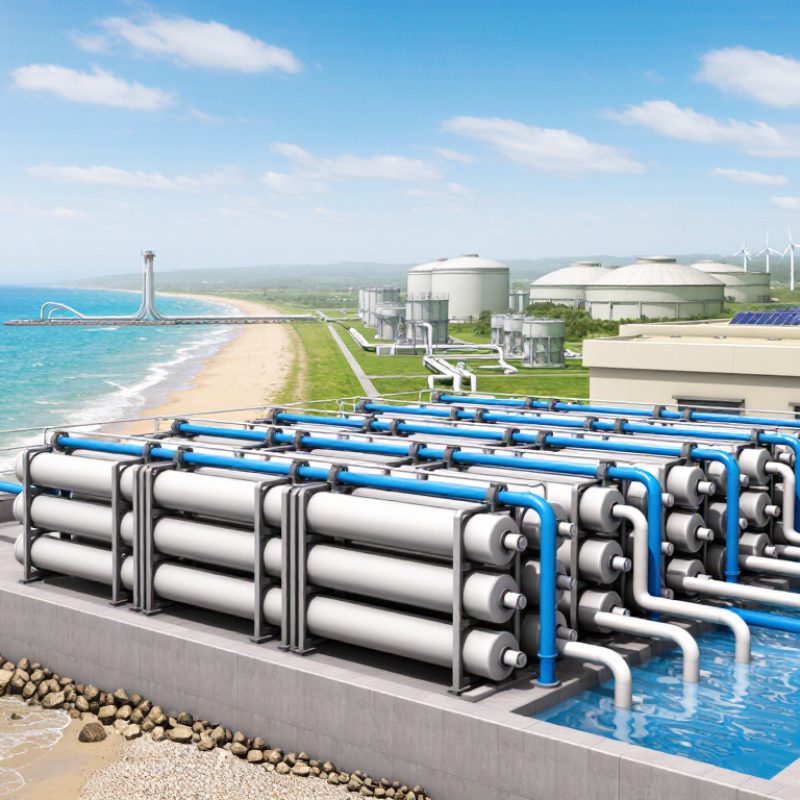
Desalination makes saline water usable by removing dissolved salts and other impurities. A seawater plant usually screens out debris, filters the water, then forces it through membranes under pressure. This process, called reverse osmosis, leaves most salts behind. The product water is then disinfected and adjusted with minerals before distribution. Thermal plants use heat to evaporate water and condense the vapor, but they generally require more energy.
The World Bank’s 2019 report, The Role of Desalination in an Increasingly Water-Scarce World, estimated global desalination capacity at about 95 million cubic metres per day. That capacity can support coastal cities, islands, and facilities with few freshwater sources. It is not a simple cure for scarcity. FAO AQUASTAT reports that agriculture accounts for roughly 70% of global freshwater withdrawals, so desalinated water alone cannot resolve every water demand.
The details matter. Intake screens can catch seaweed and small debris; membranes need careful cleaning and monitoring. Concentrated brine also returns to the sea, where poor discharge design can affect local marine conditions. A process diagram makes this look tidy. Real coastlines are messier. Operators must weigh water reliability against electricity use, maintenance, and the condition of nearby waters.
| Process | How It Works | Best-Suited Feedwater | Indicative Energy Use | Typical Recovery | Key Advantages | Main Limitations | Best Fit in 2026 |
|---|---|---|---|---|---|---|---|
| Reverse osmosis (RO) | High-pressure pumps push water through semi-permeable membranes that reject most dissolved salts. | Seawater and brackish groundwater, with pretreatment appropriate to water quality. | Seawater: approximately 3–6 kWh of electricity per m³ of product water at modern large facilities. Brackish-water RO generally uses less, but demand varies substantially with salinity and system design. | Seawater systems commonly recover about 35–50% of feedwater; brackish-water systems can often recover more, depending on scaling limits and feedwater chemistry. | Generally the leading all-purpose option for new seawater desalination because of its comparatively low energy use, modular design, and broad availability. | Needs reliable pretreatment and membrane maintenance. Produces concentrated brine, and performance can be affected by fouling, scaling, and feedwater changes. | Often the best overall choice for new seawater or brackish-water supply when electricity, pretreatment, and brine management are available. |
| Multi-stage flash distillation (MSF) | Heated seawater flashes into vapor through a series of chambers at progressively lower pressure; the vapor is condensed as freshwater. | Seawater, especially where a suitable source of heat and established thermal infrastructure are available. | Typically requires substantial heat—roughly 50–80 kWh of thermal energy per m³—plus about 2.5–5.5 kWh of electricity per m³. Actual figures depend on plant configuration and heat accounting. | Often around 10–25% per pass, depending on design and operating conditions. | Produces consistent, low-salinity distillate and can tolerate some feedwater conditions that challenge membrane systems. | High heat demand, large equipment, and generally higher cost and energy use than modern seawater RO where low-cost heat is unavailable. | Most suitable where thermal energy is readily available and operational continuity is a priority. |
| Multiple-effect distillation (MED) | Water evaporates and condenses across a sequence of effects, reusing heat from one stage to help drive the next. | Seawater, particularly at sites with usable low-grade heat or combined heat-and-water infrastructure. | Commonly about 40–70 kWh of thermal energy per m³, plus approximately 1.5–2.5 kWh of electricity per m³; values vary with design and operating conditions. | Often approximately 20–40%, depending on the number of effects and feedwater conditions. | Can make efficient use of low-temperature heat and produces high-quality distillate. | Requires heat and careful control of corrosion and scale; usually less attractive than RO if heat is costly or unavailable. | A strong option when low-grade heat can be integrated economically with water production. |
| Electrodialysis / electrodialysis reversal (ED/EDR) | An electric field moves dissolved ions through alternating ion-selective membranes, reducing the salt concentration in the product stream. | Brackish water and other feeds with moderate salinity; suitability depends on water chemistry. | Highly dependent on feedwater salinity and target product quality. It is generally more energy-efficient for brackish water than for full-strength seawater. | Can be high for suitable brackish feeds, but is limited by scaling, precipitation, and the desired water quality. | Energy use can track the amount of salt removed; polarity reversal can help manage some forms of fouling and scaling. | Not generally the preferred method for full-strength seawater. It does not remove uncharged contaminants as effectively as salt ions, so additional treatment may be needed. | Worth considering for brackish-water desalination when the feed salinity and required treatment suit an ion-removal process. |
| Solar stills and solar-driven evaporation | Solar heat evaporates water; vapor condenses on a surface and is collected as freshwater. | Small, remote, or emergency applications where sunlight is abundant and output requirements are modest. | Uses solar heat rather than a conventional high-pressure or electrically driven process; practical output is limited by available collector area and sunlight. | Usually low on a land-area basis compared with large centralized plants. | Can operate with simple equipment and little or no grid electricity. | Low productivity, weather dependence, and substantial space needs make it unsuitable for most municipal-scale supply. | Best for small-scale needs, not as a direct replacement for large RO or thermal plants. |
FAQS
Compare energy use, water recovery, pretreatment, maintenance, and final water quality. Daily output alone is not enough.
No. It can produce high-quality water, but salinity, algae, and sediment may increase treatment needs. Conditions matter.
It may fit a site with usable waste heat or experienced operators. Heat availability does not guarantee lower costs.
Muddy storm runoff can challenge an intake, while steady offshore water may be easier to manage. Seasonal testing helps reveal changes.
Include electricity or heat, staffing, repairs, pretreatment, and concentrated brine handling. Construction costs are only part of the picture.
Figures may assume ideal salinity, temperature, or demand. Ask for results from conditions close to the proposed site. Models can mislead.
Yes. A city may support centralized infrastructure and trained crews. An island may need modular equipment and accessible spare parts.
It may need minerals added before use. Storage and distribution also affect delivered water quality.
Run local pilot tests across seasons and check staffing assumptions. I would still revisit any estimate based on limited data.
Conclusion
The best Desalination Process in 2026 depends on the water source, the amount of water needed, available energy, local conditions, and the intended use of the treated water. Desalination removes salts and other unwanted substances from seawater or brackish water. Common approaches include membrane-based separation, which filters water under pressure, and thermal methods, which use heat to separate fresh water from salts. Each method has different requirements for energy, equipment, operation, and handling concentrated brine.
Comparing processes means weighing water quality, cost, energy use, reliability, environmental impact, and the ability to expand or adapt a system. Membrane methods may suit many facilities seeking efficient operation, while thermal methods can be appropriate where heat is readily available or water conditions favor them. In 2026, choices are also shaped by renewable energy, improved system design, water scarcity, and responsible brine management. Rather than one solution being best everywhere, the right process is the one that meets local needs reliably while balancing resource use and environmental considerations.
