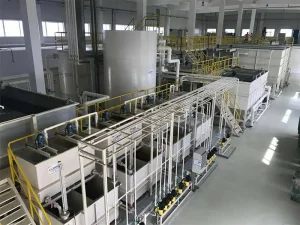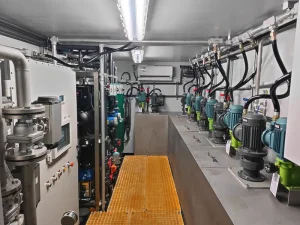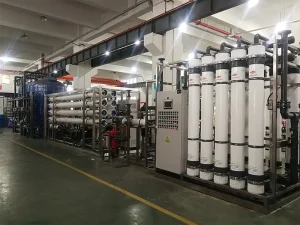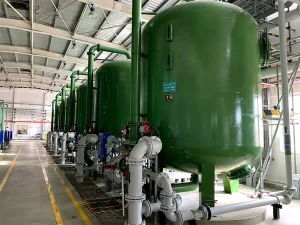
Flagship Desalination & Pure Water Manufacturing Series
Pre-engineered, containerized, and skid-mounted seawater distillation and membrane separation systems engineered for rapid industrial commissioning.
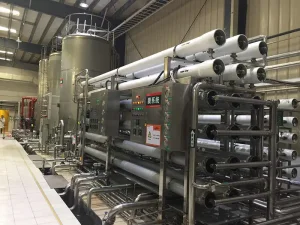
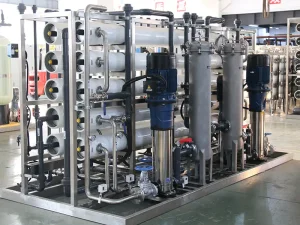
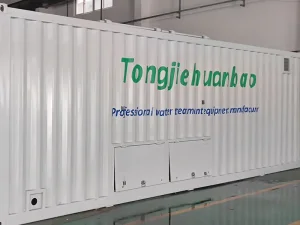
Distilling Salt Water Into Freshwater: Global Paradigm Shift
Analyzing high-salinity thermodynamic separation, membrane longevity mechanics, and modern industrial decoupling from vulnerable surface aquifers.
Thermodynamic & Hydraulic Efficiency
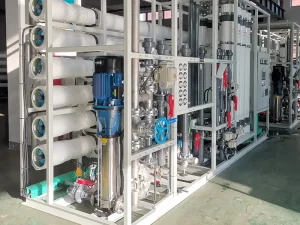
Traditional multi-stage flash (MSF) and multi-effect distillation (MED) are constrained by severe heat transfer scaling and high thermal footprints (exceeding 8-12 kWh/m³ equivalent). Modern CE-certified manufacturing transitions industrial processing to advanced Sea Water Reverse Osmosis (SWRO) paired with isobaric Energy Recovery Devices (ERD), cutting specific energy consumption down to <2.8 to 3.2 kWh/m³.
Geopolitical Water Autonomy
Critical maritime terminals, offshore extraction complexes, and arid chemical industrial parks face acute exposure to municipal water quotas and brackish table depletion. Containerized distillation platforms deliver on-site water autonomy, eliminating reliance on vulnerable third-party pipelines while guaranteeing a steady supply of low-chlorinity permeate.
Decoupling via Circular Zero Discharge
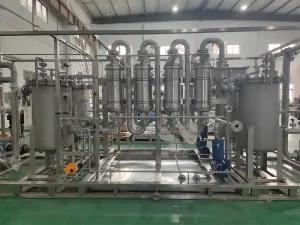
Distilling salt water is no longer isolated to marine feedwaters. Upstream industrial hubs combine membrane-based desalination with multi-effect crystallizers to concentrate high-salinity industrial blowdown. This closes process loops, recapturing >95% clean condensate for boiler feedwater while isolating crystalline solids.
Desalination Separation Architecture Matrix
A rigorous empirical comparison across core industrial separation methodologies used to distill seawater into ultra-pure and potable freshwater.
| Separation Modality | Specific Energy Consumption (SEC) | Operating Pressure Limits | Permeate TDS Recovery | CE Safety Directive Alignment |
|---|---|---|---|---|
| High-Flux SWRO (Tongjie Standard) | 2.8 – 3.4 kWh/m³ (with Isobaric ERD) | 55 – 83 bar (Duplex 2205 / 2507) | < 200 – 400 mg/L (Single-pass) | PED 2014/68/EU, MD 2006/42/EC |
| Disc Tube RO (DTRO / STRO) | 6.5 – 9.0 kWh/m³ | Up to 120 – 160 bar | < 500 mg/L (From severe brines) | PED Cat IV Pressure Integrity |
| Mechanical Vapor Recompression (MVR) | 12.0 – 22.0 kWh/m³ equivalent | Atmospheric / Sub-atmospheric | < 50 mg/L (Conductivity < 10 µS/cm) | PED / ATEX Directives (Vapor phase) |
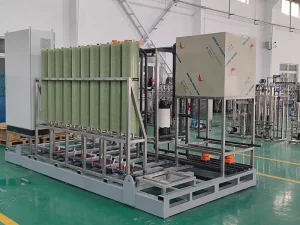
| Two-Stage RO + EDI (Electrodeionization) | 3.8 – 5.2 kWh/m³ | 15 – 25 bar (Polishing train) | Resistivity > 15 – 18.2 MΩ·cm | Low Voltage Directive (LVD) 2014/35/EU |
CE Certification Directives & Structural Metallurgical Integrity
Stringent compliance standards applied to eliminate operational, high-pressure, and electromagnetic risks across overseas plant installations.
Pressure Equipment Directive (PED 2014/68/EU)
Every membrane housing vessel, high-pressure manifold, and pulsating dampener is engineered, fabricated, and stamped in strict adherence to PED requirements. All pipe sections undergo 100% hydrostatic testing at 1.5× operational limit, backed by X-ray non-destructive weld testing on super duplex headers.
Machinery Directive (MD 2006/42/EC) & LVD
Complete mechanical safeguarding against catastrophic hydraulic rupture and pump cavitational events. Variable frequency drives (VFDs) and main PLC cabinets strictly fulfill Low Voltage Directive (LVD 2014/35/EU) and EMC Directives to safeguard against hazardous interface interference in industrial zones.
Super Duplex (PREN ≥ 40) Metallurgy
Seawater’s hyper-chloride environment accelerates pitting and crevice corrosion. Tongjie utilizes certified 2507 Super Duplex and 2205 Duplex stainless steel for all wet components downstream of the high-pressure pumps, guaranteeing sustained metallurgical life and preventing chloride stress cracking under elevated pressures.
Engineered for Global Stress Conditions
Field installations configured around local seawater salinity variations, extreme climate baselines, and stringent site footprint limits.
Middle East & Arabian Gulf (High TDS / High Temp)
TDS levels exceed 45,000 mg/L with ambient temperatures reaching 50°C. Systems incorporate automated micro-filtration pre-treatment, severe temperature derating computations, and dual-pass energy recovery turbines capable of maintaining membrane lifecycle under extreme osmotic heads.
Remote Islands & Resort Developments
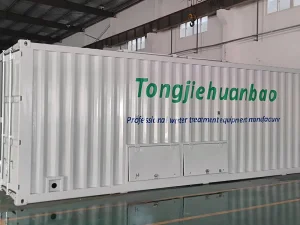
40-foot HQ containerized layout featuring internal climate controls, low-vibration structural isolators, whisper-quiet positive displacement pumps, and intelligent remote SCADA uplink via 4G/Satellite for autonomous plant operation.
Coastal Power, Hydrogen & Chemical Utilities
Seamlessly feeding high-pressure boilers and green hydrogen electrolyzers. Seawater permeate is polished directly through secondary-pass brackish RO and continuous EDI skids to deliver boiler feed conductivity <0.1 µS/cm and ultra-low silica levels (<5 ppb).
R&D Roadmap: Next-Generation Desalination Paradigms
Tongjie’s technology pipeline designed to shrink carbon intensity, raise recovery ratios, and incorporate edge computing across desalination plants.
Direct-Coupled Solar Photovoltaic Desalination
Mitigating energy losses by mating variable-speed positive displacement pumps directly to variable DC solar PV fields, bypassing high-cost inverter architectures during daylight hours.
AI Predictive Anti-Fouling Algorithms
Embedding machine learning models inside local PLC controllers to evaluate live trans-membrane pressure (TMP), feed temperature, and SDI dynamics to trigger automatic micro-flush cycles prior to irreversible biofouling.
Graphene & Biomimetic Aquaporin Membranes
Partnering with global institutions to validate next-gen biomimetic membrane matrices, boosting water flux by up to 30% while maintaining absolute monovalent salt rejection under reduced operational pressures.
Frequently Asked Technical & Procurement Questions
Direct technical answers addressing hydraulic limitations, regulatory compliance, chemical preservation, and factory acceptance testing.
How do your containerized desalination plants comply with the European Pressure Equipment Directive (PED)?
What design flux rates are implemented to guarantee long-term membrane lifespan?
What level of factory acceptance testing (FAT) is performed before international dispatch?
Can the system automatically handle red tide, high turbidity, or seasonal suspended solids?
High-Recovery Industrial Water Treatment & ZLD Equipment
Explore our specialized range of modular RO systems, fracturing flowback reconditioning skids, and continuous demineralized water generators.