Precision Modular Desalination & High-Salinity Concentration Systems
Pre-engineered, containerized, and ISO/CE-certified membrane separation skids custom fabricated for immediate global deployment.
The Global Transition in Seawater Desalination & Potable Water Conversion
Analyzing thermodynamic separation, energy optimization curves, and the engineering shift toward decentralization.
Global industrial expansion, combined with irreversible hydrological volatility, has shifted the paradigm of fresh water sourcing from conventional surface and alluvial extraction to advanced Seawater Reverse Osmosis (SWRO) conversion. Historically dominated by thermal phase-change configurations such as Multi-Stage Flash (MSF) and Multi-Effect Distillation (MED), modern industrial and municipal procurement strategies are overwhelmingly favoring pressure-driven thin-film composite (TFC) polyamide membrane separation. This decisive technological pivot is driven primarily by thermodynamic efficiency: modern SWRO arrays paired with isobaric Energy Recovery Devices (ERDs) operate at specific energy consumptions (SEC) ranging between 2.6 to 3.2 kWh/m³, compared to upwards of 8 to 15 kWh equivalent thermal energy per cubic meter in thermal evaporative facilities.
As an established National High-Tech Enterprise and Shanghai Specialized & Sophisticated Enterprise founded in 2010, Shanghai Tongjie Environmental Protection Technology Co., Ltd. leads this frontier. We maintain in-house research, chemical thermodynamics engineering, fluid mechanical modeling, structural skid fabrication, and integrated electrical automation. Our comprehensive manufacturing capacity bridges the critical gap between basic component manufacturing and turnkey, project-ready desalination infrastructure designed to convert challenging coastal ocean water into ultra-clean, compliant drinking water matching World Health Organization (WHO) and local municipal guidelines.
Isobaric Pressure Exchangers
Integration of ceramic rotor isobaric energy recovery devices (ERI PX or Danfoss iSave) directly transfers hydrodynamic energy from the high-pressure concentrate stream (65–80 bar) to the raw seawater feed with >97% recovery efficiency, dramatically curbing life-cycle operational expenditures.
Metallurgical Integrity
Raw seawater environments demand rigorous anti-corrosion architecture. All high-pressure manifolds, pump wetted parts, and high-salinity piping are engineered exclusively in Super Duplex Stainless Steel (UNS S32750 / EN 1.4410) with a Pitting Resistance Equivalent Number (PREN) > 42.
Turnkey Pre-Engineered Skid Formats
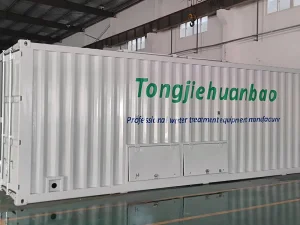
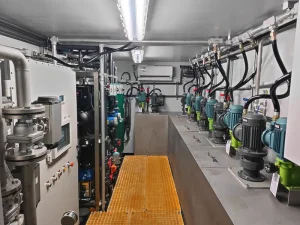
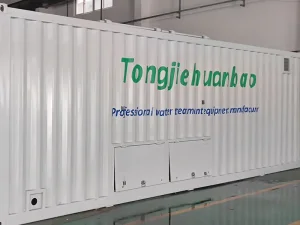
By standardizing on 20-foot and 40-foot high-cube ISO shipping container platforms, our modular systems eliminate site civil complexities, allowing remote mining camps, island resorts, and coastal municipalities to commission water production within days of dockside delivery.
Engineering Sizing Matrix & Feed Water Characterization
Translating complex marine chemistry into balanced hydraulic flux, scaling indices, and membrane longevity.
Global EPC contractors, municipal water authorities, and concession operators (BOOT/BOT) must address complex water chemistry variations when procuring desalination systems. Seawater is not a static homogeneous matrix; Total Dissolved Solids (TDS) vary from 32,000 ppm in open oceanic conditions to upwards of 45,000–50,000 ppm across the Arabian Gulf and Red Sea. Furthermore, seasonal fluctuations in marine bio-activity, turbidity, silt density index (SDI₁₅), and water temperature impose severe constraints on membrane flux rates.
| Water Quality Parameter | Intake Range (Typical Seawater) | Pretreated Feed (Pre-SWRO) | Target Drinking Permeate (Post-Remineralization) |
|---|---|---|---|
| Total Dissolved Solids (TDS) | 32,000 – 48,000 mg/L | Equal to raw intake | < 200 – 400 mg/L (WHO Standard: < 500 mg/L) |
| Silt Density Index (SDI₁₅) | 4.5 – 15.0 (High particulate fouling) | ≤ 2.5 (Ultrafiltration polishing) | Non-applicable |
| Turbidity (NTU) | 2.0 – 50.0 NTU (Storm surges) | < 0.1 NTU | < 0.05 NTU |
| Boron Concentration (B) | 4.5 – 6.5 mg/L | 4.5 – 6.5 mg/L | < 0.5 mg/L (Specialized Pass-2 Boron Array) |
| Langelier Saturation Index (LSI) | +0.5 to +1.8 (Severe scaling potential) | Controlled via anti-scalant dosing | +0.0 to +0.4 (Non-corrosive / Stabilized) |
| Free Chlorine / Oxidants | Variable (Shock bio-control) | < 0.02 mg/L (Dechlorinated via SBS) | 0.2 – 0.5 mg/L (Residual protection) |
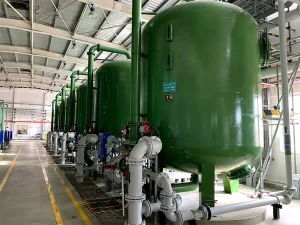
To maintain membrane warranties and prevent irreversible bio-fouling or chemical scaling, our ODM engineering team enforces strict pre-treatment metrics. Utilizing dual-stage media filtration (sand, anthracite) or pressurized hollow-fiber Ultrafiltration (UF) skids with 0.02-micron pore sizes, the feedwater SDI₁₅ is consistently depressed below 2.5 before reaching the high-pressure boost pumps. This preventative architecture ensures steady flux and prolongs membrane element life to 5–7 years of continuous duty.
End-to-End Desalination Engineering Flowsheet
The complete multi-barrier technological train behind Tongjie’s high-efficiency seawater conversion plants.
Intake & Pre-Treatment
Coarse screening, coagulation-flocculation, DAF for algae blooms, and pressurized media or UF filtration to strip SDI < 2.5.
Chemical Conditioning
Micro-dosing of proprietary scale inhibitors, acid/caustic pH trimming, and sodium bisulfite (SBS) for total dechlorination.
High-Pressure SWRO
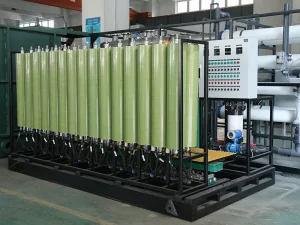
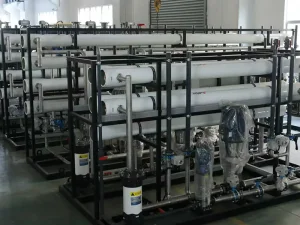
Multi-stage duplex centrifugal pumps powering 1200 PSI FRP pressure vessels with energy recovery devices recycling hydraulic head.
Pass-2 Polishing
Secondary brackish RO (BWRO) stage operating under alkaline pH conditions to selectively reject uncharged boric acid molecules.
Remineralization
Calcite limestone dissolution contactors, carbon dioxide injection, and hypochlorite dosing to create palatable, non-aggressive potable water.
Boron Elimination to WHO Standards (<0.5 mg/L)
In standard oceanic conditions, Boron exists primarily as uncharged boric acid (H₃BO₃). At neutral pH, standard seawater RO membranes only reject 80–88% of boron, leaving permeate levels at 1.0–1.5 mg/L—far exceeding the WHO drinking standard of 0.5 mg/L. Tongjie engineers incorporate an intelligent Pass-2 polishing configuration: by introducing trace sodium hydroxide (NaOH) to shift the feed pH above 9.5, boric acid ionizes into negative borate ions [B(OH)₄]⁻, allowing the secondary low-energy membrane array to achieve rejection rates exceeding 98.5%.
Permeate Stabilization & Health Remineralization
Direct SWRO permeate exhibits low mineral content, a negative Langelier Saturation Index (LSI < -2.0), and low buffer capacity, rendering it corrosive to distribution networks and unpalatable for human consumption. Our post-treatment skids integrate pressurized calcite (CaCO₃) contact beds paired with precise gaseous CO₂ injection. This re-introduces essential calcium and bicarbonate alkalinity, raising the LSI to a stable +0.1 to +0.3 range, satisfying both health mineral criteria and municipal non-corrosive pipeline standards.
Engineering Compliance, FAT Protocols & Global Support
Ensuring complete risk elimination through certified quality protocols, factory testing, and localized field engineering.
Full Factory Acceptance Testing (FAT)
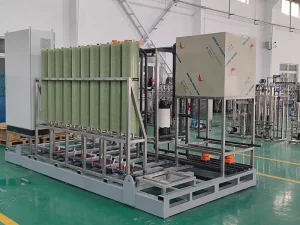
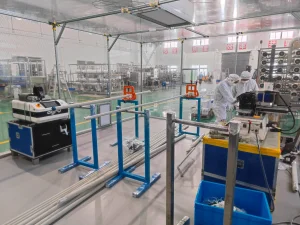
Every modular skid and containerized plant is hydrostatically pressure tested to 1.5x design pressure and undergoes dynamic wet testing with simulated saline feed at our Shanghai manufacturing center before port dispatch, reducing on-site commissioning to under 10–14 days.
- Hydrostatic pressure test logs (ASME Sec. VIII)
- Full instrumentation loop checks
- PLC automated fail-safe & trip testing
International Certification Standards
Shanghai Tongjie operates under an integrated management ecosystem certified to ISO 9001, ISO 14001, and ISO 45001. All exported electrical enclosures and pressure skids carry full European Conformity (CE) documentation and ASME pressure vessel certifications.
- CE Machinery & Low Voltage Directives
- Class II Mechanical & Electrical Contractor
- Class II Environmental Protection Contractor
Marine Environmental Engineering
Our container enclosures are fabricated using Corten anti-corrosion structural steel with an internal polyurethane insulating layer and an external marine-grade C5-M epoxy coating system designed to withstand extreme coastal salt-spray and ultraviolet degradation.
- ISO 12944 C5-M High Durability paint systems
- Class 1 Div 2 hazardous electrical options
- Dual redundancy HVAC thermal management
Technology Roadmap: Next-Generation Desalination Paradigms
Pioneering renewable integration, low-chemical operations, and valuable mineral extraction from reject brines.
Solar PV & Wind Hybridization
Integrating direct-drive variable frequency drives (VFD) that dynamically balance high-pressure pumps against fluctuating off-grid solar photovoltaic output without requiring massive battery energy storage systems (BESS).
Aquaporin & Biomimetic Membranes
Collaborating with global polymer researchers on biomimetic water channels and graphene oxide membrane coatings that deliver 30% higher water permeability at identical salt rejection, promising SEC reductions down to 2.0 kWh/m³.
Mineral Recovery & Brine Valorization
Coupling SWRO concentrate with high-pressure DTRO/STRO and electrochemical crystallizers to transition from standard ocean brine discharge into high-value chemical recovery: industrial-grade magnesium, calcium, and lithium salts.
Frequently Asked Questions: SWRO Engineering & Sourcing
In-depth responses to critical design, operational, and commercial questions raised by international procurement teams.
What is the standard recovery ratio for SWRO plants, and how is it optimized?
Standard seawater RO systems operate at recovery ratios between 40% to 45%. Operating above 45% on standard seawater (35,000–40,000 ppm TDS) causes the osmotic pressure of the reject brine to spike dramatically (exceeding 60–70 bar), demanding pump pressures beyond the standard 83 bar (1200 psi) mechanical ratings of commercial FRP vessels. By balancing feed pressure with isobaric energy recovery, recovery is maximized while preventing calcium sulfate (CaSO₄) and barium sulfate (BaSO₄) scaling.
How does Tongjie resolve red tide (algal bloom) challenges at coastal intakes?
Algal bloom events introduce massive concentrations of colloidal organic matter and transparent exopolymer particles (TEP) that blind RO membranes in hours. Tongjie incorporates an upstream Dissolved Air Flotation (DAF) clarifier paired with coagulant dosing, followed by pressurized Ultrafiltration (UF) skids. The micro-bubble flotation removes 95%+ of intact algae and organics, preserving the downstream RO flux without requiring frequent CIP stops.
What specific energy consumption (SEC) is realistically guaranteed on skid units?
On our containerized SWRO units equipped with isobaric pressure exchanger devices (PX) and premium efficiency IE4 / NEMA Super-Premium motors, we consistently achieve a specific energy consumption of 2.8 to 3.4 kWh/m³ at the RO battery limit (at 25°C, 36,000 ppm TDS, 42% recovery). Variable Frequency Drives (VFDs) dynamically trim high-pressure pump RPM against temperature-dependent seawater viscosity changes.
How does the system ensure compliance with WHO drinking water boron limits?
Standard single-pass RO membranes only reject 80–88% of uncharged boric acid molecules. We employ a split-partial or full second-pass brackish RO (BWRO) train with pH elevation (caustic dosing to pH 9.5–10.0). This ionizes boric acid into negatively charged borates, elevating rejection to over 98.5% and consistently producing final drinking water with boron levels < 0.4 mg/L, comfortably beating the 0.5 mg/L WHO threshold.
What metallurgy is selected for high-pressure seawater service?
We strictly eliminate standard AISI 304 or 316L stainless steel for high-pressure seawater due to catastrophic crevice corrosion and pitting. Tongjie exclusively utilizes Super Duplex Stainless Steel (UNS S32750 / 2507 or 1.4410) with PREN > 42 for all high-pressure piping, valves, and pump wet-ends. Low-pressure suction and reject piping utilizes non-metallic engineering polymers (UPVC, CPVC, or HDPE 100).
What is the typical lifespan and replacement cycle for the RO membranes?
Under our automated CIP flushing, automated permeate displacement on shutdown, and upstream SDI < 2.5 protocol, high-rejection SWRO membranes have an operational lifecycle of 5 to 7 years. Clean-In-Place (CIP) cleaning cycles are typically required only once every 3 to 6 months, managed through skid-integrated CIP heating, circulation, and neutralization tanks.
What are the requirements for off-grid containerized solar installations?
For off-grid installations, we provide customized PV-SWRO integration featuring soft-starting VFDs that synchronize pump speed with solar irradiance curves. Containerized systems feature integrated electrical load-shedding architecture, external heat rejection, and auxiliary battery hookups to support critical PLC and instrumentation monitoring during cloudy conditions or overnight cycles.
Can Tongjie provide white-label OEM / ODM branding for overseas EPCs?
Yes. A core pillar of our Shanghai factory operations is private-label ODM engineering. We supply complete skid-mounted and containerized packages badged to EPC or distributor branding, complete with customized Siemens or Allen-Bradley HMI screens, localized wiring codes (UL/CSA/IEC), multi-lingual O&M manuals, and dedicated engineering documentation.
High-Purity Water, Demineralizers & Concentrators
Engineered for high-purity industrial feeds, power generation boilers, and comprehensive Zero Liquid Discharge applications.
Initiate an Engineering Consultation or System Proposal
Submit your raw seawater analysis (TDS, temperature, SDI, and Boron levels) along with your capacity target. Our Shanghai application engineering team will return a comprehensive process proposal including hydraulic projections, P&ID schematics, SEC modeling, and CAPEX/OPEX calculations within 48 business hours.