
Advanced High-Salt Wastewater & ZLD Equipment in Peru
Pre-engineered, modularized, and containerized treatment skids customized for severe hyper-saline streams, mining effluents, and industrial concentrate management across Peru.
Peru's Industrial Landscape & The High-Saline Challenge
A macroeconomic and ecological perspective on water stewardship across the Peruvian Pacific coastline and the Andean mining corridors.
Hydrological Asymmetry
Over 70% of Peru's population and economic output are concentrated along the arid Pacific coastal strip, which receives less than 2% of the country’s renewable freshwater. Industries such as fishmeal processing in Chimbote and smelting in Ilo face severe regulatory quotas on subterranean aquifers and river abstraction, mandating hyper-efficient water reuse.
Mining Tailings & Acid Mine Drainage
In high-altitude mining operations (Arequipa, Moquegua, Cajamarca, Pasco), copper and gold extraction generates complex effluents rich in dissolved heavy metals, sulfates, and high total dissolved solids (TDS > 35,000 ppm). Strict environmental oversight by OEFA (Organismo de Evaluación y Fiscalización Ambiental) drives mining concessionaires toward closed-circuit ZLD architectures.
Strict Discharge Compliance
Decree Supreme DS 004-2017-MINAM sets stringent Environmental Quality Standards for Water (ECA Agua). Discharging hypersaline rejects into inland lagoons or dry coastal riverbeds is prohibited. Implementing turnkey zero liquid discharge infrastructure prevents community conflicts and guarantees operational license continuity.
Global Trends in Zero Liquid Discharge & Brine Mining
How international paradigm shifts from simple thermal evaporation to membrane-augmented resource recovery are transforming OPEX feasibility.
Decoupling OPEX via High-Pressure RO
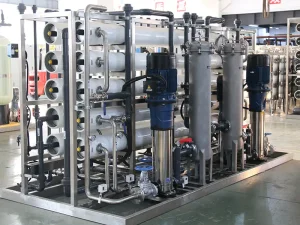
Traditional ZLD relies on multi-effect distillation (MED) or mechanical vapor recompression (MVR) directly on raw brine, consuming 40-70 kWh/m³. By integrating DTRO, STRO, and ultra-high pressure (UHP-RO) systems operating up to 160 bar, brines are pre-concentrated to 120,000–160,000 mg/L TDS, reducing thermal evaporator volume by up to 75%.
Brine Mining & Valuable Mineral Extraction
Hypersaline industrial wastewater is no longer viewed as waste, but as an ore body. Global facilities recover high-purity crystalline sodium sulfate (Na₂SO₄), battery-grade lithium salts, gypsum, and calcium chloride. In Peru’s mining and chemical circuits, selective fractional crystallization turns liability costs into secondary product streams.
Prefabricated & Modular Footprints
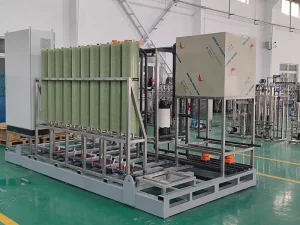
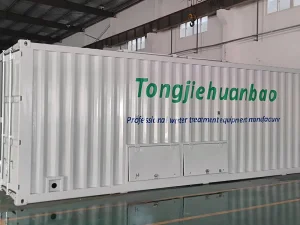
Extreme logistics in Andean ranges make field-erected civil projects cost-prohibitive. The global standard has shifted entirely to containerized, plug-and-play ZLD modules built and Factory Acceptance Tested (FAT) in state-of-the-art facilities before arriving at destination ports like Callao and Paita.
Tailored ZLD Implementation in Peru's Core Sectors
Configured specifically to handle high scaling potentials, variable silt densities, and altitude-induced physical dynamics.
Andean Heap Leach & Tailings Recovery
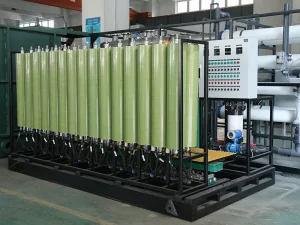
Operates under reduced atmospheric pressure at 3,500 to 4,800 meters above sea level. Tongjie systems utilize high-shear disc tube membranes with open-channel feed spacers, resisting colloidal silica fouling and heavy gypsum scaling while reclaiming >90% water for grinding and flotation loops.
Coastal Fisheries & Agro-Industrial Effluents
Fishmeal condensate and olive/citrus processing wastewaters in Piura, Ica, and Ancash carry elevated organic loads alongside severe salinity. Tongjie couples advanced Fenton/ozone oxidation and ceramic ultrafiltration ahead of DTRO, enabling ZLD without organic membrane fouling.
Refinery & Petrochemical Produced Water
Handling produced water in Talara and offshore basins. Combines API oil-water separation, induced gas flotation, and DTRO concentration to safely reduce oil-in-water to ≤5 mg/L while providing zero-discharge reinjection or process steam boiler feed.
End-to-End Technical Roadmap to True Zero Liquid Discharge
A rigorous, multi-barrier separation methodology designed to minimize thermal loads and ensure total system availability.
Chemical Desoftening & Clarification
High-density lime-soda softening combined with tubular microfiltration removes calcium, magnesium, barium, and reactive silica down to <10 mg/L, eliminating downstream mineral precipitation.
Primary High-Efficiency RO
Spiral-wound brackish reverse osmosis operating under alkaline pH conditions reduces organic fouling and silica scaling, recovering up to 80% permeate for immediate factory reuse.
DTRO / OARO Hyper-Concentration
Extreme high-pressure Disc Tube RO (120–160 bar) and Osmosis-Assisted RO concentrate brine from 50,000 to over 150,000 mg/L TDS, pushing recovery to 95%+ and cutting thermal sizing drastically.
MVR Evaporation & Crystallization
Titanium/duplex alloy Mechanical Vapor Recompression crystallizer converts the final concentrated slurry into high-purity dry salt cakes while recycling pure condensed water.
Turnkey Water Treatment & ZLD Product Matrix
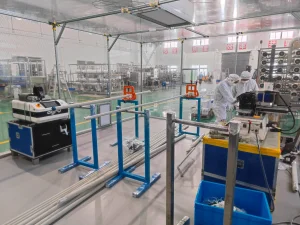
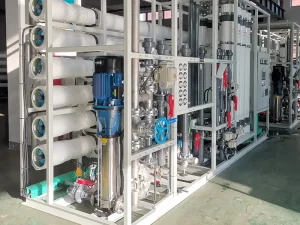
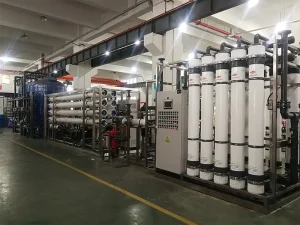
Explore our export-certified water purification, mobile desalination, and hyper-saline recovery solutions deployed worldwide.
Engineering Questions: ZLD & High-Saline Systems in Peru
Direct technical answers addressing environmental permitting, high-altitude performance, and system integration.
Q: How do your membrane systems overcome high-altitude conditions in the Andes?
At elevations between 3,000m and 4,800m (e.g., Cerro de Pasco, Southern Peru copper belt), atmospheric pressure decreases, reducing standard motor cooling efficiency and affecting boiling points in thermal stages. We de-rate electrical motors, upgrade VFD cooling, specify oversized heat exchangers, and utilize closed-circuit pressurized DTRO skids that remain completely immune to ambient barometric fluctuations.
Q: What is the advantage of DTRO over conventional spiral-wound RO in Peru mining effluents?
Mining effluents in Peru frequently contain high concentrations of calcium, sulfate (gypsum saturation), and colloidal silica. Standard spiral-wound feed spacers trap suspended solids, causing irreversible fouling within weeks. Tongjie DTRO modules feature open-channel disk architecture with short flow paths, capable of operating with feed SDI > 5 and COD up to 500 mg/L without clogging.
Q: Can the recovered distillate meet OEFA and MINAM reuse standards?
Yes. Tongjie dual-stage RO and MVR condensate systems generate product water with TDS < 50 ppm, zero detectable heavy metals, and neutral pH. The recovered water exceeds Category 3 (Irrigation and Livestock) and Category 4 (Conservation of Aquatic Environments) ECA Agua standards, permitting 100% recycling back to plant processes or boiler feed.
Q: How does Tongjie support installation, commissioning, and spare parts in Peru?
All our containerized and skid-mounted systems undergo comprehensive Factory Acceptance Testing (FAT) with wet hydraulic simulation in Shanghai before export. Upon delivery at the Port of Callao, our bilingual field engineering team provides on-site mechanical oversight, electrical hookup, PLC commissioning, and local operator training. Consumables such as membrane disks, seals, and anti-scalants are supported through reliable global freight logistics.