China China Industrial Demineralized Water Equipment - Suppliers and Factory for High-Quality RO and EDI Solutions Supplier, Manufacturer
Product Description
Product Overview and Positioning
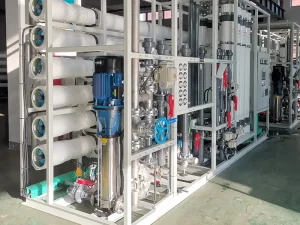
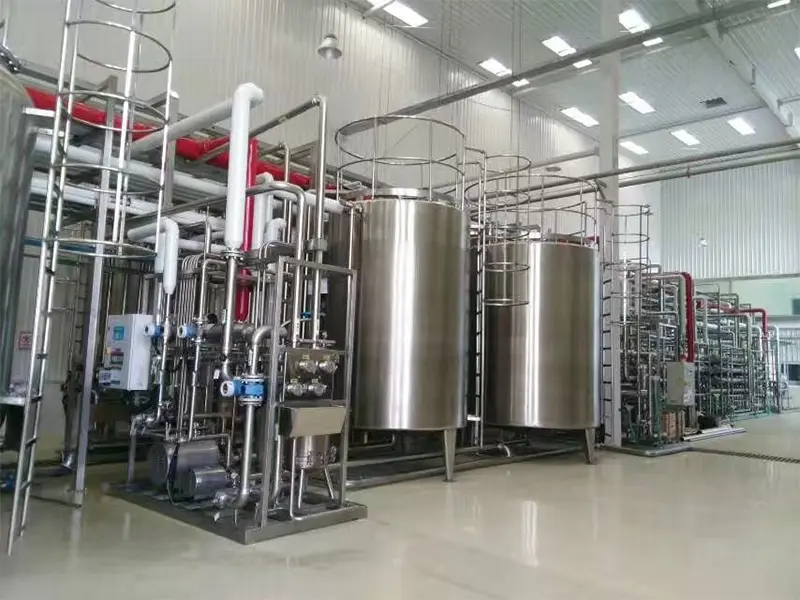
The industrial demineralized water equipment manufactured by Shanghai Tongjie Environmental Protection Technology Co., Ltd. adopts a combined process of "Pretreatment + Reverse Osmosis (RO) + Mixed Bed (MB) or Electrodeionization (EDI)" to perform deep demineralization of raw water, producing demineralized water with conductivity below 0.1 μS/cm.
The equipment operates on the principles of ion exchange and membrane separation, without the need for a heat source. The produced water quality meets the low salt content requirements of various industrial applications such as high-pressure boilers, electronics cleaning, and pharmaceutical preparation.
Process Flow and Principle
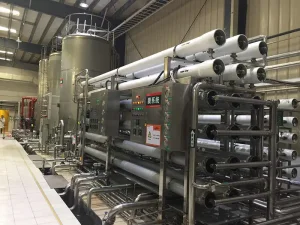
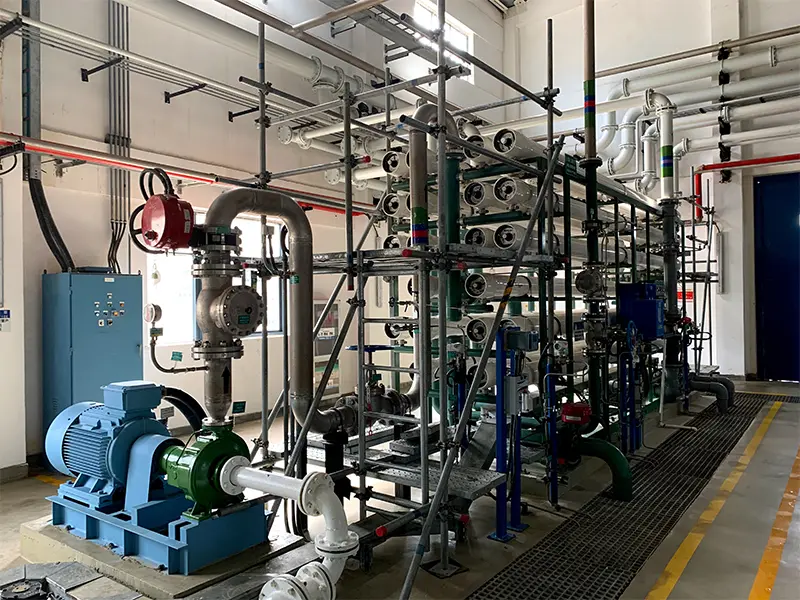
Raw water first passes through the pretreatment unit to remove suspended solids, residual chlorine, and some organic matter, then enters the Reverse Osmosis (RO) unit. The RO membrane is a polyamide composite membrane that, under an operating pressure of 1.0–1.8 MPa, removes more than 97% of dissolved salts, colloids, and microorganisms from the water. The conductivity of the RO permeate is typically reduced to below 50 μS/cm.
Depending on the final water quality requirements, the RO permeate enters a deep demineralization unit:
- Mixed Bed (MB): Uses cation and anion exchange resins to produce water with resistivity up to 18 MΩ·cm.
- Electrodeionization (EDI): Utilizes selective permeability and electrical regeneration to produce water above 17 MΩ·cm without chemical agents.
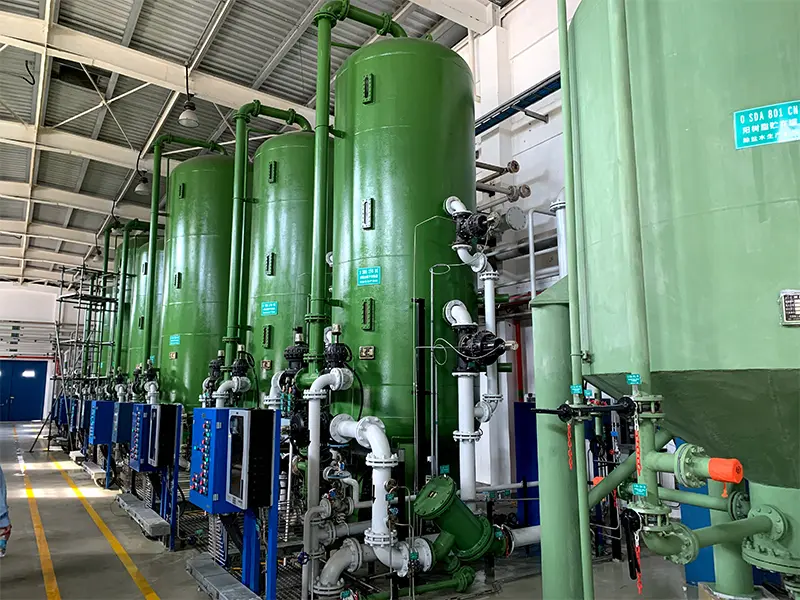
The mixed bed process uses a homogeneous mixture of cation and anion exchange resins. Through ion exchange reactions, residual cations and anions in the water are replaced with H⁺ and OH⁻ ions respectively. When the mixed bed resin becomes saturated, it is regenerated using acid and alkali.
Equipment Structure and Core Components
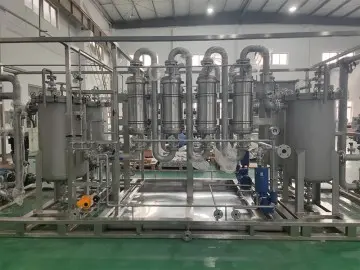
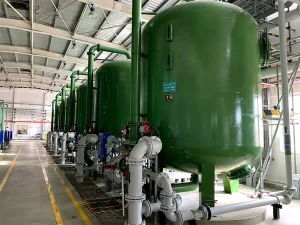
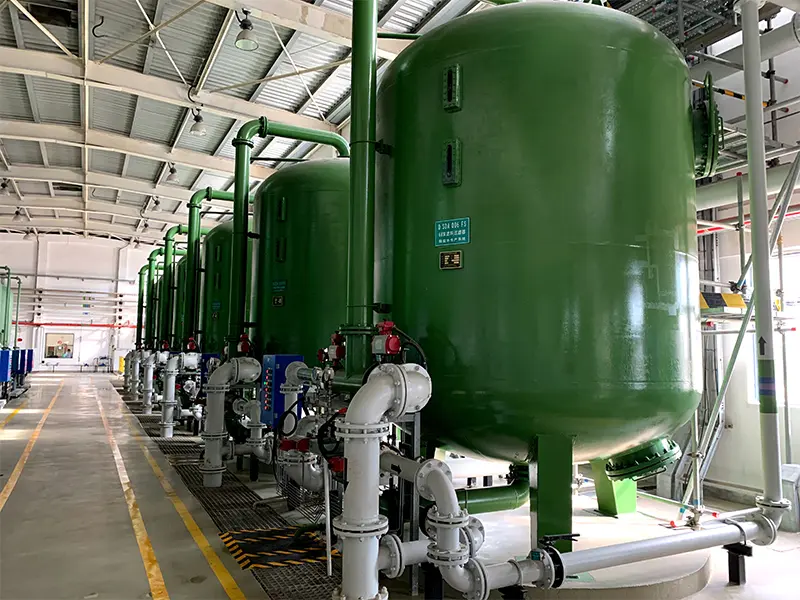
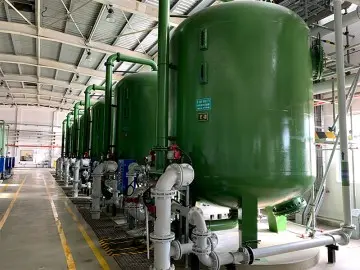
- Pretreatment: Multimedia filters and activated carbon filters.
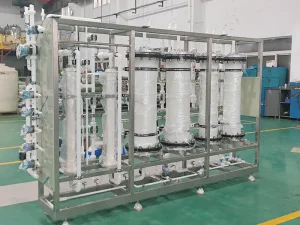
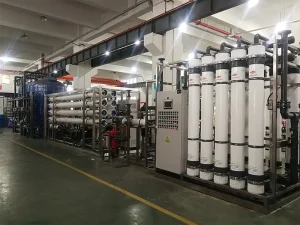
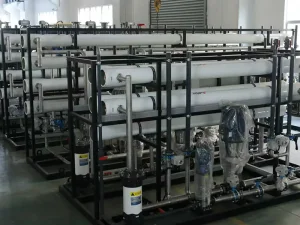
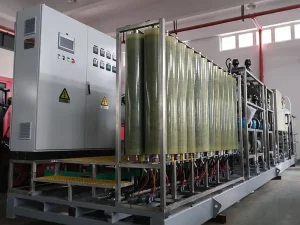
- RO Modules: Spiral-wound brackish water membranes with FRP/Stainless steel vessels.
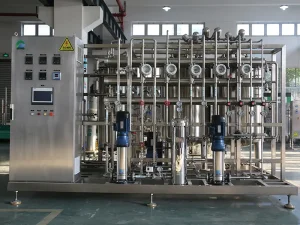
- Deep Demineralization: Mixed bed resin units or EDI plate-and-frame/spiral modules.
- Control System: PLC cabinet for automatic operation and online monitoring.
- Auxiliary Systems: Chemical dosing, cleaning systems, and fault alarms.
Key Performance Indicators and Applicable Standards
Typical control parameters include:
- Conductivity: MB product < 0.1 μS/cm.
- Resistivity: MB ≥ 18 MΩ·cm; EDI ≥ 17 MΩ·cm (GB/T 12145 standard).
- Silica Content: Controlled at ≤ 20 μg/L.
- Hardness: Zero scale formation for downstream equipment.
Based on the customer’s complete water quality analysis report, the company provides a process scheme and guaranteed performance values covering the above indicators during the design phase.
Application Fields
- Power Industry: High-pressure and ultra-high-pressure boiler makeup water.
- Electronics: Pretreatment and primary demineralization for ultrapure water.
- Pharmaceutical: Purified water and water for injection (WFI) pretreatment.
- Chemical & Food: Process ingredients, reaction mediums, and production water.
Other Products
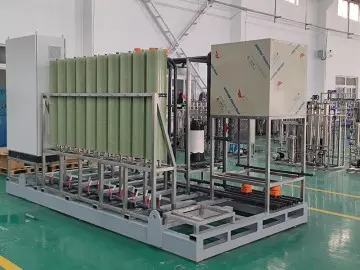
Modular Containerized Seawater Desalination
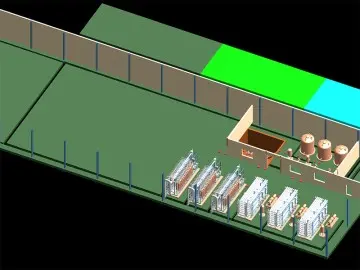
High-Salinity Wastewater ZLD System
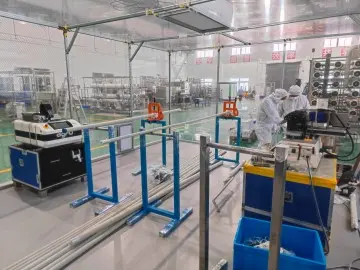
OEM Precision Manufacturing
ODM Full Value Chain Innovation
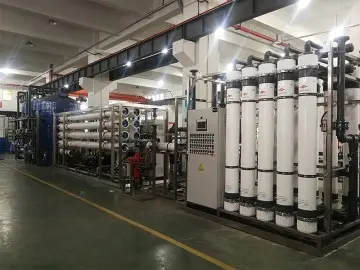
Water Reuse Equipment (UF+RO)
High-Ratio Water Reuse Process
Industrial Demineralized Water Equipment