China China Suppliers Deoxygenation Membrane Equipment Factory for Efficient Physical Degassing of Water Factory, Supplier
Product Description
Working Principle
The core working principle of the deoxygenation membrane equipment is based on Henry's Law and the gas-liquid mass transfer process. Henry's Law states that at a constant temperature, the equilibrium concentration of a dissolved gas in a liquid is directly proportional to the partial pressure of that gas in the gas phase.
The equipment uses a hydrophobic microporous hollow fiber membrane (PP or PVDF) as the interface. The micro-pore size (0.01 to 0.1 micrometers) prevents water penetration while allowing gas molecules to pass freely into the gas phase side driven by the concentration gradient.
Vacuum Deoxygenation Mode
A vacuum pump creates a negative pressure environment on the gas phase side of the membrane module, bringing the oxygen partial pressure close to zero. Driven by the partial pressure difference, oxygen molecules migrate from the liquid phase to the gas phase and are continuously discharged. In this mode, the outlet dissolved oxygen concentration can be reduced to below 1 μg/L.
High-purity Nitrogen Mode (Purity ≥ 99.999%)
High-purity nitrogen is introduced as a sweep gas to maintain an extremely low oxygen partial pressure. Dissolved oxygen passes through the membrane pores and is discharged with the sweep gas. In this mode, the outlet dissolved oxygen concentration can be reduced to below 5 μg/L.
The equipment operates efficiently within a temperature range of 5 to 40°C and an inlet water pressure range of 0.1 to 0.5 MPa.
Equipment Structure and Core Components
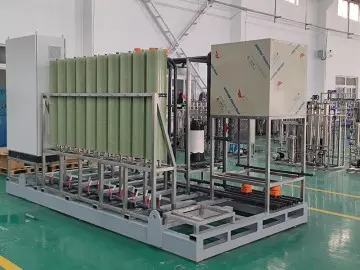
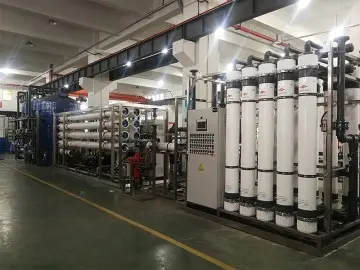
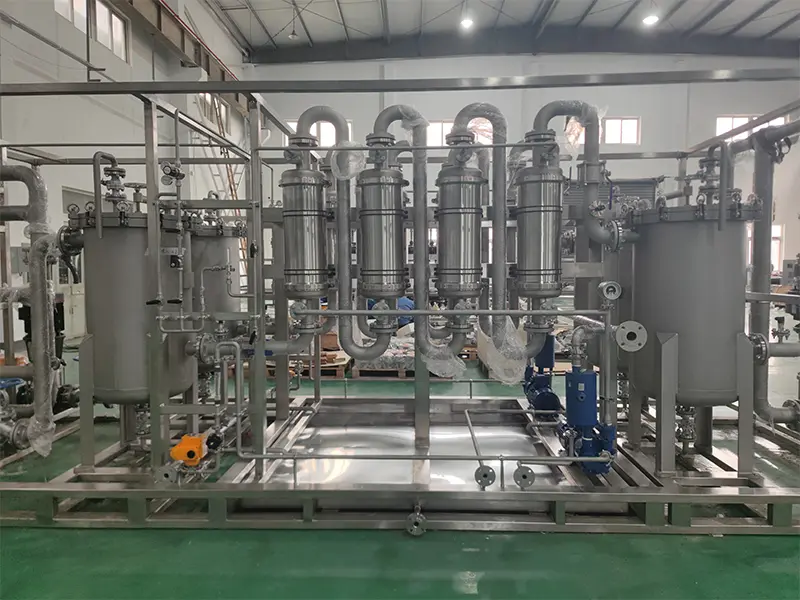
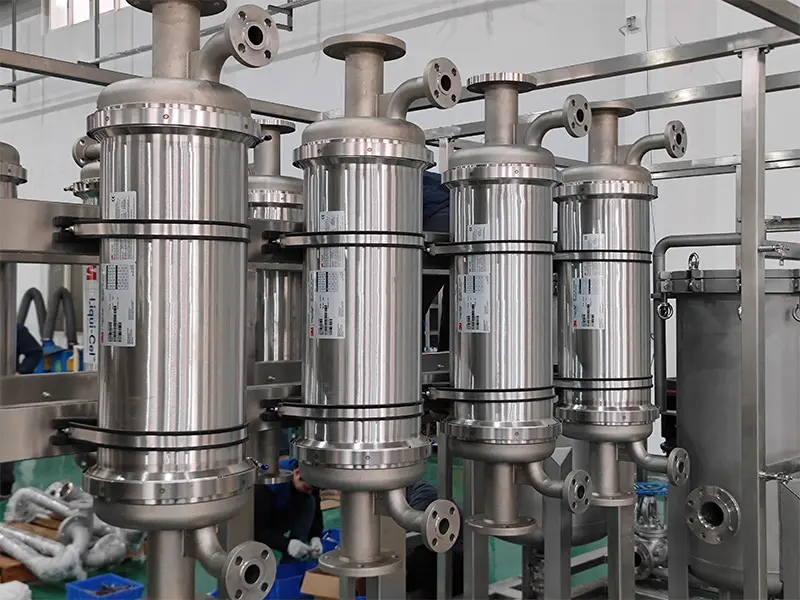
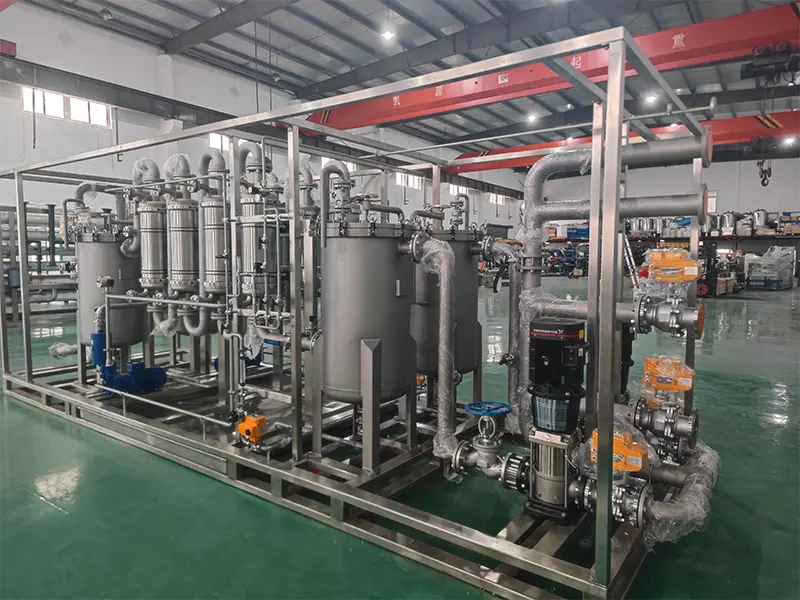
The system consists of a membrane contactor unit, a vacuum/sweep gas system, and advanced control systems. The membrane contactor is packed with hollow fiber bundles potted with epoxy resin in a stainless steel or plastic housing.
- Liquid Phase: Water flows inside or outside fibers (inside-out or outside-in design).
- Gas Phase: Equipped with vacuum ports or nitrogen inlets/outlets.
- Control System: Includes PLC, flow valves, pressure gauges, and online dissolved oxygen monitors for real-time tracking.
System Process Flow
The system is typically connected after RO or EDI modules. For requirements below 5 ppb, a two-stage process is used: Stage 1 utilizes a vacuum pump, and Stage 2 combines nitrogen sweep with vacuum.
- Turbidity Control
- Total Suspended Solids (TSS) Removal
- Residual Chlorine Free
The PLC control system uses PID algorithms to adjust vacuum frequency and sweep gas flow, optimizing quality and energy consumption.
Application Fields
- Ultrapure water for electronics and semiconductor industries.
- Boiler makeup water deoxygenation in power and heating.
- Pharmaceutical water for injection and purified water.
- Food and beverage production to prevent oxidation.
- Petrochemical water injection to reduce corrosion.
- Laboratory analysis and precision cleaning.
Other Products