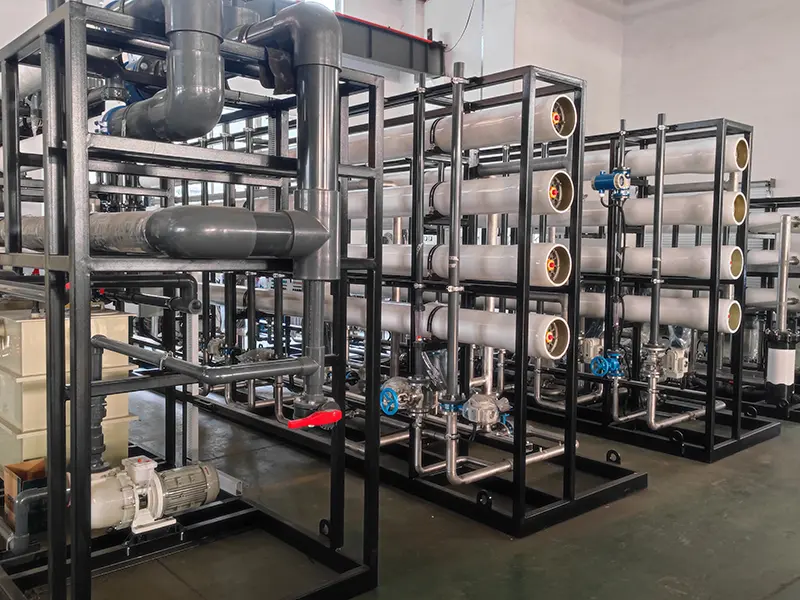
ODM High Salinity Brine Concentration System - China Factory Suppliers for Osmosis-Assisted Reverse Osmosis Solutions Factory, Manufacturer
Product Description
Core Features
In the field of high salinity wastewater treatment, conventional reverse osmosis has long faced a hard technical barrier: when feed TDS exceeds about 75 g/L, the osmotic pressure difference across the membrane forces operating pressure to approach – or even exceed – the safe limits of membrane elements. The traditional solution is to switch to thermal processes such as multi effect evaporation or mechanical vapor recompression (MVR), but thermal concentration consumes over 20 kWh/m³, accounting for up to 80% of the operating cost of a zero liquid discharge (ZLD) system.
OARO fundamentally changes this situation. It cleverly integrates reverse osmosis and forward osmosis principles by introducing a saline draw solution on the permeate side to actively reduce the transmembrane osmotic pressure difference. This keeps the net driving pressure across the membrane within a safe and economical range. This mechanism allows the system to concentrate 35 g/L brine to 125 g/L with an energy consumption as low as 4 kWh/m³, or push brine concentration to the saturation level of 250,000–260,000 ppm under conventional 70 bar pressure. Compared to traditional ZLD routes, OARO can reduce the thermal evaporation/crystallization load by more than 60% and lower total system costs by up to 60%.
An ideal solution for meeting short-term or long-term decentralized water supply demands
Core Process Flow
High salinity wastewater (the feed solution) is pressurised and enters the high pressure side of the OARO membrane element, while a low concentration salt solution (the draw solution, typically prepared by diluting a portion of the system’s own concentrate) flows on the permeate side. Under the applied driving pressure, water molecules migrate from the high pressure side to the low pressure side, the feed concentration continuously increases, and the draw solution is gradually diluted. The diluted draw solution can be either recycled back as fresh draw solution or further desalinated by a downstream RO unit to recover fresh water. Through multi stage counter current series connection, the system can approach salt saturation in a cascading manner.
Application Fields

Zero Liquid Discharge (ZLD)
Specific scenarios: ZLD front‑end membrane concentration for coal chemicals, power plant desulfurization, chemical industrial park high‑salinity wastewater.
Technical value: Concentrates brine to near‑saturation, dramatically reducing evaporation/crystallization load and significantly lowering full‑cycle system operating cost. Gradiant’s CFRO+OARO combination achieves up to 99% water recovery and up to 60% lower total system cost.

Oil & Gas Produced Water
Specific scenarios: Shale gas fracturing flow back fluid, oil & gas produced water deep treatment.
Technical value: OARO effectively treats produced water with high TDS, organics, and complex salts. With three‑stage pre-treatment, membrane flux loss can be reduced from 20% to <2%. The concentrated brine facilitates subsequent salt recovery, and treated water can be reused for fracturing fluid preparation or industrial water.

Lithium Extraction & Resource Recovery
Specific scenarios: Lithium/potassium extraction from salt lake brines, mineral recovery from seawater desalination concentrate.
Technical value: OARO concentrates low‑grade brines to saturation, creating ideal conditions for subsequent lithium/potassium selective precipitation or membrane separation. Aquatech integrates OARO with lithium processing, brine mining, and other processes to recover critical minerals from high‑salinity waste streams.

Seawater Desalination Concentrate Management
Specific scenarios: Deep concentration & resource recovery from RO seawater desalination brine.
Technical value: The concentrate discharged from conventional RO desalination has a TDS about twice that of seawater (approx. 70 g/L), posing ecological risks if discharged directly. OARO can further concentrate such brine to >250,000 ppm, dramatically reducing discharge volume and recovering valuable salts such as NaCl for the chlor‑alkali industry.
Industrial Wastewater Salt Recovery
Specific scenarios: Salt separation & resource recovery from textile, pharmaceutical, electroplating, etc., high‑salinity wastewater.
Technical value: OARO concentrates NaCl, Na₂SO₄, etc., in wastewater to saturation. Combined with nanofiltration salt separation or crystallisation, salts are recovered by fraction. In the textile industry, OARO has been validated to recover high‑purity salt from wastewater for reuse in dyeing processes; the recovered salt directly offsets part of the ZLD system’s operating cost.
RO Concentrate Re‑concentration
Specific scenarios: Volume reduction of concentrate from existing RO systems.
Technical value: Secondary concentration of RO concentrate (TDS approx. 70–80 g/L) to >150 g/L, significantly reducing concentrate disposal volume. This greatly increases the treatment capacity of an existing ZLD system without expanding evaporator capacity.
Other Products
Modular Containerized Seawater Desalination Equipment
Learn More →
Seawater desalting equipment
Learn More →
High-Salinity Wastewater Volume Reduction & ZLD System
Learn More →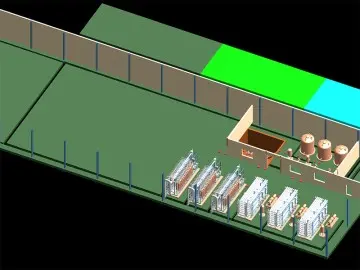
OEM Precision Manufacturing
Learn More →
ODM Full Value Chain Innovation
Learn More →
Water Reuse Equipment (Pretreatment + UF + RO Process)
Learn More →
Water Reuse Equipment High-Ratio Water Reuse Process
Learn More →