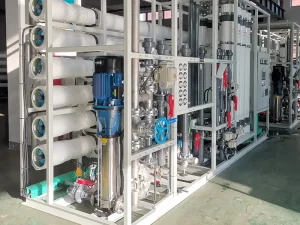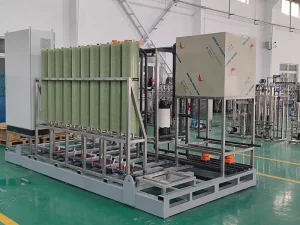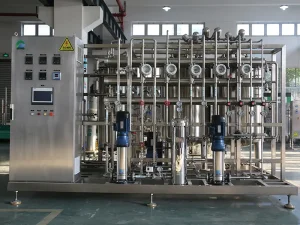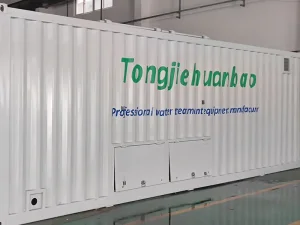
Featured Marine & Industrial Desalination Infrastructure
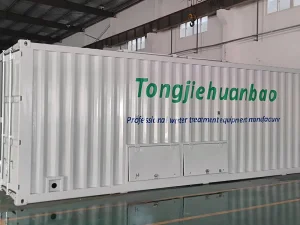
Pre-commissioned, modular and containerized configurations ready for deployment in municipal, coastal extraction, and offshore facilities.
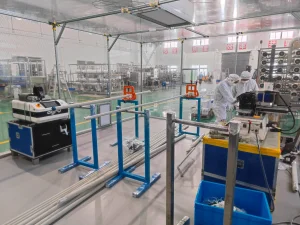
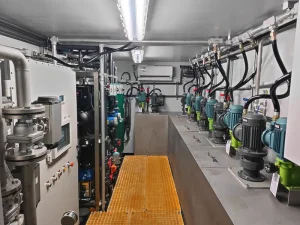
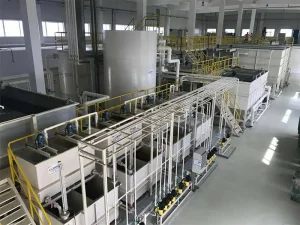
Industrial Sea Water Into Drinking Water Process: Complete Technical Blueprint
Transforming open-ocean hyper-saline water (30,000–45,000 ppm TDS) into World Health Organization (WHO) compliant potable water (<500 ppm TDS) demands a multi-barrier membrane matrix designed for operational resilience.
1. Automated Dual-Stage Pretreatment
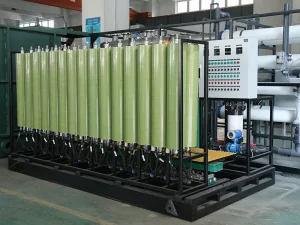
Seawater quality fluctuates dynamically due to marine life blooms, tides, and weather. Our process employs coagulant-dosed Multi-Media Filtration (MMF) coupled with hollow-fiber Ultrafiltration (UF, pore size 0.02 µm). This eliminates suspended colloids, yielding a Silt Density Index (SDI) < 3 to shield membranes from particulate fouling.
2. High-Pressure SWRO & ERD Recovery
Driven by duplex stainless steel or super duplex (2507) high-pressure pumps operating at 55–75 bar, feed water crosses semi-permeable polyamide thin-film composite membranes. We integrate isobaric Energy Recovery Devices (ERD) that salvage up to 96% of reject brine pressure, reducing specific energy consumption to <2.8 kWh/m³.
3. Stabilization, Remineralization & UV
Permeate water from reverse osmosis is corrosive, depleted of essential minerals, and slightly acidic. Our system runs stabilization through a calcite (CaCO3) dissolving bed and sodium bicarbonate dosers, adjusting Langelier Saturation Index (LSI) to a stable 0 to +0.2, followed by secondary barrier UV disinfection prior to distribution.
| Process Stage | Key Operational Parameter | Target Output / Safety Standard | CE & Global Compliance Alignment |
|---|---|---|---|
| Raw Seawater Intake | TDS: 32,000 – 45,000 mg/L, Turbidity > 5 NTU | Coarse screening (<500µm) | ISO 14001 Environmental Protection Standard |
| UF / Membrane Guard | Flux: 60-85 LMH, SDI15 testing | SDI < 3.0, Turbidity < 0.1 NTU | Pressure Vessel Verification (PED 2014/68/EU) |
| SWRO Separation | Operating Pressure: 55–75 bar, 40-45% Recovery | Permeate TDS < 300 mg/L, Boron < 0.5 mg/L | CE Machinery Directive (2006/42/EC) |
| Remineralization & Disinfection | pH balance 7.2–8.2, Hardness: 50–120 mg/L as CaCO3 | WHO Potable Water Drinking Guidelines | EN 60204-1 Electrical Safety & Sanitary Directive |
Global Procurement Demands & Macro Industry Solutions
From EPC infrastructure leaders to private mining conglomerates, desalination demands have shifted from static land-based assets to modularized, instantly operable, lower lifecycle cost units.
Island Resorts & Civil Municipalities
Off-grid tourism hubs across the Caribbean and Southeast Asia face severe seasonal freshwater shortages. Our modular containerized SWRO units operate with acoustic dampening (<72 dB), automated smart CIP cycles, and ultra-compact footprints, producing immediate municipal-grade water.
Coastal Power & Chemical Hubs
Large manufacturing clusters require vast volumes of high-reliability feedwater for steam turbines and cooling towers. Integrating high-ratio SWRO with industrial purified water trains (RO+EDI) delivers continuous process feed while mitigating coastal environmental impact.
Mining & Remote Camp Worksites
Located far from central water grids, remote sites require turnkey systems resistant to hyper-saline brackish water, ambient heat up to 50°C, and fluctuating power voltages. Our skid systems are built on industrial structural steel coated with marine-grade C5M anti-corrosion protection.
Emergency Aid & Military Deployment
Natural disasters and rapid military staging require mobile, air-transportable, containerized seawater desalination systems that deploy in under 24 hours. Integrated automated intake strainers and diesel/PV hybrid inputs ensure continuous water security anywhere.
Technology Roadmap: Next-Gen Zero Chemical & Low-Carbon Desalination
Desalination is rapidly evolving toward full decarbonization, intelligent digital control, and minimum environmental footprint.
100% Off-Grid Renewable Desalination
Variable solar irradiance poses pressure challenges for reverse osmosis membranes. Our engineering integrates variable-frequency drive (VFD) pressure modulation algorithms with battery storage buffers, enabling seawater plants to directly harness PV and wind power without grid instability.
AI-Driven Membrane Predictive Health
By capturing real-time conductivity, transmembrane pressure (TMP), and temperature fluctuations, our neural algorithmic monitoring system predicts membrane scale crystallization up to 140 operational hours in advance, optimizing Clean-in-Place (CIP) schedules and extending membrane life by 25%.
Brine Mineral Valorization & Near-ZLD
Reject brine disposal creates ecological concerns near sensitive coral reefs. Tongjie combines disc tube reverse osmosis (DTRO) and high-recovery concentration systems to concentrate brine toward near saturation, laying the foundation for rare mineral extraction (Lithium, Magnesium) and Zero Liquid Discharge (ZLD).
CE Certification Rigor & Quality Engineering Standards
Operating high-pressure seawater systems involves substantial mechanical and electrical hazards. Tongjie ensures every unit adheres strictly to mandatory European and global codes.
Machinery Directive (2006/42/EC)
Full risk assessment of all rotating elements, high-pressure pump cavitation fail-safes, dual mechanical interlocks, emergency de-pressurization venting, and ergonomic operator maintenance clearances inside all containerized housings.
Pressure Equipment Directive (PED 2014/68/EU)
All piping manifolds, FRP membrane pressure vessels, valves, and couplings undergo 1.5x hydrostatic pressure testing. Welding joints on 2507 Super Duplex and 316L stainless steel are inspected via NDT (Non-Destructive Testing) radiographic examinations.
Factory Acceptance Testing (FAT)
No system leaves our Shanghai production center untested. Every plant undergoes wet hydraulic simulation, electrical insulation checks, PLC alarm sequence verification, and flow rate validation prior to export packaging.
Frequently Asked Questions (Technical & Procurement)
Direct engineering insights regarding water parameters, energy recovery, and equipment lifecycle management.
How does the CE Certified Sea Water into Drinking Water process ensure boron removal meets drinking guidelines?
What materials are utilized to resist severe chloride-induced pitting and crevice corrosion?
What is the expected operating life of the high-pressure reverse osmosis membranes?
Can the desalination system operate stably during marine red tide (harmful algal bloom) occurrences?
Specialized Industrial Water & Advanced Separation Systems
Explore custom reverse osmosis systems, zero liquid discharge units, and high-salinity volume reduction equipment manufactured for worldwide delivery.