
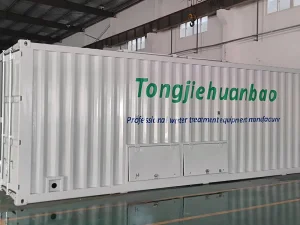
Featured High-Purity & Desalination Systems (Phase I)
Engineered skid-mounted and containerized membrane treatment modules fabricated to international engineering codes.
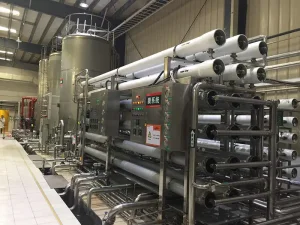
OEM China Suppliers Factory Water Purification System for Food & Beverage Production - Ensuring Safety and Quality Factories, Supplier
Explore Specification
China China Suppliers: Factory-Direct Containerized Seawater Desalination Plants for Efficient Mobile Water Solutions Factory, Suppliers
Explore Specification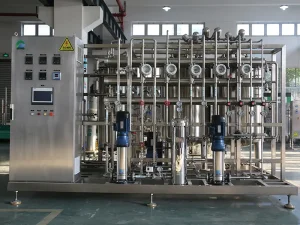
Wholesale China Pharmaceutical Purified Water & WFI System - Reliable Suppliers & Factory Solutions for Quality Water Production Manufacturers, Manufacturer
Explore Specification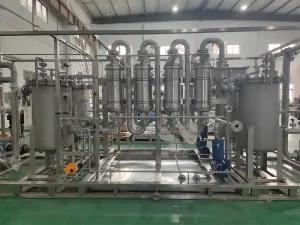
China China Suppliers Deoxygenation Membrane Equipment Factory for Efficient Physical Degassing of Water Factory, Supplier
Explore Specification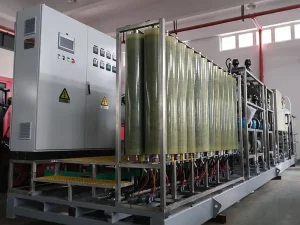
Wholesale Oilfield Fracturing Flowback Fluid Factory, Manufacturers
Explore Specification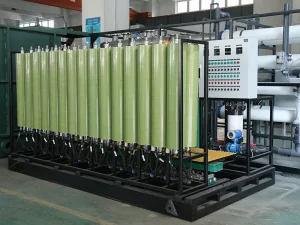
CE Certification High-Pressure Membrane Concentration System Suppliers and Factory in China - DTRO & STRO Technology Suppliers, Manufacturers
Explore Specification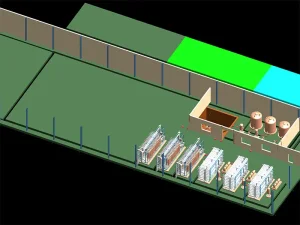
ODM OEM Precision Manufacturing - China Suppliers & Factory for Customized Environmental Water Treatment Equipment Solutions Supplier, Manufacturers
Explore SpecificationThe Science of Ultrapure Water (UPW): Theoretical Limits & Parameters
Understanding how industrial UPW surpasses standard demineralized water to reach theoretical chemical neutrality at 18.2 MΩ·cm.
Theoretical Resistivity
Pure H2O undergoes slight self-ionization into H+ and OH- ions. At 25°C, the intrinsic electrical resistivity of completely deionized water reaches the thermodynamic limit of 18.24 MΩ·cm (conductivity ≤ 0.055 μS/cm).
- Target Resistivity (25°C): 18.18 – 18.20 MΩ·cm
- Dissolved Sodium (Na+): < 0.001 ppb (1 ppt)
- Chloride (Cl-): < 0.001 ppb (1 ppt)
TOC Suppression
Total Oxidizable Carbon (TOC) represents trace non-ionic organic molecules that escape standard ion exchangers. In wafer lithography and thin-film deposition, residual hydrocarbons produce microscopic surface contamination.
- Bulk TOC Target: < 1.0 ppb (μg/L)
- Critical Fab Rinsing: < 0.5 ppb (500 ppt)
- Oxidation Method: 185 nm VUV Photolysis
Sub-Micron Particles
At 3nm and 2nm semiconductor nodes, colloidal silica and inert particulate matter larger than 10 nanometers bridge gate contacts, causing structural defects and devastating batch yield drops.
- Particle Limit (≥ 20 nm): < 1 count / mL
- Reactive Dissolved Silica: < 0.2 ppb
- Colloidal Silica: Undetectable
17+
Years Membrane R&D
38+
Patents & Intellectual Rights
< 1 ppb
TOC Decomposition Standard
18.2
MΩ·cm Resistivity Benchmark
How Is Ultra Pure Water Produced: 5-Stage Engineering Architecture
The manufacturing sequence required to strip dissolved minerals, trace organics, dissolved gases, and biological colloids down to single-digit parts-per-trillion levels.
STAGE 01
Pretreatment & Clarification
Municipal or borehole water contains silt, natural organics, and hardness. Shanghai Tongjie utilizes automated Multi-Media Filtration (MMF), granular activated carbon (GAC) beds, sodium bisulfite dosing, and pressurized Ultrafiltration (UF) hollow-fiber membranes to consistently reduce SDI15 < 2.5.
STAGE 02
Double-Pass Reverse Osmosis
Pressurized cross-flow filtration across high-rejection polyamide thin-film composite membranes. The primary pass rejects > 99.2% of dissolved ions and minerals. The permeate is conditioned with NaOH (shifting carbonate balance to gas-impermeable bicarbonate) before the secondary pass, lowering conductivity to < 2 μS/cm.
STAGE 03
CEDI Continuous Demineralization
Continuous Electrodeionization (CEDI) replaces hazardous acid-base chemical regeneration. An electric direct-current potential continuously splits water into H+ and OH- ions to self-regenerate ion-exchange resins while flushing rejected ions, bringing water resistivity up to 15.0 – 17.5 MΩ·cm.
STAGE 04
Membrane Contact Degasification
Hydrophobic microporous hollow-fiber contactor contact membranes strip Dissolved Oxygen (DO) down to < 1 ppb and residual CO2 to < 5 ppb using dry nitrogen sweep gas and vacuum extraction. Controlling DO prevents subsurface wafer oxidation during thermal manufacturing steps.
STAGE 05
Sub-ppb Polishing Loop
Consists of 185 nm Vacuum UV photo-oxidation lamps generating hydroxyl radicals to shatter stubborn organics, non-regenerable nuclear-grade mixed-bed polishing resin, and terminal 0.05 μm polyethersulfone ultrafiltration modules operating on continuous 24/7 recirculating hydraulics.
Macro Industry Solutions & Commercial Landscape
Strategic deployment of custom-engineered UPW systems across high-yield global manufacturing environments.
Semiconductors & Microelectronics
In sub-7nm extreme ultraviolet (EUV) lithography, chemical mechanical planarization (CMP), and anisotropic silicon etching, UPW is the universal rinsing medium. Our OEM/ODM UPW skids integrate real-time boron, silica, and TOC laser spectrometers, guaranteeing that no atomic redeposition takes place on silicon substrates.
- SEMI Standard: SEMI C35 / C79 Type E-1.3
- Hydraulic Loop: PVDF-HP BCF Welded Piping
- Boron Rejection: > 99.8% with selective resin
Biopharma & Injectable WFI
Biotechnology and parenteral medicine lines require sterile Purified Water (PW) and Water for Injection (WFI). Membrane-based chemical-free trains eliminate thermal still costs while fully complying with cGMP, USP ⟨645⟩, USP ⟨643⟩, and European Pharmacopoeia (EP) criteria.
- Bacterial Endotoxin: < 0.25 EU / mL
- Total Viable Count: < 10 CFU / 100 mL
- Sanitization: 85°C Hot Water Sanitation (HWS)
Photovoltaics & Green Hydrogen
Next-generation N-type TOPCon, HJT solar cell manufacturing, and Proton Exchange Membrane (PEM) water electrolyzers require massive volumes of ultrapure demineralized water. Residual conductive ions in electrolyzers foul catalyst surfaces and accelerate membrane degradation.
- Stack Water Conductivity: < 0.1 μS/cm
- Chloride Protection: Zero pitting in Titanium anodes
- Water Recovery Ratio: Up to 90% via High-Ratio RO
Localization Support, Factory Engineering & Compliance Assurance
Shanghai Tongjie provides global EPC contractors and industrial operators with fully traceable fabrication, validation documentation, and plug-and-play commissioning.
Certifications & Permits
CE-certified machinery directive compliance, ISO 9001, ISO 14001, and ISO 45001. We maintain Class II National Engineering Contracting qualifications for mechanical, electrical, and environmental installations.
Sanitary Material Grade
Distribution loops feature high-purity PVDF with beadless (BCF) infrared welding, or AISI 316L stainless steel orbital-welded piping with internal electro-polishing down to surface roughness Ra ≤ 0.4 μm (15 μin).
Factory Acceptance (FAT)
Pre-packaged containerized and skid-mounted skids undergo 100% full-load wet functional testing, hydrostatic pressure retention tests, and software interlock validation in our Shanghai facility before maritime shipment.
Digital SCADA & DQ/IQ/OQ
Equipped with Siemens S7-1500 or Allen-Bradley PLCs, remote SCADA industrial IoT gateways, and complete qualification portfolios (Design, Installation, and Operational Qualification) compliant with FDA 21 CFR Part 11.
Technical Roadmap: Next-Generation Ultrapure Water Innovations
Pioneering sustainable, chemical-free polishing and artificial-intelligence-driven predictive hydraulics.
AI Dynamic Digital Twins
Integration of hydrodynamic predictive algorithms monitoring transmembrane pressure (TMP), normalized permeate flux, and salt passage curves in real-time. The system predicts biofouling and scaling 15 to 20 days prior to flux deterioration, auto-optimizing Clean-In-Place (CIP) schedules.
Zero-Chemical Solid State Polishing
Eliminating non-regenerable resin disposal through Ultra-High Purity Continuous Electrodeionization (UHP-EDI). Utilizing patented multi-chamber bipolar membrane configurations, secondary-stage polishing operates continuously without spent radioactive-rated resin disposal hazards.
High-Recovery Closed Loop (95%+)
Traditional UPW facilities lose 20-30% of incoming water to RO concentrate and EDI reject streams. Shanghai Tongjie pairs Disc Tube Reverse Osmosis (DTRO) and high-pressure STRO membranes to recover 90% to 95% of effluent, redirecting recovered brine into industrial utilities and cooling towers.
Comprehensive Technical & Engineering FAQ
Direct engineering answers addressing critical design choices, sizing, metallurgy, and water chemistry.
Why is standard DI water insufficient compared to 18.2 MΩ·cm UPW for semiconductors?
Standard deionized (DI) water measures ionic resistance but overlooks non-conductive impurities. Colloidal silica, uncharged trace organics, particulate debris, and dissolved oxygen do not register on basic conductivity meters. Ultrapure Water requires comprehensive reduction of TOC (<1 ppb), silica (<0.5 ppb), dissolved oxygen (<1 ppb), and sub-20nm particles to protect sub-micron gate circuits from shorting.
How does 185 nm VUV radiation eliminate Total Oxidizable Carbon (TOC)?
While 254 nm UV light disrupts microbial DNA for disinfection, 185 nm vacuum ultraviolet light photolytically cleaves pure water molecules (H2O → H• + OH•). The resulting hydroxyl radicals are potent oxidizers that rapidly mineralize complex organics into CO2 and H2O. The ionized bicarbonate is subsequently scavenged by the downstream polishing ion exchanger.
What piping materials are mandatory for UPW delivery loops to prevent leaching?
Ultrapure water is chemically aggressive and rapidly leaches ions from standard stainless steel or PVC. For primary distribution and polishing loops, high-purity unpigmented Polyvinylidene Fluoride (PVDF-HP) assembled via Beadless Clean Flare (BCF) infrared welding is standard. For pharmaceutical WFI systems, electropolished 316L stainless steel (Ra ≤ 0.4 μm) with sanitary tri-clamp fittings is utilized to facilitate hot water sanitization.
What feed water data is required for sizing an ODM Ultrapure Water system?
We require a comprehensive water test showing Total Dissolved Solids (TDS), electrical conductivity, total hardness, alkalinity, reactive silica (SiO2), iron, manganese, SDI15, turbidity, free chlorine, and seasonal temperature variance. Additionally, the daily production demand (m³/h), peak flow rates, and specific destination industry standards (e.g., SEMI, ASTM, USP) must be identified.
How does Shanghai Tongjie guarantee rapid commissioning for overseas projects?
Our systems are pre-assembled as integrated skid units or containerized modules within our Shanghai ISO 9001 facility. Electrical conduits, internal interconnecting hydraulic piping, sensors, and PLC cabinets are completely pre-wired and wet-tested during Factory Acceptance Testing (FAT). Upon site arrival, the unit requires only external utility hookups, shortening commissioning to approximately 15 days.
How are silica and boron selectively removed from the water stream?
Boron and silica exist primarily as weakly ionized, uncharged species (boric acid B(OH)3 and silicic acid H4SiO4) at neutral pH. In our process trains, we inject high-purity sodium hydroxide (NaOH) between the first and second RO passes to elevate pH above 9.5 – 10.0. This deprotonates the compounds into charged ions (borate and silicate), increasing secondary RO membrane rejection rates beyond 99%.
Advanced Wastewater, ZLD & High-Ratio Reuse Portfolio (Phase II)
Robust heavy-duty wastewater reclamation, Zero Liquid Discharge evaporators, and precision ODM water systems.
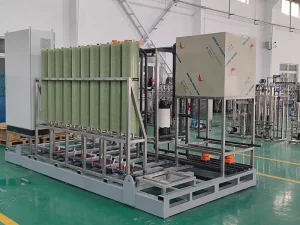
OEM High-Salinity Wastewater Treatment System - ZLD Solutions from China Suppliers and Factory Suppliers, Manufacturers
Explore Specification
OEM OEM Precision Manufacturing: China Suppliers and Factory for Customized Environmental Water Treatment Solutions Factory, Manufacturer
Explore Specification
ODM OEM Precision Manufacturing Factories, Manufacturer
Explore Specification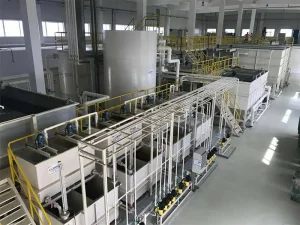
China High-Ratio Water Reuse Process Equipment Suppliers in China | Advanced Wastewater Treatment Factory Manufacturers, Manufacturer
Explore Specification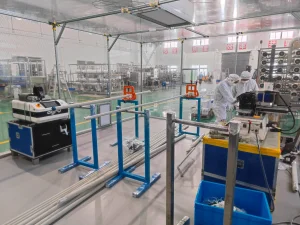
OEM Eco-Friendly Water Treatment Solutions from China ODM Suppliers - Tailored by Our Expert Factory Supplier, Manufacturer
Explore Specification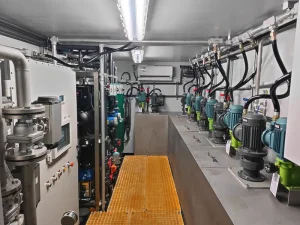
CE Certification China Suppliers Factory for Fracturing Flowback Water Reuse Treatment Equipment for Oil & Gas Field Stimulation Suppliers, Supplier
Explore Specification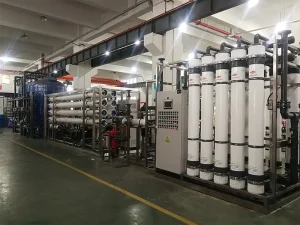
CE Certification High-Ratio Water Reuse Equipment Suppliers in China - Advanced Pretreatment, UF & RO Process Factory Factories, Manufacturer
Explore Specification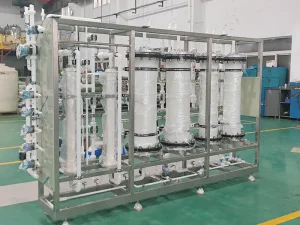
OEM China Suppliers Ultra-Pure Water System for Semiconductor & Electronics Manufacturing | Quality Factory Solutions Factory, Suppliers
Explore SpecificationRequest an Engineered Ultrapure Water System Proposal
Collaborate directly with Shanghai Tongjie’s senior membrane process engineers. Submit your raw water analysis and required delivery standards to receive a customized P&ID layout, mass balance calculation, and skid dimension schedule within 48 hours.