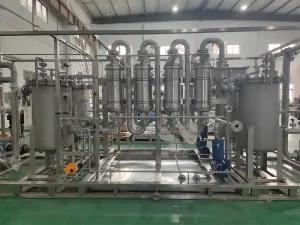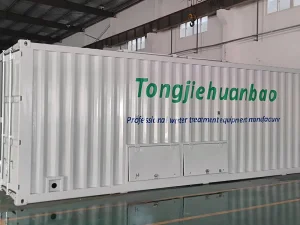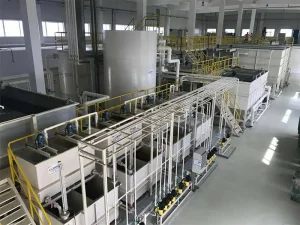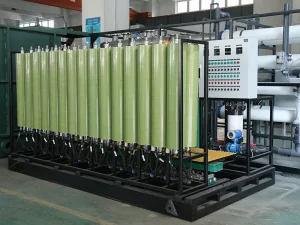
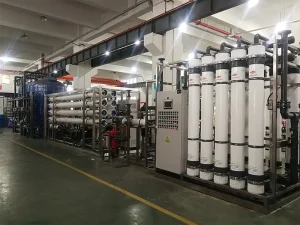
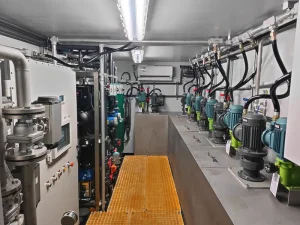
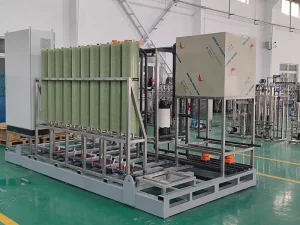
Primary Modular Deployments
Factory Direct Desalination & High-Salinity Systems
Engineered for high flux stability, low specific energy consumption (SEC), and extreme salinity tolerances across municipal, marine, and extreme oilfield conditions.
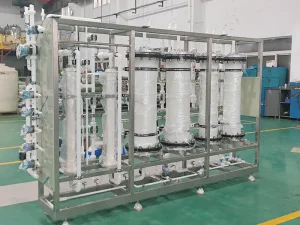
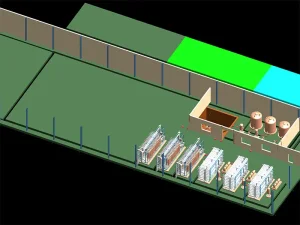
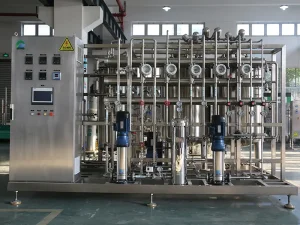
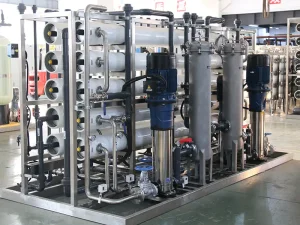
Technical Whitepaper
Engineering Architecture: Global SWRO & Membrane Optimization
Modern Seawater Reverse Osmosis (SWRO) has evolved past off-the-shelf catalog skids. As an authoritative ODM manufacturer, our factory implements rigorous thermodynamics, hydrodynamic membrane modeling, and metallurgy selection to defeat biofouling, scaling, and energy loss.
Advanced Energy Recovery Devices (ERD)
We integrate isobaric energy recovery systems (pressure exchangers) that capture mechanical energy from the high-pressure concentrate stream, yielding operational efficiencies exceeding 97%. This drives total plant SEC down toward the thermodynamic minimum of 2.8 - 3.2 kWh/m³, directly reducing client operational expenditure (OPEX).
Metallurgical Integrity: Super Duplex 2507
Seawater corrosion at pressures up to 83 bar demands zero compromise. All wet-end high-pressure piping, manifolds, and pump volutes are manufactured using 2507 Super Duplex Stainless Steel (PREN > 42) or high-grade Titanium Grade 2, eliminating pitting corrosion, crevice failure, and costly marine operational shutdowns.
Robust Pretreatment & UF Defense
Raw oceanic intakes encounter red tides, seasonal biological blooms, and colloidal suspended solids. We pair our SWRO blocks with dual-stage media filters, self-cleaning disc screens, and hollow-fiber Ultrafiltration (UF) skids, maintaining a Silt Density Index (SDI₁₅) < 2.5 to drastically extend the operating life of polyamide membrane elements.
17+
Years of SWRO & Membrane R&D
38+
Invention & Utility Patents
50+
Dedicated Process Engineers
1,000+
Global Contract Deliveries
Global Landscape
Worldwide Industrial Demand & Decentralized Commercial Adoption
Across arid coastlines, offshore platforms, remote mining corridors, and petrochemical refineries, access to high-purity water defines commercial continuity. Here is how our ODM manufacturing supports multi-sector operational infrastructure.
Island Resorts & Coastal Real Estate
Decentralized tourism and real estate hubs require silent, vibration-isolated, and small-footprint desalination. Our containerized systems are engineered with acoustic dampening, marine anti-corrosive coatings (C5-M), and post-treatment mineralization to deliver pristine, potable water compliant with WHO standards.
Power Generation & Heavy Petrochem
Combined cycle gas turbine plants, refineries, and chemical manufacturers require low-conductivity boiler feed water from marine sources. We combine high-rejection SWRO modules with secondary Brackish Water RO (BWRO) and Electrodeionization (EDI) to deliver boiler make-up water at < 0.1 µS/cm.
Offshore Exploration & Marine Vessels
Naval and offshore applications face high motion, dynamic roll/pitch, and variable feed water quality. Our skid designs conform to rigorous DNV-GL marine standards, featuring dry-run protection, explosion-proof ATEX instrumentation, and automated fresh-water flushing during downtime.
E-E-A-T Reliability & Compliance
Factory Acceptance Testing (FAT) & Global Compliance Assurance
A successful desalination project is decided on the factory floor before shipping. Our production process ensures that every container, valve array, and control loop undergoes comprehensive quality verification.
01
Hydraulic Hydrotesting
Every Super Duplex 2507 spool and high-pressure manifold undergoes 1.5x design pressure hydrostatic proofing to eliminate installation risk in high-salinity service.
02
Full Electrical Wet FAT
We test motor control centers, VFD harmonics, automated valves, and PLC interlocks in our Shanghai workshop using verified salinity test media prior to container packing.
03
Comprehensive Validation Dossiers
Complete traceability is provided with mill test certificates (EN 10204 3.1), weld map logs, CE Declaration of Conformity, and ISO 9001 quality documentation.
Future Engineering
Technical Roadmap: Next-Generation Desalination Engineering
How our R&D team addresses brine reduction, operational carbon intensity, and autonomous plant lifecycle control.
PHASE I: PRESENT
PV-SWRO Hybrid Grid Integration
Deploying smart power-matching software that synchronizes high-pressure pump variable frequency drives (VFDs) directly with solar photovoltaic outputs, eliminating the need for battery storage in remote off-grid locations.
PHASE II: MID-TERM
Osmosis-Assisted Low Energy ZLD
Integrating Osmotically Assisted Reverse Osmosis (OARO) and high-pressure disc-tube membranes (DTRO) to push brine concentrations past 130,000 mg/L TDS before thermal crystallizers, slashing evaporative energy consumption by 45%.
PHASE III: FUTURE
AI Predictive Membrane Cleaning (CIP)
Training neural network models on real-time normalized flux, differential pressure, and feed SDI to forecast fouling kinetics, scheduling CIP routines dynamically to optimize membrane element life.
Procurement & Technical Clarifications
Frequently Asked Questions for EPCs & Industrial Buyers
Key technical criteria, lead times, materials specification, and sizing guidelines for commercial SWRO procurement.
What parameters are essential to size an industrial SWRO plant accurately?
A comprehensive raw seawater analysis is required: total dissolved solids (TDS), temperature ranges (critical for flux calculations), seasonal boron concentrations, silica, hardness (calcium/magnesium), barium, strontium, and biological/turbidity markers (SDI₁₅, TSS, TOC). Additionally, define your permeate target (WHO drinking water or boiler-grade demineralization), required daily capacity (m³/day), and on-site utility voltage/frequency.
How does your factory mitigate biofouling and biological blooms?
Our plants feature automated dual-stage pretreatment. Raw seawater is treated with coagulation/flocculation, passing through auto-backwashing multimedia sand/anthracite filters or hollow-fiber Ultrafiltration (UF) skids. Automated sodium hypochlorite dosing with timed SBS dechlorination and non-oxidizing biocide injection protects membranes from biological slime formation.
What energy recovery devices (ERD) do you specify for large systems?
For small-to-medium containerized skids, we integrate energy recovery turbochargers or hydraulic pressure exchangers. For large utility-scale configurations, we utilize isobaric rotary pressure exchangers (such as Energy Recovery Inc. PX devices), enabling energy transfer from high-pressure brine to incoming feed with up to 98% efficiency.
What is the standard manufacturing and delivery timeframe for containerized SWRO units?
Standard containerized systems (50 to 1,000 m³/day) feature pre-engineered P&ID layouts and are delivered in 6 to 10 weeks, inclusive of Factory Acceptance Testing (FAT). Custom-engineered packages requiring exotic metallurgy (Hastelloy, Inconel) or explosion-proof certifications (IECEx/ATEX) typically run 12 to 16 weeks from approved technical drawings.
Do your systems support SCADA integration and remote operation?
Yes. Every unit comes standard with industrial-grade Siemens or Allen-Bradley PLCs, high-resolution touch HMIs, and secure IoT gateways (Modbus TCP/IP, Profinet). Operations teams can monitor recovery rates, conductivity, membrane differential pressure, and specific energy consumption from any browser or central control room.
Comprehensive Membrane Portfolio
Specialized Industrial Skids, WFI Trains & Brine Units
Explore our complete manufacturing portfolio covering degassing, containerized solar desalination, and high-purity pharmaceutical water equipment.