
Precision OEM Industrial Equipment Systems
Explore high-recovery seawater desalination packages, industrial pure water trains, and high-salinity concentration units tested at our Shanghai integration center.
Global Seawater Treatment: Status & Industrial Realities
A rigorous examination of expanding desalination demand driven by extreme baseline water stress, coastal industrialization, and stringent environmental discharge mandates.
Global installed desalination capacity has surpassed 105 million cubic meters per day, driven by rapid groundwater depletion, climate-induced precipitation volatility, and exponential expansion in heavy manufacturing, microelectronics fabrication, and thermal power generation across coastal economic zones. In regions across the Middle East, North Africa (MENA), Mediterranean Europe, Southern California, Western Australia, and coastal East Asia, baseline water stress often exceeds 80%. Under these operating conditions, reverse osmosis seawater treatment plants (SWRO) are no longer merely municipal drought-mitigation assets; they have evolved into critical production utilities for petrochemical refining, green hydrogen electrolysis, coastal mining extraction, and marine logistics infrastructure.
Industrial facility operators increasingly reject monolithic, field-erected civil infrastructure projects due to multi-year delivery timelines, unpredictable on-site labor overhead, and protracted environmental permitting processes. Instead, global capital allocation has pivoted decisively toward modular, skid-mounted, and containerized seawater desalination equipment manufactured under controlled ISO-certified shop conditions. Prefabricated SWRO systems allow EPC engineering teams to implement plug-and-play water generation within 12 to 24 weeks of site readiness, drastically lowering construction financing risks and accelerating commercial operational dates (COD).
Severe Baseline Water Deficits
Over 40 countries experience hyper-stressed water tables where withdrawal rates consistently surpass natural aquifer replenishment. Coastal industries cannot rely on municipal supply allocations and must deploy on-site captive seawater desalination plants to ensure uninterrupted commercial uptime.
Electrification & Green Energy
The global push toward green hydrogen electrolyzers (requiring 9 liters of high-purity demineralized water per kilogram of H&sub2;) and coastal solar-thermal installations demands continuous, high-efficiency SWRO trains that synchronize dynamically with fluctuating renewable power supplies.
Zero Liquid Discharge (ZLD) Mandates
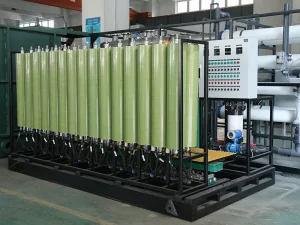
Environmental regulators in chemical industrial parks are mandating strict near-zero brine discharge policies. Modern OEM seawater treatment designs integrate advanced brine concentrators, high-pressure disc-tube reverse osmosis (DTRO), and mechanical vapor recompression (MVR) evaporators.
Engineering Architecture of Industrial SWRO Plants
A multi-stage chemical and mechanical train engineered for seawater with TDS from 32,000 ppm to 45,000 ppm, elevated silt density index (SDI), and marine biological contaminants.
1. Advanced Pretreatment Train
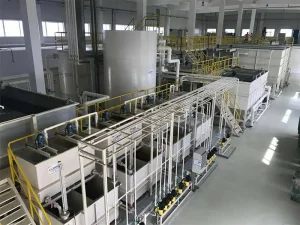
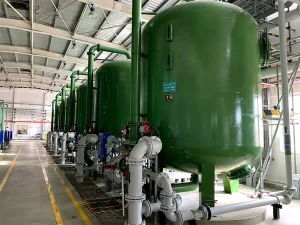
Raw seawater undergoes coagulation, flocculation, and dual-media sand-anthracite filtration, followed by pressurization through automated Ultrafiltration (UF) hollow-fiber membranes. This eliminates colloidal organics, silt, and algae blooms, consistently achieving an SDI15 < 2.5 and turbidity < 0.1 NTU to prevent irreversible membrane fouling.
- Coagulant dosing & inline static mixer
- Pressurized or gravity DAF for marine organics
- PVDF hollow-fiber UF modules (pore size 0.02 μm)
- 5-micron high-capacity melt-blown safety cartridge filters
2. High-Pressure SWRO Core & ERD
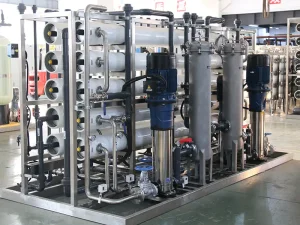
Feedwater is delivered via Super Duplex Stainless Steel (2507/UNS S32750) high-pressure booster pumps into thin-film composite polyamide spiral-wound SWRO membranes operating at 55 to 70 bar. An Isobaric Energy Recovery Device (ERD) captures kinetic energy from the high-pressure reject brine stream, cutting electrical consumption by up to 60%.
- Pressure exchanger recovery efficiency up to 96%
- Specific energy consumption (SEC) reduced to 2.5 - 3.2 kWh/m³
- ASME-certified FRP pressure vessels rated to 1200 PSI
- High-boron rejecting SWRO elements (boron < 0.5 mg/L)
3. Post-Treatment & Pure Water Polishing
For municipal and industrial reuse, permeate water is neutralized, remineralized via calcite filters, and disinfected. When high-pressure boiler feed or semiconductor fabrication grade water is demanded, second-pass Brackish Water RO (BWRO) coupled with continuous Electro-deionization (EDI) delivers resistivity exceeding 16-18 MΩ·cm.
- Calcite limestone bed remineralization & CO2 dosing
- Sodium hypochlorite or UV radiation disinfection
- Polishing RO + EDI modules for boiler feed (conductivity < 0.1 μS/cm)
- Automated CIP (Clean-In-Place) skid with neutralization flushing
Chinese Manufacturing Efficiency & Supply Chain Dominance
How Shanghai Tongjie combines vertically integrated precision engineering, Tier-1 component alliances, and comprehensive factory functional testing to provide global EPC clients with distinct capital and schedule advantages.
In modern industrial procurement, international buyers evaluate OEM manufacturers on three core metrics: total cost of ownership (TCO), delivery schedule certainty, and verified compliance with global quality and mechanical standards. Based in Jiading District, Shanghai since 2010, Shanghai Tongjie Environmental Protection Technology Co., Ltd. operates as a National High-Tech Enterprise and Shanghai Specialized & Sophisticated Enterprise holding Class II contracting qualifications in environmental protection engineering and mechanical & electrical installation. Our 15,000+ square meter engineering base bridges advanced thermodynamic process simulation with robust industrial fabrication.
The manufacturing efficiency advantage of China's marine-industrial supply chain stems from complete vertical integration. Pressure vessel filament winding, titanium and super duplex CNC machining, automated orbital welding, electrical control panel wiring, and skid structural frame hot-dip galvanizing are completed within a compact regional radius. This localized industrial concentration reduces skid assembly lead times by 35% compared to North American or European equipment integrators, while delivering an overall capital expenditure (CapEx) savings of 25% to 40% on identical bill-of-materials specifications.
| Evaluation Parameter | Conventional Field-Erected Project | Tongjie OEM Modular / Containerized SWRO |
|---|---|---|
| Fabrication & Assembly Lead Time | 12 - 18 months on-site civil construction | 8 - 14 weeks factory fabrication & skid integration |
| Pre-Shipment Testing (FAT) | Components tested independently on-site | 100% full-load hydraulic, pressure & PLC dry-run tested |
| Site Commissioning Window | 60 - 90 days with large on-site engineering crews | 7 - 15 days plug-and-play tie-in (power, feed, permeate) |
| Civil Footprint & Permitting | Large permanent concrete footprint and extensive permits | Compact ISO high-cube container footprint, self-contained |
| Metallurgical & Weld Integrity | Variable on-site welding environment | Argon-shielded orbital automatic welding, X-ray inspected |
| SCADA & System Automation | Fragmented controls configured on-site | Unified Siemens/Rockwell PLC with 4G/Satellite IoT telemetry |
Tier-1 Global Core Sourcing
To ensure non-negotiable field reliability, Tongjie integrates industry-benchmark components: Danfoss APP / FEDCO high-pressure pumps, Energy Recovery Inc. (ERI) pressure exchangers, DuPont FilmTec / Toray SWRO membranes, and Siemens / Allen-Bradley PLC automation hardware.
Factory Acceptance Testing (FAT)
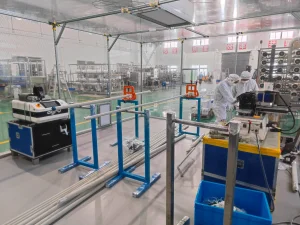
Every modular seawater plant undergoes hydraulic pressure tests up to 1.5 times working pressure, full electrical loop checks, automated sequence simulations, and sensor calibration in our Shanghai facility before export crating, virtually eliminating site commissioning surprises.
Turnkey Export Packaging
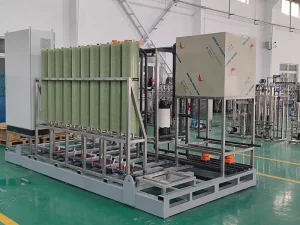
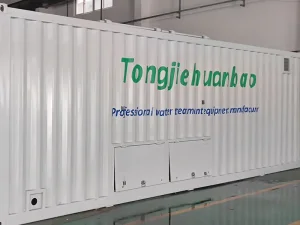
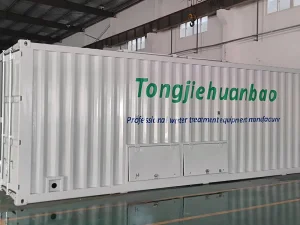
Systems are integrated inside marine-grade ISO standard containers (20-foot and 40-foot High Cube) treated with C5-M extreme anti-corrosion marine polyurethane coatings, thermal insulation, motorized ventilation, explosion-proof illumination, and internal service access cranes.
Localized Applications & Extreme Environments
Engineered to operate reliably under extreme conditions: from +50°C Arabian Gulf deserts to remote Pacific archipelagos and Caspian offshore exploration platforms.
Island Resorts & Off-Grid Utilities
Deployed throughout the Caribbean, Maldives, and Southeast Asian islands. Systems feature quiet operation, integrated solar-diesel hybrid bus synchronizers, and low-footprint containerized structures that supply WHO-standard potable water to luxury resorts and coastal municipal grids.
- Capacities: 50 m³/d to 5,000 m³/d
- Solar-PV direct hybrid integration capability
- Comprehensive remineralization for clean taste
Offshore Oil & Gas Platforms
Supplied to offshore drilling operations, FPSO vessels, and coastal workover bases in the Persian Gulf and Central Asia. The systems handle fracturing flowback water and seawater injection, achieving reinjection oil content ≤ 5 mg/L and suspended solids ≤ 1 mg/L via Disc Tube Reverse Osmosis (DTRO).
- Explosion-proof ATEX / IECEx certified instrumentation
- Compact footprint for offshore deck space
- Rapid 15-day commissioning on site
Coastal Power & Chemical Complex
Providing high-purity demineralized boiler feedwater and process make-up water for thermal power generation, ethylene cracker plants, and fertilizer complexes. Systems incorporate continuous EDI and high-efficiency brine recovery stages to support zero-discharge environmental limits.
- Conductivity down to < 0.06 μS/cm
- High silica and boron rejection trains
- Continuous unmanned SCADA operation
Emerging Trends Reshaping Seawater Desalination
From solar-direct reverse osmosis to AI-driven predictive membrane maintenance: discover where industrial desalination engineering is headed over the next decade.
1. Off-Grid Solar-Coupled Desalination
Traditional SWRO plants require continuous baseload grid power. Next-generation systems feature variable-frequency drive (VFD) pressure pumps coupled to DC microgrids powered by photovoltaic arrays. Intelligent energy balancing algorithms vary permeate recovery rates in response to solar irradiance, enabling completely off-grid municipal water production.
2. AI-Driven Predictive Maintenance Twins
By pairing live operational data (trans-membrane pressure, normalized permeate flux, differential pressure across stages) with machine learning models, modern Tongjie plants anticipate mineral scaling and biofouling up to 14 days before performance declines occur, prompting targeted CIP cycles and prolonging membrane lifespans by up to 35%.
3. Ultra-High Salinity Membrane Concentration
Closing the gap between membrane processes and thermal evaporation, innovations such as Osmosis-Assisted Reverse Osmosis (OARO) and high-pressure disc-tube reverse osmosis (DTRO) push brine concentration up to 120,000–140,000 ppm TDS at 120 bar, cutting thermal crystallizer steam consumption by more than 50% in industrial ZLD projects.
Specifying an OEM Sea Water Treatment Plant: Technical Checklist
Essential design criteria and verification parameters every international EPC procurement team, chief engineer, and utility buyer must evaluate prior to issuing a purchase tender.
Under-specifying seawater treatment equipment frequently leads to premature membrane failure, severe galvanic corrosion, and unmet delivery guarantees. Marine environments place extreme operational stress on equipment. Feedwater conditions vary continuously throughout seasonal tidal cycles, monsoons, and industrial discharge events. A properly engineered RFP package must move beyond generic output capacity metrics and define the operational parameters listed below:
Comprehensive Raw Feedwater Assay
Never rely on a single salinity reading. Sizing membranes requires a full 12-month chemical analysis, including seasonal TDS swings, minimum/maximum temperature (°C), Silica (SiO2), Boron, Iron/Manganese, Turbidity, Total Suspended Solids (TSS), and organic TOC content.
Metallurgical & Wetted Part Specifications
Avoid lower-grade stainless steels. All wetted metal components under high pressure (>16 bar) must be Super Duplex Stainless Steel (2507/UNS S32750 or 2205) with PREN ≥ 40. Low-pressure manifolds must specify Schedule 80 PVC, Super Duplex, or GRP/FRP pipework.
Documentation & Traceability Deliverables
Demand complete QA/QC documentation: P&ID schematics, 3D BIM step files, ASME Section VIII vessel code stamps, EN 10204 3.1 material test mill certificates, hydrostatic pressure charts, and PLC control logic source code with full ladder diagrams.
Frequently Asked Questions: Engineering & OEM Sourcing
Authoritative, engineering-level answers addressing technical inquiries, component longevity, boron mitigation, and cross-border project delivery.
High-Efficiency Desalination & Wastewater Systems
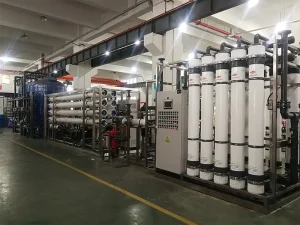
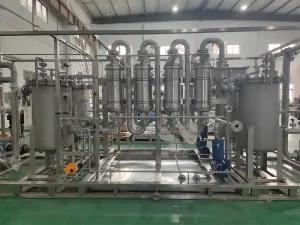
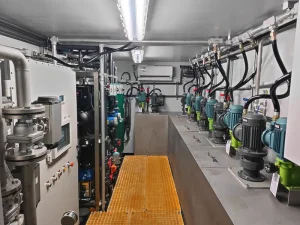
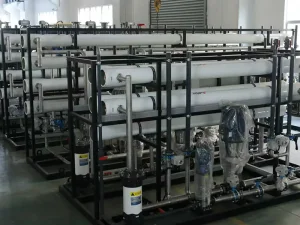
Explore containerized mobile water production packages, deoxygenation degassing systems, oilfield DTRO units, and high-efficiency brine concentrators.
Request an Engineered Process Simulation & Proposal
Send your raw seawater or wastewater laboratory analysis report to our Shanghai engineering team. We deliver custom membrane flux projections, P&ID schematics, 3D GA drawings, and itemized factory pricing within 48 hours.
Initiate Technical RFQ