
High-Efficiency Membrane Separation & Desalination Plants
Explore standard, containerized, and high-recovery water production units certified with CE and ISO international accreditations for demanding global infrastructure.

ODM China Food & Beverage Process Water System - Reliable Suppliers and Factory Solutions
Explore Specification
ODM High-Pressure Membrane Concentration System for High-Salinity Wastewater | Factory Direct
Explore Specification
China High-Efficiency Brine Concentration Systems by China Suppliers | Factory Engineering
Explore Specification
China High-Ratio Water Reuse Process Equipment Suppliers - Advanced Wastewater System
Explore Specification
CE Certification Deoxygenation Membrane Equipment for Physical Degassing to ppb Levels
Explore Specification
Wholesale China Industrial Demineralized Water Equipment Factory - RO + EDI High-Purity Trains
Explore Specification
Wholesale High-Salinity Wastewater Reduction System - ZLD Zero Liquid Discharge Technology
Explore Specification
China ODM Suppliers: Eco-Friendly Water Treatment Solutions from a Leading Factory
Explore SpecificationWhy Tier-1 EPCs and Municipalities Source Desalination Equipment from China
Over the past two decades, the global seawater reverse osmosis (SWRO) landscape has experienced an epochal shift. Sourcing managers and EPC leaders seeking competitive capital expenditure (CAPEX) without sacrificing operational uptime (OPEX) increasingly look toward Chinese advanced manufacturing hubs. Shanghai Tongjie Environmental Protection Technology Co., Ltd. (Tongjie), founded in 2010, exemplifies the highest caliber of engineering in this field, functioning not as a mere component assembler, but as an integrated process designer and skid manufacturer with full in-house capabilities.
The manufacturing edge of China’s high-salinity membrane industry rests upon four foundational pillars:
Complete Metallurgy & Supply Chain
Seawater desalination demands elite metallurgy, specifically 2507 Super Duplex Stainless Steel, Titanium Grade 2, and specialized high-pressure FRP housings to counteract chloride-induced stress corrosion. China's integrated supply chain yields rapid machining, orbital welding, and surface pickling at unrivaled lead times.
Standardized Factory FAT Protocols
Tongjie executes exhaustive Factory Acceptance Testing (FAT) on full hydraulic load prior to port dispatch. Skids and containers leave the facility pre-piped, pre-wired, and wet-tested, slashing on-site commissioning timelines down to an agile 10–15 days across overseas destinations.
Rigorous R&D and Patent Portfolios
Certified as a National High-Tech Enterprise and Shanghai Specialized & Sophisticated Enterprise, Tongjie holds more than 38 national patents and automated control software copyrights, offering unmatched process optimization in energy recovery devices (ERD) and membrane anti-scaling schemes.
Global Technological Trends Transforming Desalination Infrastructure
Driven by extreme water stress, rising industrial effluent penalties, and net-zero carbon mandates, modern seawater desalination is evolving beyond legacy, energy-intensive paradigms into high-efficiency, multi-stage eco-engineering.
Energy Recovery Hybridization
Deploying isobaric pressure exchangers (PX) enables recovery of up to 98% of the hydraulic energy contained in the concentrate stream. This reduces electrical consumption of SWRO units to sub-3.0 kWh/m³, redefining long-term plant OPEX.
Intelligent SCADA & AI-Driven Flux
Modern systems leverage real-time transmembrane pressure (TMP), conductivity, and flow sensors integrated with automated dosing algorithms. This minimizes biological and colloidal fouling while predicting optimal CIP (Clean-in-Place) intervals.
Off-Grid Renewable Integration
Decentralized SWRO systems now seamlessly interface with photovoltaic (PV) arrays and battery storage, eliminating fossil fuel dependence for isolated resorts, remote islands, and marine exploration vessels.
Engineered Deployment Matrix Across Diverse Critical Environments
Tongjie’s reverse osmosis and high-salinity separation architectures are modularized to withstand specific regional and chemical water profiles.
| Deployment Scenario | Feed Water Profile (TDS/Contaminants) | Engineered Process Train | Effluent Purity Standard |
|---|---|---|---|
| Remote Islands & Coastal Resorts | Seawater (30,000–45,000 ppm TDS, Boron, Algae) | Dual Media Filtration + DAF + Cartridge + SWRO + Remineralization | WHO Potable Drinking Water (<500 ppm TDS) |
| Offshore Oil & Gas Platforms | Produced Water & Seawater (High Hydrocarbons, H2S) | Hydrocyclone + Coalescence + Softening + DTRO (Disc Tube RO) | Reinjection Grade (≤5 mg/L Oil, ≤1 mg/L SS) |
| Power & Chemical Boiler Feed | Brackish Coastal / Estuary Water (5,000–18,000 ppm TDS) | UF + Double-Pass SWRO + Degassing Membrane + EDI Polish | Demineralized High-Purity Boiler Feed (<0.1 μS/cm) |
| Heavy Chemical & Mining ZLD | Concentrated Brines (50,000–120,000 ppm TDS, Heavy Metals) | Chemical Precipitation + High-Pressure RO + MVR Evaporation + Crystal | Zero Liquid Discharge / Pure Distillate + Dry Solids |
Comprehensive Turnkey Engineering (From Intake to Delivery)
A resilient SWRO infrastructure entails more than assembling membranes. Tongjie provides holistic solutions spanning complex intake dynamics (beach wells, open intakes with passive screens), comprehensive multi-barrier pre-treatment (flocculation, ultrafiltration), core high-pressure separation, energy recovery coupling, and downstream post-treatment including remineralization (calcite contactors) and chemical disinfection.
How Global Sourcing Directors Vet Desalination Manufacturers
Acquiring industrial or municipal membrane equipment from abroad demands systematic qualification to avoid lifecycle disruption. Here is the operational specification framework required by top-tier EPC teams.
1. Hydrochemical Water Analysis
Buyers must provide comprehensive feed water assays: seasonal TDS fluctuations, silt density index (SDI15), turbidity, silica, iron, barium, total organic carbon (TOC), and minimum/maximum water temperature to prevent membrane compaction or fouling.
2. Quality Management Accreditations
Verify manufacturer authenticity via ISO 9001 (Quality Management), ISO 14001 (Environmental), ISO 45001 (Occupational Safety), and European CE directives. Tongjie also holds Class II Engineering Contracting Qualifications for environmental systems.
3. Plug-and-Play Modularization
Containerized plants built within ISO high-cube shipping containers offer integrated HVAC, anti-corrosive floor coatings, lighting, and internal fire detection, ensuring robust turnkey mobilization in remote or harsh environments.
Certified Production Standards Backing Global Deliveries
Our complete manufacturing lifecycle complies with rigorous European and international auditing criteria.
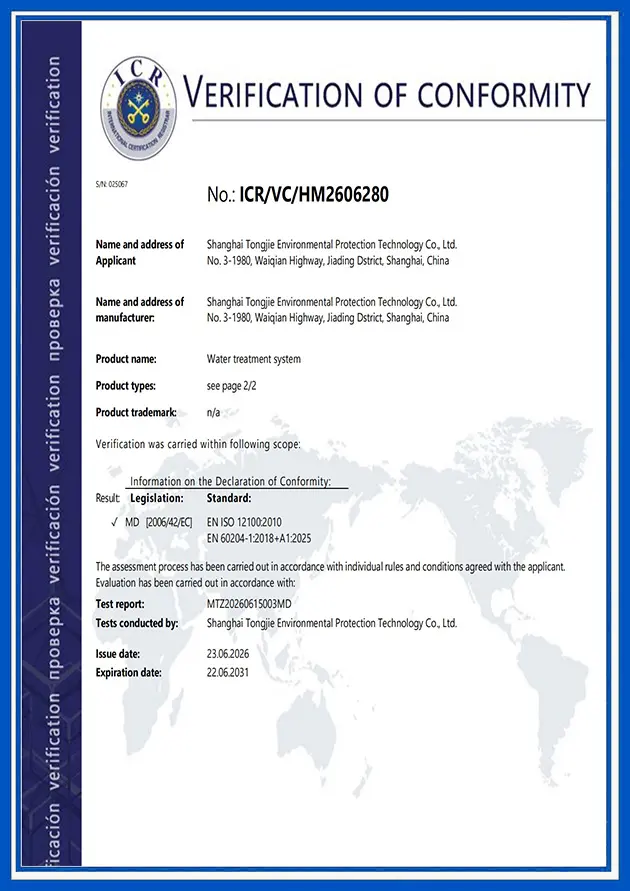
CE Certification (EU Conformity)
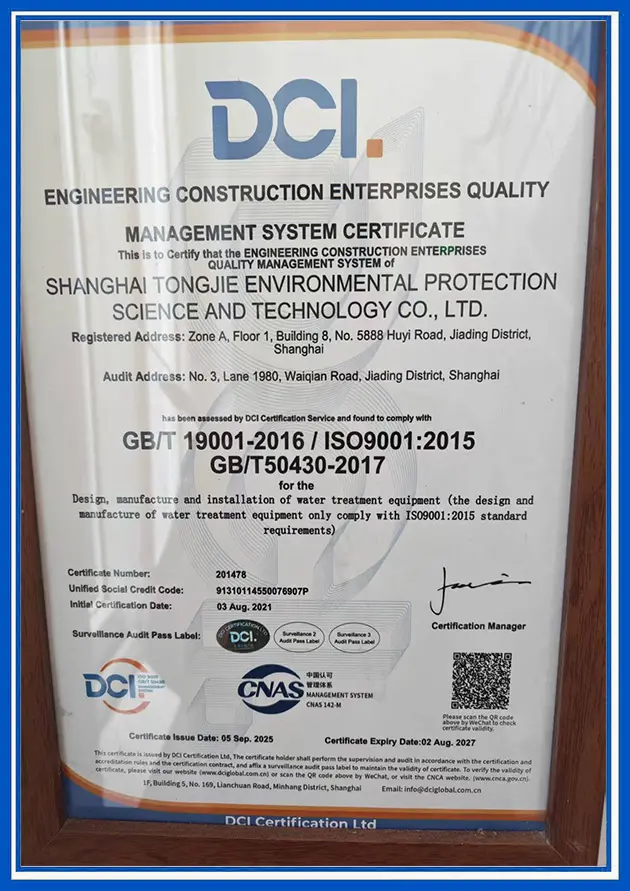
ISO 9001: Quality Management
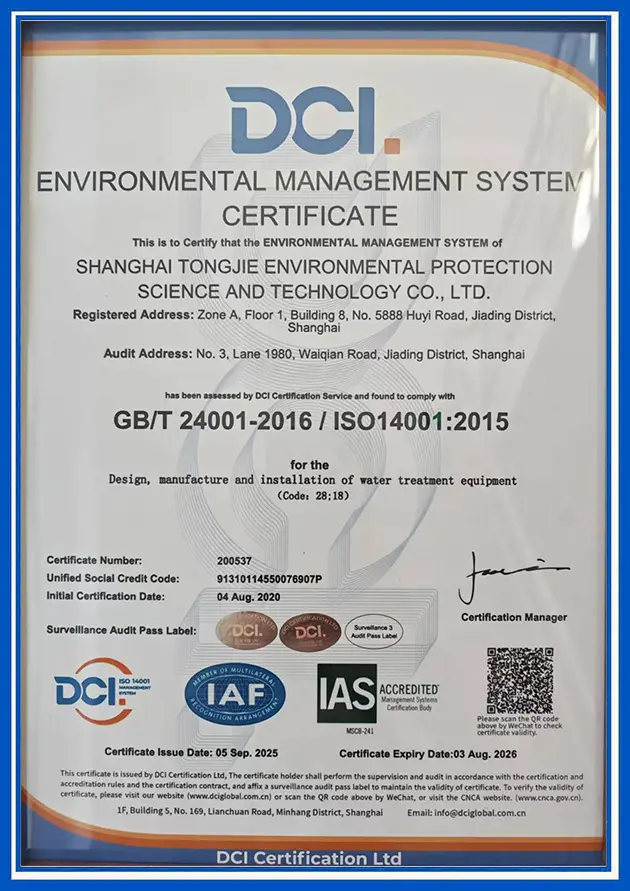
ISO 14001: Environmental Protection
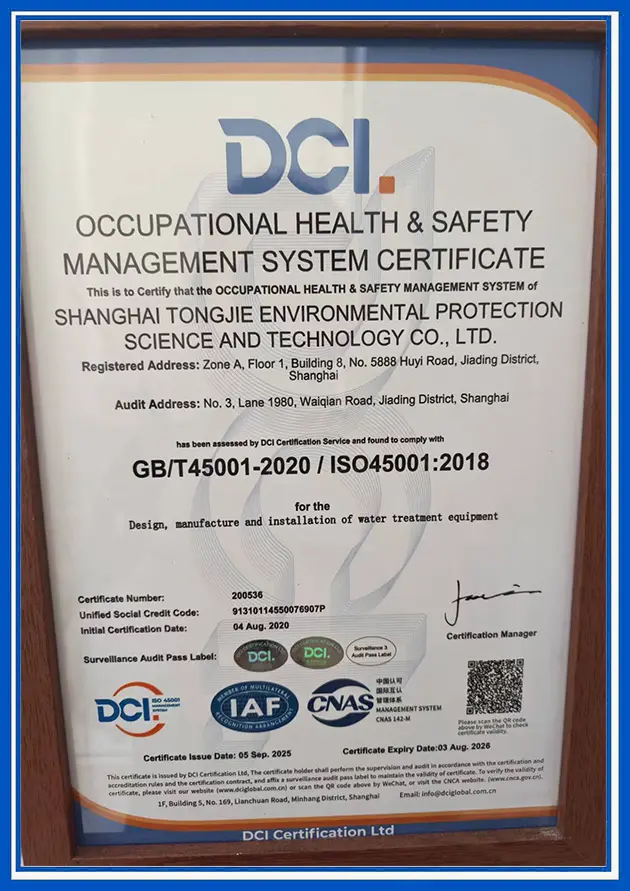
ISO 45001: Health & Safety
Frequently Asked Questions: Industrial & Seawater Desalination
Clear, technical explanations addressing design parameters, material selections, and commissioning protocols.
What specific data is essential to size a commercial or industrial seawater RO plant?
How do Tongjie containerized plants accelerate overseas deployment?
Can high-salinity oilfield produced water be treated for reinjection?
What metallurgical standards are used to combat seawater pitting and corrosion?
Do you offer customized OEM / ODM manufacturing for international engineering contractors?
Specialized Industrial, Marine & Pharmaceutical Systems
Explore customized RO/EDI skids, ultra-pure water packages, and high-salinity concentration modules built for zero-downtime service.

OEM China Pharmaceutical Purified Water & WFI System - Reliable Suppliers and Factory
Explore Specification
ODM OEM Precision Manufacturing - Factory for Environmental Water Treatment Equipment
Explore Specification
China Compact Seawater Desalination Equipment - Efficient Reverse Osmosis System
Explore Specification
Wholesale China Pharmaceutical Purified Water & WFI System - Factory Water Solutions
Explore Specification
OEM Containerized Seawater Desalination Plants - Mobile Water Production Solutions
Explore Specification
China High-Efficiency Brine Concentration System for Wastewater Treatment Solutions
Explore Specification
CE Certification High-Quality Pharmaceutical Purified Water & WFI System Solutions
Explore Specification
OEM High-Efficiency Brine Concentration Systems | Advanced Membrane Technology Factory
Explore SpecificationInitiate Your Desalination Project With Factory Engineers
Forward your feed water quality report, capacity targets, and project footprint requirements. Our engineering team will formulate mass balance projections, P&ID schemes, and an itemized quotation within 24 hours.