
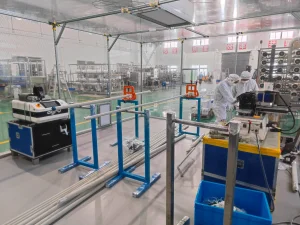
Primary Systems
Featured Industrial Skids for Mexico City Facilities
Pre-engineered, factory-assembled, and tested membrane skids optimized for local water quality, fluctuating pressure grids, and environmental compliance across Mexico City, Toluca, and surrounding industrial hubs.
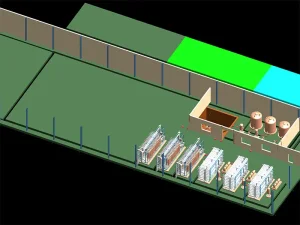
Precision Engineering ODM/OEM Skid Systems for Mexico City Manufacturing
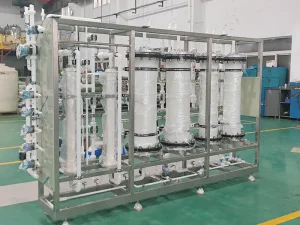
CE Certified Ultra-Pure Water (UPW) Systems for Electronics & High-Tech in Central Mexico
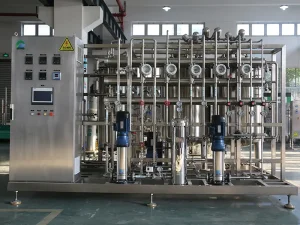
ODM Pharmaceutical Grade Purified Water & WFI Generation Systems for CDMX Pharma Hubs
Market Reality & Constraints
Industrial Water Realities in the Valley of Mexico & Nearshoring Pressures
A rigorous examination of groundwater exhaustion, strict municipal discharge laws, and escalating water supply tariffs driving capital investment into closed-loop water infrastructure across Greater Mexico City.
The Metropolitan Area of the Valley of Mexico (ZMVM)—comprising Mexico City (CDMX) and 60 contiguous municipalities in the State of Mexico and Hidalgo—represents one of the most hydro-geologically complex manufacturing landscapes in Latin America. Operating in key industrial clusters such as Vallejo-i, Naucalpan, Tlalnepantla, Ecatepec, Toluca-Lerma, and Cuautitlán Izcalli requires an uncompromising approach to industrial water engineering. Subterranean aquifers that have traditionally sustained industrial extraction are severely depleted, contributing to land subsidence rates exceeding 30 cm per year in specific zones, and triggering critical water supply rationing via the Cutzamala and Lerma reservoir infrastructure.
Concurrently, the historic acceleration of nearshoring has directed multi-billion-dollar investments into Mexican industrial manufacturing corridors. Tier-1 automotive sub-assembly plants, contract pharmaceutical manufacturing organizations (CDMOs), precision plastics, consumer chemical formulation, and high-density computing facilities are intensifying regional water demand. For global corporations and domestic operators alike, relying on municipal water concessions (granted under tight quotas by the National Water Commission, CONAGUA) or private water transport tankers (pipas) introduces extreme volatility into operational cost structures and supply security.
Strategic Takeaway for CDMX Plant Engineers: Industrial water treatment is no longer a utility postscript; it has transitioned into a core risk management matrix. Facilities achieving >90% internal water recirculation through integrated membrane bioreactors (MBR), secondary reverse osmosis (RO), and thermal brine concentration insulate their operations against municipal water cut-offs, minimize tanker dependence, and eliminate non-compliance penalties under the overhauled federal standard NOM-001-SEMARNAT-2021.
Manufacturing Excellence
China Factory 4.0: Scaled Precision Engineering & Global Supply Chain Agility
How state-of-the-art Chinese manufacturing facilities provide Mexican industrial enterprises with high-efficiency membrane systems, uncompromised material traceability, and 30–45% Capex optimization.
Automated Skid Fabrication
Robotic orbital TIG welding and automated mechanical polishing achieve uniform surface roughness down to Ra < 0.4 μm for sanitary SS316L pipework, preventing biofilm formation and meeting global ASME BPE standards.
- Full endoscopy weld video records
- Automated acid passivation tracking
- Class 10,000 cleanroom assembly
Tier-1 Component Architecture
We do not cut corners on core process equipment. Systems combine international membrane elements (DuPont FilmTec, Hydranautics, Toray) with high-efficiency Danfoss or Grundfos high-pressure pumps and Siemens/Rockwell automation.
- Energy Recovery Devices (ERD) >95%
- Dual-redundant remote telemetry
- CE & UL certified control panels
Complete Factory Wet FAT
Prior to containerization and oceanic transit to Veracruz or Manzanillo, every skid undergoes exhaustive Factory Acceptance Testing (FAT) with simulated chemical feed water, complete loop pressure checks, and control logic validation.
- Hydrostatic pressure holding at 1.5x
- Pre-commissioned PLC HMI scripts
- Complete DQ/IQ/OQ documentation packages
Engineered Applications
Sector-Specific Solutions for Central Mexico’s Core Industries
Engineered treatment trains designed to conquer distinct raw water matrices, feed variations, and regulatory frameworks across key industrial sectors in the Valley of Mexico.
| Target Sector | Primary Industrial Zones | Critical Water Challenge | Recommended Process Architecture | Compliance / Quality Standard |
|---|---|---|---|---|
| Pharmaceuticals & Biotech | Tlalpan, Xochimilco, Coyoacán, Jiutepec corridor | Endotoxins, microbial control, high conductivity from well supply | Multimedia Filtration + Double-Pass RO + Continuous EDIPolishing + Hot-Water Sanitization | NOM-059-SSA1-2015, USP/Ph. Eur. Purified Water & WFI |
| Automotive & Tier-1 Parts | Cuautitlán, Toluca-Lerma, San Martín Texmelucan | Heavy metal precipitation, oily wash-water, zero liquid discharge mandates | DAF Oil Clarification + Softening + Disc Tube RO (DTRO) + MVR Evaporator + Centrifuge | NOM-001-SEMARNAT-2021 Table 1 & 2 Heavy Metals |
| Food & Beverage Processing | Vallejo, Azcapotzalco, Ecatepec, Tlalnepantla | High COD/BOD organic loading, total dissolved solids, taste/odor stability | Anaerobic MBR + RO Brackish Membranes + UV Sterilization + Physical Degassing | NOM-127-SSA1-2021 (Drinking Water Guidelines) |
| High-Tech & Data Centers | Querétaro-CDMX Corridor, Santa Fe | Silica scaling, evaporative cooling water shortages, ultra-low conductivity | High-Recovery RO + Hollow-Fiber Physical Deoxygenation + Polishing Mixed Beds | ASTM D5127 Type E-1 / 18.2 MΩ·cm Ultra-Pure Water |
Engineering Deep Dive
Technical Roadmap: Overcoming Hard Water & High-Silica Challenges in CDMX
Groundwater throughout the volcanic Trans-Mexican Volcanic Belt features high concentrations of colloidal silica (SiO&sub2; > 45 mg/L), excessive total hardness (CaCO&sub3; > 350 mg/L), and volatile alkalinity. Here is how our membrane configurations prevent premature fouling and maximize operating uptime.
A persistent failure mode of imported reverse osmosis plants in Mexico City is rapid membrane scaling caused by reactive silica polymerization. When silica levels exceed 120–140 mg/L in the RO concentrate stream at standard 25°C operating temperatures, amorphous silica scales precipitate irreversibly onto polyamide thin-film composite leaves. Traditional cleaning-in-place (CIP) regimens with sodium hydroxide or citric acid prove entirely ineffective against dense silica silicate lattices, leading to exponential differential pressure jumps and cartridge destruction.
Our engineering matrix integrates three advanced countermeasures designed specifically for volcanic basin feed chemistry:
Hermetic Disc Tube RO (DTRO)
Utilizing open-channel hydraulic flow dynamics with independent disc plates and octagonal membrane cushions. High-velocity cross-flow suppresses boundary layer concentration polarization, allowing stable processing of feed streams with SDI > 5 and COD up to 800 mg/L without clogging.
Chemical-Free Deoxygenation
Physical degassing contactor membranes separate dissolved oxygen (DO down to < 1 ppb) and dissolved CO&sub2; without chemical sodium bisulfite dosing. This eliminates sulfate ion loading downstream, preserving membrane longevity and protecting boiler feed infrastructure.
Smart IoT SCADA Telemetry
Every system incorporates smart PLCs (Siemens or Allen-Bradley) featuring normalized permeate flux calculations, real-time salt passage tracking, automated CIP triggering, and bidirectional encrypted remote diagnostic linkups directly with our engineering hub.
Turnkey Reliability
Compliance, Spare Parts Buffering & Local Technical Support
Eliminating procurement friction: navigating Mexican import regulations, NOM standards, bilingual documentation, and critical spares availability for high-throughput factories.
Purchasing capital water treatment equipment from overseas can create anxiety regarding logistics, electrical matching, local documentation, and long-term maintenance. We have structured our manufacturing and export protocols to address these operational requirements seamlessly:
440V / 220V 60Hz Compatibility
Industrial power grids in Mexico City and the Bajío region operate at 60Hz, typically 440V 3-phase or 220V. All electrical drive components, high-pressure booster pumps, variable frequency drives (VFDs), and instrumentation are native 60Hz units, eliminating phase conversion issues.
Bilingual Technical Packages
We provide full project documentation in both English and Spanish. This includes Process and Instrumentation Diagrams (P&ID), 3D isometric layout schematics, electrical single-line wiring diagrams, operating manuals, and full standard operating procedures (SOPs) for local operators.
Consumable Buffering & Logistics
We provide comprehensive 2-year operational spare packages alongside initial equipment shipments—including mechanical seals, sensors (pH, ORP, conductivity, flow), solenoid valves, and spare membrane elements—clearing customs through Veracruz, Manzanillo, or Mexico City AICM/AIFA airports.
Comprehensive Catalog
Industrial Water Systems & Membrane Units Available for Mexico
Explore our core product lines configured for nearshoring industrial zones, food and beverage facilities, high-salinity discharge plants, and municipal utilities.
Custom Industrial Reverse Osmosis & Environmental Water Solutions for Valley of Mexico
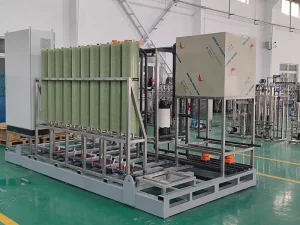
Heavy-Duty ZLD & High-Salinity Wastewater Reduction Plants (NOM-001 Compliant)
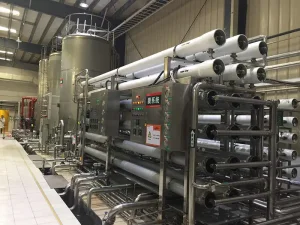
High-Volume Food & Beverage Process Water Purification Units for Central Mexico Hubs
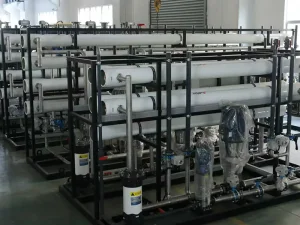
High-Efficiency Brine Concentration & Resource Recovery Membrane Modules
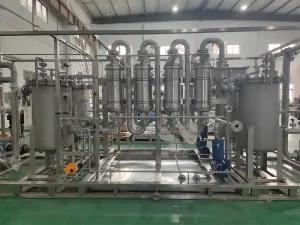
Membrane Contactor Physical Deoxygenation Degassing Systems for Boilers & Microelectronics
High-Purity cGMP Purified Water & WFI Storage & Distribution Skids for Mexican Laboratories
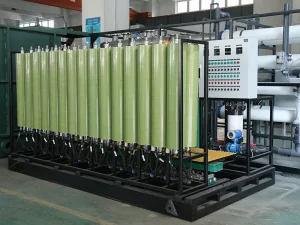
Heavy Industrial High-Pressure DTRO & STRO Membrane Leachate & Brine Units
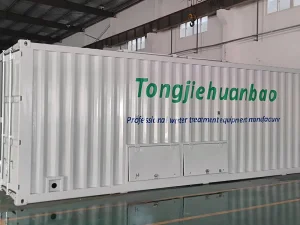
Containerized Emergency & Mobile Desalination / Brackish RO Units for Fast Deployment
Technical & Procurement FAQ
Frequently Asked Questions for Mexican Operations
In-depth responses covering process guarantees, international logistics, electrical frequency matching, and local environmental standards.
How do your RO and ZLD systems guarantee compliance with NOM-001-SEMARNAT-2021?
The updated NOM-001-SEMARNAT-2021 significantly lowers allowable thresholds for Chemical Oxygen Demand (COD), total organic carbon, heavy metals (nickel, lead, cadmium), and phosphorus discharged into national water bodies. Our systems integrate advanced physicochemical precipitation, ultrafiltration barriers, and specialized high-rejection brackish water or DTRO membranes that remove >99.2% of multivalent cations and heavy metals, guaranteeing discharge metrics well below federal parameters.
What are the lead times for manufacturing and delivering skids to Mexico City?
Standard skid-mounted reverse osmosis and purified water systems have a factory production and wet-testing schedule of 4 to 6 weeks. Customized containerized systems, high-pressure DTRO, or mechanical vapor recompression (MVR) evaporators typically require 8 to 12 weeks. Oceanic transit from Shanghai/Ningbo to the Port of Manzanillo (Pacific) or Port of Veracruz (Gulf) takes approximately 22–28 days, followed by 3–5 days of customs clearance and inland bonded transport directly into Mexico City or State of Mexico industrial parks.
Can equipment withstand the high silica concentrations found in Valley of Mexico groundwater?
Yes. Untreated volcanic well water in Mexico City frequently exhibits reactive silica concentrations exceeding 40–60 mg/L. We utilize specialized silica-dispersant antiscalants, run the primary RO train at conservative recoveries (65–75%), and feed the primary concentrate into an intermediate chemical softening stage or a secondary Disc Tube RO (DTRO) equipped with wide spacer channels. This process prevents colloidal silica polymerization on membrane leaves, sustaining standard flux rates without premature replacement.
Do your pharmaceutical water systems support COFEPRIS and FDA validation?
Absolutely. Every pharmaceutical Purified Water (PW) and Water for Injection (WFI) unit is delivered with a complete cGMP validation documentation package including Design Qualification (DQ), Installation Qualification (IQ), and Operational Qualification (OQ) protocols. Materials contacting purified water are fabricated in AISI 316L stainless steel with surface finishes verified at Ra ≤ 0.4 μm (electropolished). Full 3.1 material test reports (MTR), weld maps, borescope inspection logs, and calibration certificates for TOC and conductivity meters are included.
How is on-site installation and commissioning supported in Mexico?
We provide a hybrid support model. Every skid arrives 100% pre-piped, pre-wired, and wet-tested with quick-connect fluid and electrical terminations. Our senior commissioning engineers can be dispatched directly to your Mexican plant for site sign-off, or our remote commissioning team can oversee local mechanical and electrical contractors via continuous encrypted video link and PLC telemetry, reducing installation timelines and commissioning overhead.
What warranty coverage and long-term service agreements are available?
All structural skids, high-pressure vessels, and piping assemblies carry an extended 24-month manufacturer warranty. High-pressure pumps, motors, instruments, and PLC hardware are backed by international warranty support from their original Tier-1 makers (Danfoss, Grundfos, Siemens). We also offer multi-year consumable replenishment contracts with scheduled air shipments of replacement membrane modules and calibrated sensors to guarantee continuous uptime.
Initiate Your Industrial Water Feasibility Study
Connect with our senior engineering directors to review raw water reports, calculate Capex vs. Opex projections, and schedule technical consultations for your Mexico City project.
Send Inquiry Now