
⚙️ Standard-Setting Technologies for Azerbaijan Industrial Operations
Pre-engineered, CE-certified skid and containerized modular water treatment units configured for harsh raw water conditions across Absheron and Caspian energy corridors.
-
View Process Train & Spec
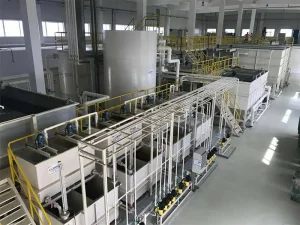
China Water Reuse Equipment High-Ratio Water Reuse Process Supplier, Manufacturer (Azerbaijan Grade)
Ultra-high recovery rate membrane arrays designed for aggressive municipal & petrochemical wastewater recycling.
-
View Process Train & Spec
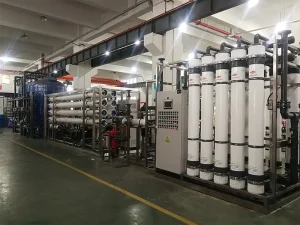
China Water Reuse Equipment (Pretreatment + UF + RO Process) Factories, Supplier
Dual-stage hollow fiber UF barrier combined with high-rejection brackish water RO elements for stable reuse streams.
-
View Process Train & Spec
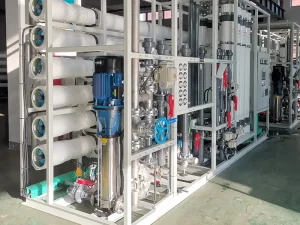
OEM Compact Seawater Desalination System Suppliers in China - Caspian Marine Drinking Water
Engineered with duplex stainless steel wet ends to reliably manage Caspian Sea brackish-to-saline fluctuations.
-
View Process Train & Spec
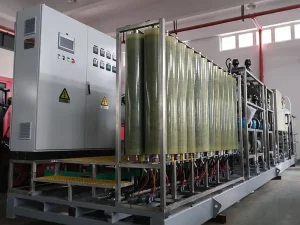
ODM China Suppliers Factory for Oilfield Fracturing Flowback Fluid Treatment System with Zero-Discharge Technology
Specialized hydrocyclone separation, induced gas flotation, and DTRO elements built for offshore and onshore flowback recovery.
🌐 Azerbaijan Industrial Water Ecosystem: Challenges & Structural Opportunities
Addressing the shifting paradigm from single-pass abstraction to closed-loop recycling across the South Caucasus region.
Severe Water Scarcity & Transboundary Reliance
Azerbaijan depends on external river basins—specifically the Kura and Aras rivers—for more than 70% of its surface freshwater inflows. Upstream extraction, climate variability, and seasonal droughts have sharply curtailed seasonal volume, pushing the national water agenda toward mandatory reuse quotas and industrial closed-loop cycles.
Sumqayit Chemical Industrial Park (SCIP) Expansion
As industrial clusters around Baku and Sumqayit diversify into polymers, specialty chemicals, fertilizers, and metallurgy, biological oxygen demand (BOD) and chemical oxygen demand (COD) discharge restrictions have tightened. Heavy industrial plants require high-rate membrane recovery to retain water internally and curb utility tariff impacts.
Caspian Offshore & Onshore Upstream Operations
The Caspian Sea features a unique brackish-to-saline chemistry (~12,000 to 13,500 mg/L TDS) paired with complex organic contaminants from decades of hydrocarbon development. Upstream E&P operators face stringent reinjection criteria (oil content ≤ 5 mg/L, suspended solids ≤ 1 mg/L), mandating skid-mounted produced water reuse systems.
Comparative Operational Parameters: Raw Water vs. Reclaimed Specs in Absheron Region
| Water Parameter Metric | Typical Caspian / Regional Feed | Standard Municipal Discharge | Tongjie Reclaimed Pure Stream | System Operational Advantage |
|---|---|---|---|---|
| Total Dissolved Solids (TDS) | 12,000 – 14,000 mg/L | 1,500 – 3,000 mg/L | < 50 – 200 mg/L | Energy-recovery turbochargers cut kWh/m³ by 35% |
| Total Suspended Solids (TSS) | 80 – 350 mg/L | ≤ 30 mg/L | ≤ 1 mg/L (Permeate) | PVDF hollow fiber UF backwash logic prevents fouling |
| Hydrocarbon / Free Oil Content | 50 – 500 mg/L | ≤ 10 mg/L | ≤ 0.5 mg/L | Multi-stage coalescing + ceramic/DTRO open channel |
| Silica (SiO2) Concentration | 25 – 65 mg/L | Variable | < 0.1 mg/L | Antiscalant dosing models tuned to alkaline brackish feeds |
| Bacteriological / Biofouling Potential | High (Warm coastal waters) | Moderate | Non-detectable | Automated sanitization & intermittent biocide flushing |
🏗️ Engineering Superiority: Chinese Direct Factory Advantages for Azerbaijan
Combining vertically integrated component fabrication, high-tier metallurgical engineering, and rigorous European CE conformity.
Full CE & EU Directive Compliance
Tongjie’s manufacturing plant implements harmonized standards under the Machinery Directive 2006/42/EC, Low Voltage Directive 2014/35/EU, and Pressure Equipment Directive (PED) 2014/68/EU. This simplifies project commissioning, safety validation, and customs clearance through Baku International Sea Trade Port (Alat).
Advanced Metallurgy for High-Chloride Feeds
The Caspian basin’s warm brackish profile induces rapid pitting corrosion in standard stainless steels. We build wet-end systems using Super Duplex Stainless Steel (2507 / UNS S32750), 904L, or high-pressure FRP piping arrays with robotic orbital welding and certified hydrostatic factory acceptance testing (FAT).
Rapid Factory Assembly & Containerization
By pre-assembling, wiring, programming, and wet-testing inside standard ISO 20ft/40ft shipping containers at our Shanghai facility, we eliminate up to 70% of on-site construction work in Azerbaijan. Skids land on-site plug-and-play, shortening commissioning cycles from months to under 15 days.
Require a Process Simulation for an Absheron Water Reuse Facility?
Upload your raw water analysis (TDS, Hardness, COD/BOD) to receive a mass balance model within 24 hours.
🔬 Modular Industrial Scenarios: Engineered for Azerbaijan
Translating process-train architectures into scalable performance across primary manufacturing sectors.
1. Oil & Gas Produced Water Reclamation
Feed: Heavy hydrocarbon-laden flowback water with TDS exceeding 35,000 mg/L from Sangachal or Siazan fields.
Process Train: API Separator → Dissolved Air Flotation (DAF) → Multi-Media Filter → Disc Tube Reverse Osmosis (DTRO).
Output: High-purity water for boiler make-up or compliant reservoir reinjection (≤5 mg/L oil, ≤1 mg/L TSS).
2. Petrochemical Industrial Park Closed-Loop Reuse
Feed: Secondary biologically treated effluent from chemical and plastics synthesis.
Process Train: Ozonation Pre-Oxidation → Ultrafiltration (UF) → Brackish Water Reverse Osmosis (BWRO) → Mixed-Bed Polisher.
Output: High-volume demineralized cooling tower make-up, reducing municipal freshwater consumption by 85%.
3. Zero Liquid Discharge (ZLD) for Chemical Process Brines
Feed: High-salinity reject brine from secondary RO stages (>65,000 mg/L TDS).
Process Train: High-Efficiency Membrane Concentration (DTRO/PRO) → Mechanical Vapor Recompression (MVR) Evaporation → Crystallizer.
Output: 99% pure water recovery alongside crystallized industrial-grade solid salts suitable for reuse.
📊 Strategic Sourcing: Global EPC Procurement Requirements
Why Tier-1 international project developers and regional state utilities require standardized instrumentation and modularity.
Automated Instrumentation & Telemetry Protocols
Global plant operators demand remote visibility over critical transmembrane pressure (TMP), permeate conductivity, and SDI indices. Tongjie systems are built with Siemens S7 or Allen-Bradley PLCs featuring Modbus/Profibus fieldbus protocols, enabling integration into central SCADA networks across Baku and distributed regional installations.
Energy Optimization & Life-Cycle Cost Engineering
Power consumption dominates total operational expenditure over a 15-year lifecycle. By coupling ceramic isobaric energy recovery devices (ERD) with VFD-driven high-pressure Grundfos or Danfoss pumps, our containerized seawater and wastewater plants recover up to 96% of reject brine hydraulic energy, cutting kWh/m³ consumption significantly.
⚙️ Comprehensive CE-Certified Industrial Water Treatment Portfolio
Explore our full line of specialized membrane modules, pure water skids, and high-salinity ZLD concentration plants built for worldwide export.
-
View Process Train & Spec
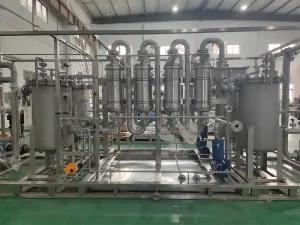
China Deoxygenation Membrane Equipment Suppliers and Factory in China for Effective Water Treatment Solutions
Dissolved gas stripping down to ppb levels for thermal power boilers and electronics cooling in industrial hubs.
-
View Process Train & Spec
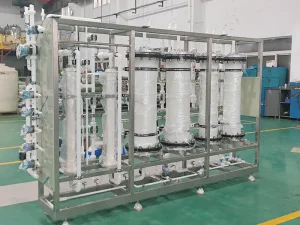
China China Ultra-Pure Water System for Semiconductor & Electronics - Reliable Suppliers & Factory Solutions
Double-pass RO + continuous EDI delivering up to 18.2 MΩ·cm resistivity for high-tech microelectronics rinsing.
-
View Process Train & Spec
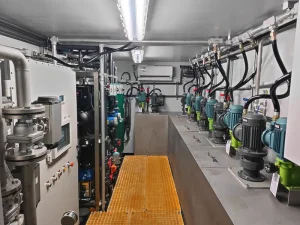
China China Suppliers Factory for Fracturing Flowback Water Reuse Treatment Equipment for Oil & Gas Operations
Robust skid-mounted clarification, softening, and membrane modules engineered for high oil and suspended solids.
-
View Process Train & Spec
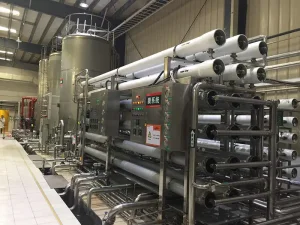
OEM China Suppliers Factory Purified Water System for Food & Beverage Production – Quality & Safety
Sanitary grade SS316L piping, automated hot water sanitization, and continuous UV disinfection for beverage plants.
-
View Process Train & Spec
CE Certification China Fracturing Flowback Fluid Treatment System by Suppliers and Factory for Zero-Discharge Reuse
Certified explosion-proof controls (ATEX/IECEx compliant) suited for upstream oilfield drilling pad environments.
-
View Process Train & Spec
China High-Ratio Water Reuse Process Equipment Suppliers in China - Advanced Wastewater Treatment Factory
Multi-stage recovery configuration achieving up to 90% permeate recovery on challenging industrial feeds.
-
View Process Train & Spec
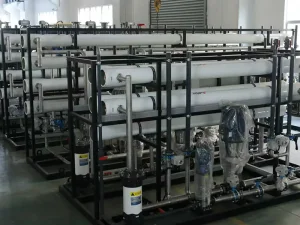
OEM High-Efficiency Brine Concentration Systems from China Suppliers | Advanced Membrane Technology Factory
High-pressure membrane stages concentrating salinity past 120,000 mg/L before thermal crystallization stages.
-
View Process Train & Spec
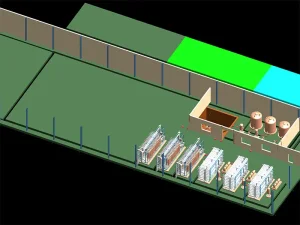
OEM Precision Manufacturing: China Suppliers and Factory for Customized Environmental Water Treatment Solutions
Tailored modular skids built to customer-specified footprints, valve matrices, and regional electrical standards.
❓ Engineering & Procurement FAQ: Supplying Azerbaijan
Direct answers addressing technical parameters, metallurgy, logistics, and on-site support for Caspian projects.
🔹 How do your systems handle the salinity and scaling profile of the Caspian Sea?
The Caspian Sea features a TDS profile of approximately 12,000–13,500 mg/L, marked by higher sulfate-to-chloride and calcium ratios than open ocean water. We engineer customized pretreatment trains integrating anti-scalant dosing algorithms and low-fouling, high-rejection membranes with automated CIP (Clean-In-Place) flushing cycles to prevent gypsum and silica scaling.
🔹 What documentation is provided for customs clearance at Baku International Sea Port?
Every shipment is delivered with a complete export dossier: Official CE Declarations of Conformity, ISO 9001/14001/45001 certificates, EN 10204 3.1 Material Test Reports (MTRs) for pressure piping and vessels, hydrostatic pressure test certificates, electrical safety test logs, and Russian/English dual-language O&M manuals.
🔹 Can your skid-mounted container units handle continental winter extremes in Azerbaijan?
Yes. Containers shipped to the South Caucasus and Central Asia can be specified with internal thermal insulation (mineral wool or polyurethane panels), industrial HVAC temperature regulation, internal trace heating on exposed sample and feed lines, and automated low-temperature drain protection to prevent freeze-thaw damage.
🔹 What is the standard lead time for a 1,000 m³/day containerized RO water reuse system?
Standard containerized systems have a manufacturing cycle of approximately 6 to 8 weeks at our Shanghai facility, including full wet Factory Acceptance Testing (FAT). Transit via direct rail-sea multimodal routes to Baku Port typically takes 20 to 25 days, enabling rapid deployment for urgent industrial projects.