
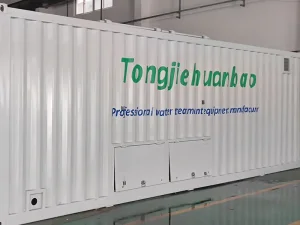
Primary Solutions
High-Performance Seawater & Membrane Plants
Engineered for mission-critical marine, industrial, and hyper-saline separation applications.
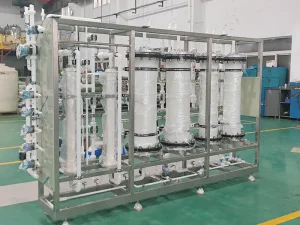
CE Certified Ultra-Pure Water System
View Specifications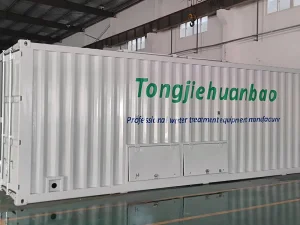
Containerized Mobile Desalination Plants
View Specifications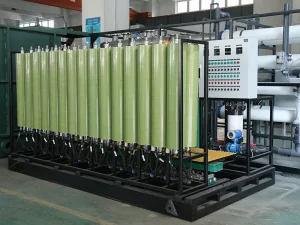
DTRO & STRO Membrane Concentration
View Specifications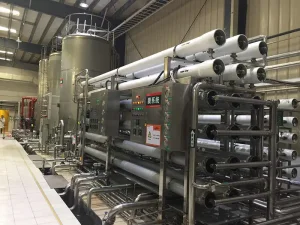
Food & Beverage Purified Water Systems
View Specifications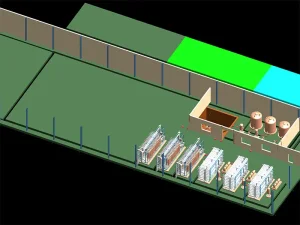
Custom Environmental Treatment Skids
View Specifications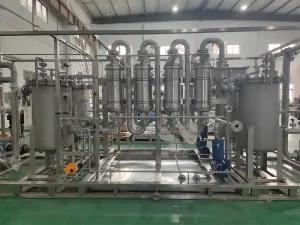
Membrane Deoxygenation Degassing Unit
View Specifications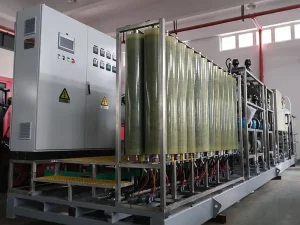
Oilfield Fracturing Flowback Unit
View Specifications
Macro Dynamics
Global Landscape: Seawater Desalination in Modern Industry
From maritime baseload water security to hydrogen production and mining dewatering, thermodynamic separation remains the foundation of global industrial continuity.
Severe Water Stress & Decentralization
Over 2.4 billion people reside in water-stressed nations. Centralized utilities cannot pivot quickly to rapid urban expansion or remote coastal mining developments, pushing procurement towards turnkey containerized SWRO units that produce potable permeate within 48 hours of mechanical hookup.
Green Hydrogen & Power Plant Decoupling
Electrolyzer stacks mandate ultra-pure water with strict conductivity targets (<0.1 μS/cm). Coastal hydrogen export hubs increasingly integrate direct seawater desalination with dual-pass SWRO and EDI polishing stages to ensure complete independence from local aquifers.
Zero Liquid Discharge (ZLD) Mandates
Strict environmental enforcement across Europe, North America, and East Asia penalizes surface brine dumping. Desalination brine streams are no longer purely waste—they serve as feedstocks for mineral harvesting, requiring integrated DTRO and thermal crystallizer concentration circuits.
38+
Invention & Utility Patents
17+
Years Engineering Excellence
≤2.8
kWh/m³ Energy Recovery Benchmark
100%
Factory Acceptance Tested (FAT)
Localized Engineering
High-Yield Deployment Scenarios for Desalinated Water
Standardized catalogs often fail because feed water chemistry varies globally. Our systems are engineered for specialized environments.
Island Resorts & Isolated Coastal Municipalities
Off-grid geography dictates minimal footprint, acoustic baffling, and energy self-sufficiency. Tongjie pairs high-efficiency isobaric energy recovery devices (ERD) with containerized SWRO units, lowering specific energy consumption below 3.0 kWh/m³ and integrating seamlessly with microgrid solar-diesel combinations.
Semiconductor Rinse & Pharmaceutical Formulation
Seawater permeate acts as stable municipal makeup for high-spec facilities. Dual-pass reverse osmosis followed by continuous electro-deionization (EDI) drives dissolved ions below detectable limits, guaranteeing electrical resistivity up to 18.2 MΩ·cm and Total Organic Carbon (TOC) < 5 ppb for sub-nanometer cleanrooms.
Upstream Petroleum & Petrochemical Processing
Offshore drill rigs and coastal refineries demand reliable boiler feedwater and produced water recycling. Tongjie provides Disc Tube Reverse Osmosis (DTRO) assemblies configured for oily feed streams, delivering ≤5 mg/L residual oil content and resilient performance against silica saturation and scale-forming anions.
Future Roadmap
Engineering Trajectory: Next-Generation Separation Architectures
Addressing thermodynamic flux boundaries, mineral extraction, and edge computing diagnostics.
Phase 1: Osmosis-Assisted Reverse Osmosis (OARO)
Overcoming the 70-80 bar operating threshold of standard spiral-wound membranes. OARO uses salinity gradient stages to extract clean water from hyper-saline brines exceeding 120,000 ppm TDS without triggering catastrophic membrane compaction or tearing.
Phase 2: Ceramic Ultrafiltration Pretreatment
Replacing standard polymeric hollow-fiber media with inorganic silicon carbide (SiC) membranes. Ceramic modules permit backwashing under aggressive chemical regimes, eliminate red-tide bio-fouling failures, and support 10+ year operational lifespans under continuous chlorine dosing.
Phase 3: Machine-Learning Scaling Predictions
Deploying edge AI PLCs that continuously compute the Langelier Saturation Index (LSI) and Stiff-Davis Index from real-time stream sensors. The system dynamically fine-tunes antiscalant stoichiometry and initiates automated micro-flushes before irreversible crystallization occurs.
Factory Capabilities
Chinese Manufacturing Resiliency & Supply Chain Velocity
Consolidated supply clusters in the Yangtze River Delta ensure reliable mechanical tolerances and rapid dispatch schedules.
Full-Chain Domestic Supply Clusters
Our Shanghai facility draws from localized precision foundries for Super Duplex Stainless Steel (2507/1.4410), ASME-certified high-pressure membrane housings, and direct-coupled inverter drives, removing cross-border bottlenecks and guaranteeing stable 6-8 week build cycles.
100% Wet Testing Factory Acceptance (FAT)
We do not ship blind assemblies. Every containerized SWRO system undergoes wet hydro-testing up to 100 bar using actual salinity test blends in our Shanghai test bays. Permeate rate, pressure decay, and SCADA safety interlocks are validated and recorded prior to marine freight dispatch.
Class II Contracting Qualifications
Holding both Class II Environmental Protection Engineering and Class II M&E Installation licenses alongside ISO 9001/14001/45001 accreditations, Tongjie engineers designs that pass third-party Lloyd's, DNV, or SGS inspection protocols on arrival.
Regulatory Framework
CE Certification Directives & International Compliance Assurance
A declaration of conformity is only as credible as its underlying harmonized calculations. We design strictly to European directives.
Pressure Equipment Directive (PED 2014/68/EU)
SWRO modules operate at 55 to 85 bar. Our pressure lines, headers, and cartridge pre-housings are manufactured in strict compliance with PED Module H/H1, utilizing qualified welding procedures (WPS/PQR) and non-destructive ultrasonic testing on all load-bearing seams.
Machinery Directive (MD 2006/42/EC)
All rotating pumps, energy recovery turbines, and automated backwash valves feature integrated physical guarding, dual-circuit Emergency Stop architectures, and low-voltage control circuits that comply with EN ISO 13849-1 functional safety criteria.
Electromagnetic Compatibility (EMC 2014/30/EU)
High-capacity variable frequency drives (VFDs) generate electrical harmonics. Tongjie designs incorporate tuned active harmonic filters and shielded cable enclosures, avoiding interference with sensitive marine navigation and distributed PLC communication buses.
Extended Applications
High-Salinity Separation & Industrial Wastewater Skids
Specialized ZLD recovery, degassing membranes, and pharmaceutical water systems.
Integrated Containerized SWRO Plants
View Specifications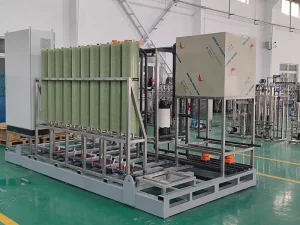
High-Salinity Wastewater ZLD System
View Specifications
Industrial Deoxygenation Contactors
View Specifications
Custom Wastewater Treatment Skids
View Specifications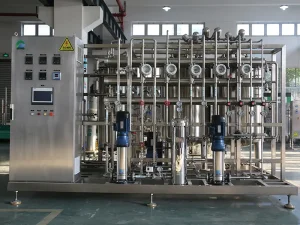
Pharmaceutical WFI Water Generation
View Specifications
API Production Purified Water Unit
View Specifications
Solar-Powered Off-Grid SWRO Units
View Specifications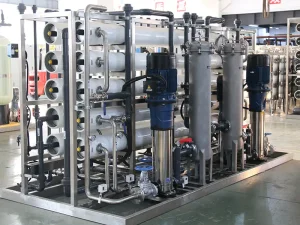
Osmosis-Assisted RO (OARO) System
View Specifications
Procurement & Technical FAQ
Frequently Answered Technical Questions
Direct technical explanations addressing common procurement concerns for CE-marked membrane water treatment skids.
What specific documentation is provided with CE-marked seawater desalination equipment?
Every CE-certified machine shipped by Shanghai Tongjie includes an official EU Declaration of Conformity referencing the Pressure Equipment Directive (2014/68/EU), Machinery Directive (2006/42/EC), and EMC Directive (2014/30/EU). Our technical file dossier contains material test certificates (EN 10204 3.1) for all wet components (duplex 2205/2507, titanium), hydrostatic test sign-offs, weld mapping with NDT reports, and localized risk assessment documentation under EN ISO 12100.
How does Tongjie tackle bio-fouling and high boron concentrations in standard seawater feed?
Raw open-ocean intakes can present high Silt Density Index (SDI) and microbiological challenges. Tongjie uses a dual-stage train: automated coagulant dosing with multi-media depth filtration, or pressurized ultrafiltration (UF) as pretreatment, maintaining SDI < 3. For boron reduction (required under WHO potable standards of < 0.5 mg/L), we engineer a specialized second pass with pH adjustment (dosing NaOH to reach pH 9.5-10.0), shifting uncharged boric acid into borate ions that are rejected at rates exceeding 99% by brackish water membranes.
What is the typical specific energy consumption (SEC) of your containerized SWRO units?
Using integrated isobaric pressure exchangers (such as PX devices) or turbochargers, energy from the high-pressure concentrate stream (55-70 bar) is directly transferred back into the feed stream at over 96% efficiency. This reduces overall specific energy consumption to 2.6 - 3.2 kWh per cubic meter of produced water, depending on seawater salinity (35,000 to 42,000 ppm) and water temperature profiles.
Can containerized SWRO systems operate unattended in remote offshore environments?
Yes. Tongjie skids incorporate industrial Siemens or Allen-Bradley PLCs linked with end-to-end SCADA telemetry via satellite or 4G/5G cellular modules. The automation loops manage variable feed pressures, run pre-shutdown permeate flushes to stop scale sedimentation, adjust chemical dosing based on temperature-corrected flux profiles, and alert off-site support teams to anomalies prior to membrane damage.
What is the lead time for customized containerized plants (100 m³/day to 2,000 m³/day)?
Standard containerized SWRO platforms (100 m³/d to 500 m³/d) are ready for wet FAT in Shanghai within 6 to 8 weeks. Larger modular arrangements (1,000 to 5,000 m³/d) or custom multi-train designs usually require 10 to 14 weeks from verified process design approval to factory shipping release, backed by our streamlined domestic component integration.