
Primary Desalination & High-Purity Equipment
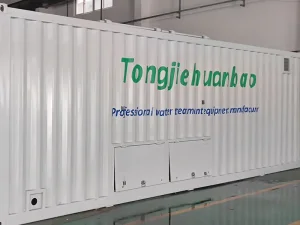
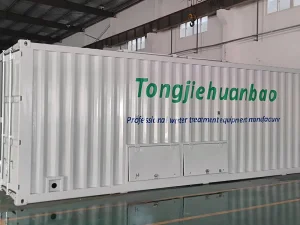
Explore our foundational range of turnkey containerized SWRO units, deoxygenation membranes, and industrial concentration modules.
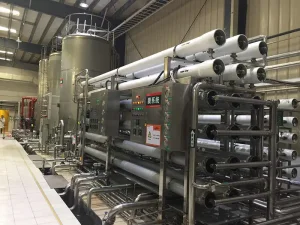
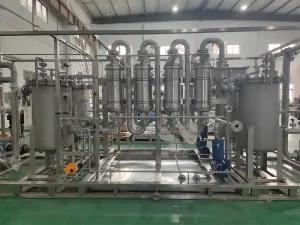
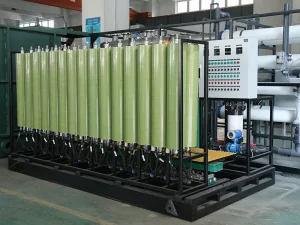
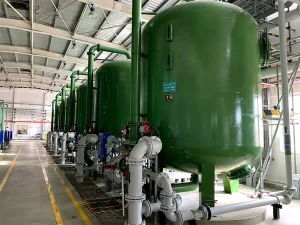
Transforming Seawater: The Macro Industrial Imperative
As groundwater depletion and hyper-salinization accelerate worldwide, seawater purification has shifted from an emergency drought fallback into fundamental utility infrastructure.
Energy Recovery Devices (ERD)
Utilizing high-efficiency isobaric ceramic pressure exchangers, we transfer mechanical energy from the concentrated brine stream directly to feed water, recouping up to 98% of hydraulic energy and lowering total kWh per cubic meter.
Metallurgical Integrity
Seawater environments generate aggressive chloride pitting. Tongjie systems are built using premium Super Duplex 2507 stainless steel and high-pressure FRP housings, completely preventing crevice corrosion under 70+ bar operations.
Boron & Ion Rebalancing
Standard SWRO permeate often contains excess boron exceeding WHO drinking guidelines. Our cascading secondary-pass RO arrays and calcite remineralization beds restore healthy minerals (Ca²⁺, Mg²⁺) while maintaining total dissolved solids under 200 mg/L.
Localized Scenarios & Compliance Assurance
From isolated island resorts in Southeast Asia to hyper-saline waters of the Arabian Gulf, Chinese manufacturing standards are adapted to meet localized compliance requirements.
Island Municipal Supply
Decentralized containerized SWRO units operate with turnkey solar integration. They bypass municipal supply disruptions to provide consistent, potable drinking water adhering strictly to WHO specifications.
Coastal Heavy Industry
Providing high-volume demineralized feed water for petrochemical refineries, thermal power generation cooling circuits, and metallurgical facilities needing uninterrupted feed water supply independent of municipal grids.
Offshore & Marine Operations
Vibration-proof, compact marine desalination equipment for cargo vessels, offshore drilling platforms, and marine barges. Engineered for automated high-salinity filtration under rough seas.
Global Standards Compliant
Fully compliant with CE Machinery & Pressure Directives, ISO 9001, ISO 14001, and ISO 45001. System instruments meet ASME, ASTM, and DIN standards, ensuring seamless integration for EPC global tenders.
The Engineering Roadmap: Next-Gen Desalination Tech
Tongjie’s dedicated R&D engineering center continues to pioneer zero-discharge and energy-saving desalination frameworks through structured milestones.
Ultrafiltration Pre-treatment
Deploying PVDF hollow fiber pressurized membranes to reduce feed water Silt Density Index (SDI < 2.5), insulating high-pressure RO elements from dynamic algal blooms.
High-Flux Nanocomposite RO
Graphene-enhanced polyamide membranes deliver superior anti-fouling characteristics, extending chemical cleaning intervals (CIP) from 3 months to over 9 months.
AI-Driven Flux Control
Intelligent SCADA systems with neural-network feedback algorithms analyze feed TDS, temperature, and transmembrane pressure in real time to regulate variable frequency pump drives.
Zero Liquid Discharge Brine Valorization
Integrating DTRO and STRO to squeeze brine concentration up to 160,000 ppm TDS, feeding into mechanical vapor recompression (MVR) for clean salt resource recovery.
Advanced Treatment & ZLD Product Fleet
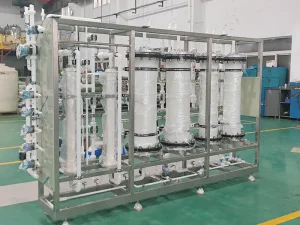
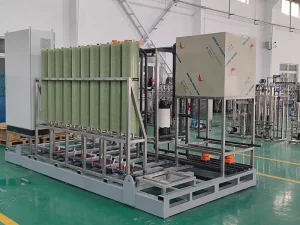
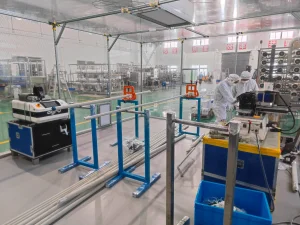
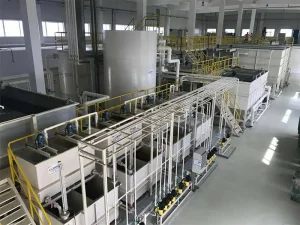
Explore our lineup of semiconductor-grade ultrapure systems, ZLD salt crystallizers, and custom OEM/ODM green treatment packages.
Technical Clarifications & Engineering FAQ
Critical knowledge regarding plant design parameters, intake dynamics, and operational expenditures for prospective plant operators.
How do Tongjie SWRO plants prevent biological fouling during Red Tide events?
Our containerized systems incorporate coagulant dosing coupled with dual-stage automated backwashing multimedia filters and ultrafiltration (UF) polishing. When biological loads spike, automated biocidal shock dosing (followed by sodium bisulfite neutralization) ensures the membrane SDI remains well below 3.0.
What specific materials are used to handle high chloride concentrations?
All high-pressure piping exposed to raw seawater is constructed from Super Duplex 2507 stainless steel (UNS S32750) or 904L, providing a Pitting Resistance Equivalent Number (PREN) > 42. Low-pressure manifolds utilize schedule 80 UPVC or PVDF to prevent galvanic and electrochemical corrosion.
Can containerized SWRO units run directly on off-grid solar energy?
Yes. Tongjie designs DC-coupled and hybrid solar-diesel SWRO modules. By incorporating Variable Frequency Drives (VFD) on high-pressure plunger pumps and dynamic membrane sequencing, the plant modulates water production in direct sync with variable solar irradiance curves.
What is the average specific power consumption (SEC) of the systems?
For standard open ocean seawater (TDS 35,000–38,000 ppm) operating at 25°C, our integrated isobaric energy recovery devices limit overall system power consumption between 2.7 to 3.2 kWh per cubic meter of clean drinking water produced.
How is membrane lifecycle managed under high operating temperatures?
Tropical and Middle Eastern seawater often reaches 38°C to 45°C. Our process designs adjust hydraulic recovery rates and deploy high-temperature membrane elements with reinforced feed spacers to prevent membrane compaction, yielding a predictable 3 to 5-year operational lifecycle.
What validation and export documentation is delivered with shipments?
Every industrial unit leaves our Shanghai factory with complete hydro-testing reports, factory acceptance testing (FAT) logs, non-destructive testing (NDT) reports for high-pressure welds, full electrical schematics, CE certification, and ISO quality conformity certificates.