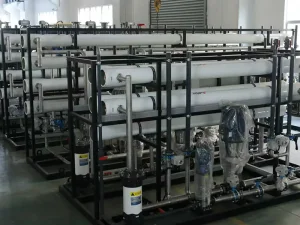
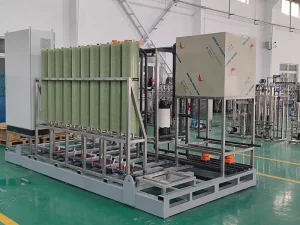
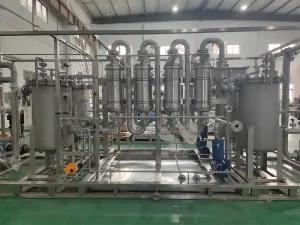
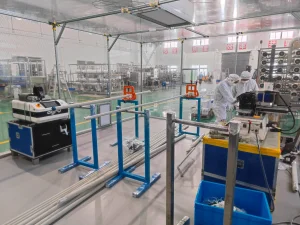
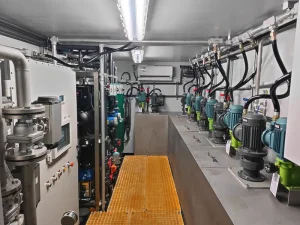
Precision Modular Desalination & Concentration Systems
Pre-engineered, factory-tested skids and containerized seawater treatment systems engineered for plug-and-play field deployment under harsh marine and industrial environments.
The Global Desalination Landscape: Shifting Paradigms to Modular SWRO
Addressing escalating coastal water deficits through high-recovery membrane architecture, energy recovery innovations, and vertically integrated fabrication networks.
Industrial Synthesis: According to global hydrological data, over 40% of the world's coastal population and heavy industrial complexes operate under severe baseline water stress. The transition from thermal multi-stage flash (MSF) evaporation to high-pressure Seawater Reverse Osmosis (SWRO) has decreased specific power consumption by more than 65%, rendering membrane separation the undeniable baseline for marine desalination worldwide.
Global Capacity Demands
Global installed desalination capacity exceeds 100 million cubic meters per day, driven by rapid urban expansion across MENA, Latin American mining operations, and island resorts across Southeast Asia and the Caribbean. High-efficiency reverse osmosis accounts for over 80% of newly commissioned municipal and industrial capacities.
China's Manufacturing Evolution
China has transitioned from an equipment-assembling region to an engineering design and innovation powerhouse. Domestic manufacturers like Shanghai Tongjie leverage complete manufacturing clusters, integrated R&D centers, and proprietary metallurgy fabrication to produce CE-certified, high-reliability SWRO skids that compete with European and US legacy brands on both quality and CAPEX.
Operational Energy Benchmarks
Modern SWRO engineering requires rigorous energy stewardship. Contemporary Chinese systems incorporate positive-displacement or high-pressure centrifugal pumps paired with isobaric Energy Recovery Devices (ERD), bringing specific energy consumption (SEC) down to 2.8 – 3.2 kWh/m³ of permeate produced, vastly lowering plant lifecycle OPEX.
Deep Process Architecture: Inside an Advanced SWRO Treatment Train
A multi-stage barrier philosophy designed to isolate aggressive chlorides, resist biofouling, and preserve membrane integrity across 5-7 year operational cycles.
1. Dynamic Pretreatment
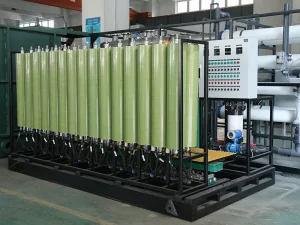
Seawater feed undergoes coarse screening, automatic backwash disc filtration, followed by Dissolved Air Flotation (DAF) and pressurized Ultrafiltration (UF) hollow-fiber modules. This eliminates silt, colloidal organics, and marine algae, ensuring a Silt Density Index (SDI15) consistently below 2.5.
2. High-Pressure SWRO Core
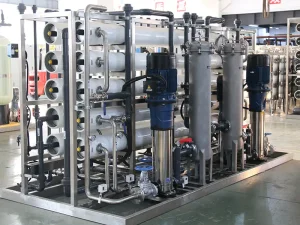
Equipped with Super Duplex Stainless Steel (2507 / 1.4410) high-pressure manifolds and ASME-certified FRP membrane vessels rated for 1,200 PSI. Thin-film composite polyamide SWRO elements provide high sodium chloride and boron rejection even in warm, high-salinity seawater.
3. Isobaric Energy Recovery
Rotary ceramic pressure exchangers or dual-work exchanger energy recovery units transfer hydraulic pressure from the concentrated reject brine directly to incoming feed with over 96% mechanical-hydraulic efficiency, dramatically cutting pump drive power requirements.
4. Remineralization & CIP
Permeate is balanced via calcite limestone contactors and carbon dioxide dosing to correct Langelier Saturation Index (LSI), paired with automated chemical-in-place (CIP) and low-pressure permeate flush skids that cycle during shutdowns to prevent scaling crystallization.
| Parameter / Specification | Standard Municipal Seawater RO | Industrial Ultra-Pure Demineralized RO | High-Salinity DTRO / ZLD Concentration |
|---|---|---|---|
| Raw Feed TDS Range | 32,000 – 45,000 mg/L (Seawater) | 500 – 3,000 mg/L (Brackish / Well) | 60,000 – 140,000 mg/L (Brine / Flowback) |
| Operating Pressure Matrix | 55 – 75 bar (800 – 1100 psi) | 12 – 20 bar (175 – 290 psi) | 90 – 160 bar (1300 – 2300 psi) |
| System Hydraulic Recovery | 40% – 50% single stage | 75% – 85% double pass | 70% – 85% (volume reduction) |
| Metallurgy Classification | Super Duplex 2507 / SMO 254 | SS304 / SS316L Sanitary Grade | Hastelloy C-276 / High-Grade Titanium Gr.2 |
| Permeate Water Quality | WHO Drinking Potable (<300 μS/cm) | Demineralized (<0.1 μS/cm with EDI) | Distillate / Pure Brine for Crystallizer |
Localized Real-World Applications: Engineered for Severe Geographies
From isolated island resorts cut off from public grids to remote desert oilfields and mega-petrochemical complexes requiring uninterrupted water supply.
Islands & Remote Coastal Resorts
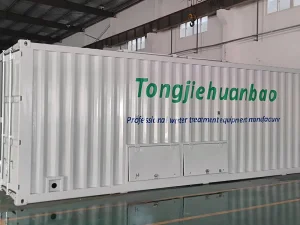
Containerized 20ft and 40ft standard ISO footprint plants. Self-contained acoustic insulation, marine-grade epoxy coatings, integrated diesel or PV solar tie-in, delivering 50 to 1,500 m³/day without complex civil works.
Offshore Platforms & Vessels
Explosion-proof ATEX / IECEx certified skids designed to withstand continuous pitch-and-roll motion, marine atmospheric corrosion, and compact footprint constraints for deep-sea oil platforms and maritime vessels.
Thermal & Green Hydrogen Power
Supplying continuous high-purity boiler feedwater and proton-exchange membrane (PEM) electrolyzer feeds via integrated SWRO → Brackish RO → Electro-deionization (EDI) polishing skids with ultra-low conductivity (<0.06 μS/cm).
Coastal Mining & Mineral Slurry
Heavy-duty, high-turbidity tolerant desalination skids designed for hyper-arid mineral extraction regions (such as Chile's Atacama and Western Australia), supporting mineral separation and copper-lithium processing.
Emergency Potable Infrastructure
Rapid-response, skid-mounted RO trailers deployed for military camps, humanitarian disaster relief, or seasonal drought emergencies, capable of producing potable water within 24 hours of on-site electrical connection.
China's Supply Chain Resilience: Engineering Superiority & CAPEX Precision
How localized industrial clusters in Shanghai and the Yangtze River Delta deliver uncompromised international build quality with superior project velocity.
Complete Industrial Ecosystem
Direct proximity to specialized steel casting, precision CNC machining, high-pressure piping fabricators, and certified pressure vessel manufacturers eliminates tier-2 supply chain bottlenecks, shortening production lead times by 30–50% compared to fragmented western operations.
Tier-1 Component Harmonization
Tongjie integrates global benchmark components (Danfoss / FEDCO pumps, DuPont / Toray / Hydranautics membranes, ERI pressure exchangers, Siemens / Schneider PLC controls) onto structural frames engineered and welded to ISO 3834 and EN 1090 standards.
Optimized Total Cost of Ownership
System capital expenditures (CAPEX) are 30% to 45% more competitive than European or North American equivalents. Low fabrication overhead, combined with optimized hydraulic design that minimizes membrane fouling, leads directly to lower lifetime cost per cubic meter of clean water.
Technological Roadmap: The Next Era of Sustainable Desalination
Pioneering low-carbon, AI-driven, and near-zero liquid discharge membrane methodologies for next-generation resource stewardship.
Direct Photovoltaic Coupling
Eliminating heavy battery bank investments by coupling variable-frequency drives (VFD) directly with variable solar PV and offshore wind output. Systems dynamically throttle membrane feed flow and isobaric loops to follow clean energy curves in real time.
Hypersaline OARO & DTRO
Integrating Osmosis-Assisted Reverse Osmosis (OARO) and high-pressure Disc Tube RO (DTRO) up to 160 bar, pushing reject brine concentrations beyond 140,000 ppm TDS to shrink downstream thermal crystallizer sizing in Zero Liquid Discharge (ZLD) configurations.
Graphene & Biomimetic Membranes
Collaborating with academic research institutes on covalent organic frameworks (COF) and aquaporin-embedded thin films that demonstrate double the water flux of classical polyamide layers with higher monovalent ion selectivity.
AI Digital Twin Cloud SCADA
Continuous edge-computing telemetry monitors normalized permeate flux, differential pressure (ΔP), and temperature-corrected conductivity, dynamically calculating mineral scaling risks and scheduling automated CIP cycles to eliminate human operational error.
International Compliance, Rigorous FAT & Global Support
Ensuring that every containerized desalination skid meets rigid European and American engineering standards before it leaves our manufacturing floors.
Certified Quality Systems
Operating under certified ISO 9001 (Quality Management), ISO 14001 (Environmental Systems), ISO 45001 (Occupational Safety), and complete CE conformity marking covering Machinery Directive 2006/42/EC and Low Voltage Directive 2014/35/EU.
100% Full-Load FAT Protocols
No container leaves our factory uncommissioned. Systems undergo a 72-hour hydraulic pressure test, helium leak validation on high-pressure manifolds, full electrical insulation tests, and live PLC simulation under simulated salinity profiles.
Worldwide Field Engineering
Supported by Tongjie's global field network. We provide bilingual commissioning engineers, standardized spare parts kits (O-rings, cartridges, high-pressure seals), and 24/7 cloud telemetry connectivity across the Middle East, Central Asia, and the Americas.
Frequently Asked Questions: Technical & Procurement Insights
Detailed engineering clarification on selecting, sizing, importing, and operating Chinese membrane seawater desalination systems.
Boron in standard seawater exists primarily as non-ionized boric acid (H3BO3) at natural pH (7.8 - 8.2), which passes through standard RO membranes. To meet the stringent WHO drinking guideline of <0.5 mg/L (or <1.0 mg/L in arid regions), our engineering team implements a specialized two-pass design or a split-stream second pass where pH is elevated to 9.5–10.0 using food-grade sodium hydroxide. At this elevated pH, boric acid dissociates into ionized borate (B(OH)4-), which standard polyamide RO membranes reject at rates exceeding 98%.
Standard SS304 or even SS316L will suffer catastrophic pitting and crevice corrosion under high chloride exposure (>19,000 mg/L Cl-) and pressures above 50 bar. Tongjie standardizes on Super Duplex Stainless Steel (2507 / EN 1.4410 / UNS S32750) with a Pitting Resistance Equivalent Number (PREN) > 42 for all high-pressure piping, fittings, and valves. For low-pressure seawater intake sections, high-grade UPVC, Polypropylene (PP), or Super Austenitic 254SMO is used, eliminating corrosion risks.
Because containerized units are fully prefabricated, pre-wired, and fully wet-tested (FAT) in our Shanghai plant, on-site commissioning typically takes just 3 to 7 working days. The client only needs to provide a level concrete pad, connect the raw seawater feed intake line, link the brine discharge and clean permeate delivery piping, and connect the primary 3-phase power supply.
With robust ultrafiltration pretreatment maintaining SDI15 < 2.5 and automated low-pressure permeate flush cycles upon system shutdown, membrane elements achieve an operational lifespan of 5 to 7 years. High-pressure positive displacement or centrifugal pumps built with Duplex / Super Duplex metallurgy feature MTBF (Mean Time Between Failures) ratings exceeding 40,000 hours with standard bearing and seal service intervals.
Yes. Tongjie regularly acts as an engineering manufacturing partner (OEM/ODM) for global engineering firms and regional water treatment brands. We provide customized container graphics, branded HMI screens in multiple languages (English, French, Spanish, Russian, Arabic), specified component brands, and complete engineering documentation packages (P&ID, 3D CAD, electrical schematics, CE conformity certificates).
For contemporary systems utilizing isobaric ceramic pressure exchangers (such as ERI or Danfoss iSave), total plant specific energy consumption ranges between 2.8 and 3.4 kWh per cubic meter of potable permeate produced, depending on raw water temperature and salinity (35,000 to 42,000 ppm TDS). Systems without energy recovery consume between 6.5 and 8.5 kWh/m³, highlighting why energy recovery devices are standard across all Tongjie configurations.
High-Efficiency Brine Concentration & Pure Water Technology
Specialized physical degassing, oilfield flowback reuse, and advanced OARO membrane concentration equipment engineered to conquer hypersaline industrial wastewater.