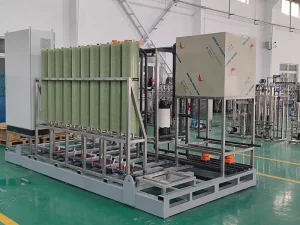
Standard & Modular Engineered Systems
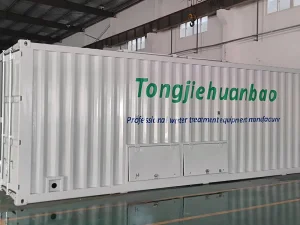
Pre-engineered containerized reverse osmosis skids and brine concentration solutions built for rapid field deployment.
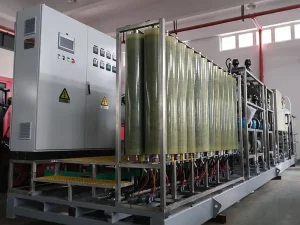
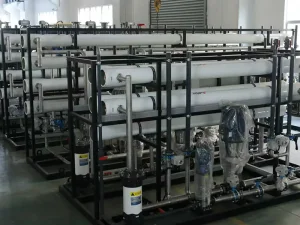
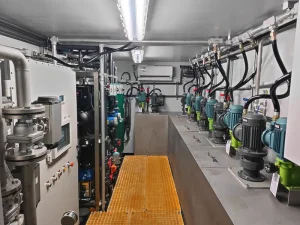
Global Landscape of Desalination & ODM Manufacturing
Evaluating multi-stage membrane separation, dynamic thermodynamic barriers, and the macro transition toward decentralized coastal infrastructure.
Across arid coastal territories, GCC member states, North African municipal corridors, and maritime industrial centers, water scarcity has transitioned from an environmental hurdle to an existential operational threat. Conventional thermal desalination paradigms (such as Multi-Stage Flash and Multi-Effect Distillation) are increasingly retired in favor of high-recovery Seawater Reverse Osmosis (SWRO) architectures due to their substantially lower Specific Energy Consumption (SEC)—now consistently driven down from >6.0 kWh/m³ to sub-2.8 kWh/m³ via advanced isobaric Energy Recovery Devices (ERD).
However, the global desalination and wastewater reclamation sectors face compounding technical bottlenecks: accelerated biofouling from oceanic red tides, high Total Dissolved Solids (TDS exceeding 45,000 ppm in regions like the Arabian Gulf and Red Sea), hyper-saline blowdown discharge challenges, and complex organic loading in oilfield stimulation and industrial effluents. Addressing these operational realities requires a fundamental shift from off-the-shelf equipment assembly toward engineered, Original Design Manufacturing (ODM) seawater desalination ecosystems built from corrosion-resistant metallurgy (Super Duplex 2507, 1.4410), precision hydrodynamic design, and automated Clean-In-Place (CIP) mechanics.
Severe Environment SWRO
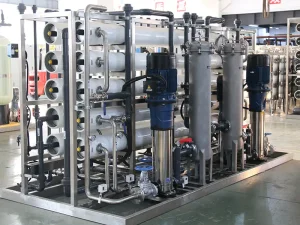
Engineered for high-temperature, hyper-saline oceanic feedstocks. Systems leverage high-rejection aromatic polyamide membranes paired with ceramic rotary energy exchangers to secure a steady permeate salinity below 200 ppm even with 45,000 ppm TDS inlet.
DTRO & High-Pressure Osmosis
Disc Tube Reverse Osmosis (DTRO) and Osmosis-Assisted Reverse Osmosis (OARO) engineered to overcome osmotic pressure limitations, concentrating refractory wastewater brines up to 120,000–160,000 ppm TDS without premature scaling.
Thermal ZLD Integration
Pre-concentrated brines transition downstream into automated MVR (Mechanical Vapor Recompression) and forced-circulation crystallizers, producing dry salt cakes and high-purity distilled condensate for closed-loop industrial reuse.
Localized Applications & Technology Roadmap
Field-proven engineering matrices implemented across varying geopolitical and hydrological landscapes.
| Application Domain | Feed Water Characteristics | ODM Technical Process Train | Achieved Water Standard | Operational Lifetime |
|---|---|---|---|---|
| Remote Islands & Resorts | TDS 35,000–42,000 ppm, fluctuating algae/turbidity | Containerized DAF + Dual-Stage Ultrafiltration + SWRO + Calcite Remineralization | WHO Potable Standard (TDS < 300 ppm, Boron < 0.5 ppm) | 20+ Years (Duplex Steel Wetted Parts) |
| Offshore Oil & Gas Platforms | Seawater + Produced water with free/dissolved hydrocarbons | Coalescence De-oiling + Ceramic Microfiltration + 80-bar SWRO Skid | Utility/Turbine Injection Quality (Oil < 5 ppm, SS < 1 ppm) | Continuous Unmanned 24/7 Automation |
| Coastal Chemical Complexes | Raw seawater + high organic backwash contaminants | UF + Double-Pass SWRO + Electrodeionization (EDI) Polish | High-Pressure Boiler Feed (Resistivity > 16 MΩ·cm, SiO₂ < 10 ppb) | 15–20 Years with Factory CIP Protocols |
| Shale Gas & Oilfield Stimulation | Hydraulic fracturing flowback, heavy metals, TDS > 80,000 ppm | Flocculation Softening + Multi-Media + High-Pressure DTRO + MVR Evaporator | Reinjection & Zero Liquid Discharge (ZLD Solid Salt Recovery) | Modular Skid Relocatable per Wellpad |
Digital Twin & Hybrid SWRO
Integration of IoT-driven predictive membrane flux monitoring, auto-dosing antiscalants based on real-time scaling indices (LSI/S&DSI), and factory-integrated solar/wind off-grid hybrid power skids.
Electrically Driven Separation
Adoption of Low-Salt Rejection RO (LSRRO) and Electrodialysis Metathesis (EDM) to selectively concentrate divalent salts, dramatically cutting thermal evaporator sizing in industrial ZLD projects.
Resource-Mining Desalination
Brine-to-chemical technology extracting battery-grade lithium, high-purity magnesium hydroxide, and caustic soda directly from SWRO concentrate, transforming desalination from cost center to revenue generator.
Chinese Supply Chain Resilience & Factory Advantages
Why Tier-1 global EPCs rely on specialized ODM facilities for large-scale containerization and membrane skid fabrication.
Navigating the capital-intensive world of desalination requires reconciling stringent engineering tolerances with compressed capital expenditure cycles. Shanghai and the broader Yangtze River Delta manufacturing corridor represent the world's most concentrated ecosystem for pressure vessels, automated robotic orbital welding, duplex machining, and control integration. Our facility in Jiading, Shanghai, leverages this high-density industrial cluster to reduce component procurement lead-times by over 45% compared to Western European or North American skid builders.
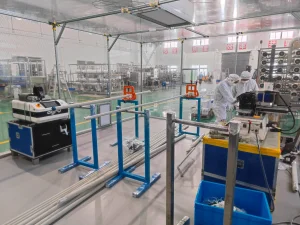
Furthermore, complete vertical integration—from structural skid blasting and polyurethane marine-grade coating to pressure piping fabrication under ASME Boiler and Pressure Vessel Code Section VIII and IX—guarantees that every high-pressure spool, manifold, and DTRO stack undergoes 100% radiographic weld testing, hydrotesting at 1.5x design pressure, and pre-commissioning wet Factory Acceptance Tests (FAT) using calibrated saline test beds.
International Certifications & Localization Framework
Engineering built to harmonize with international EPC standards, stringent local environmental regulations, and electrical codes.
ASME, CE & ISO Ecosystem
Fully compliant with CE Machinery Directive (2006/42/EC), Low Voltage Directive, and Pressure Equipment Directive (PED 2014/68/EU). Certified under ISO 9001 (Quality), ISO 14001 (Environmental), and ISO 45001 (Safety).
Electrical & PLC Adaptability
Controls built to client electrical specifications: 380V/400V/480V at 50Hz or 60Hz. Standard integration with Siemens S7-1500, Allen-Bradley ControlLogix, or Schneider PLC platforms with multi-lingual HMI (English, Spanish, Arabic, Russian).
Lifecycle Spares & Telemetry
Every containerized plant features edge-computing telemetry for remote technical diagnostics, alongside standardized wear-and-tear consumables (cartridges, seals, chemical dosing lines) available via bonded warehousing hubs globally.
Frequently Asked Technical Questions
Detailed technical responses addressing design parameters, material selections, and deployment logistics.
What engineering data is strictly required to quote an ODM seawater desalination system?
- Comprehensive Raw Water Chemistry: Total Dissolved Solids (TDS), pH, temperature ranges (min/max), specific ions (Chlorides, Sulfates, Calcium, Magnesium, Silica, Iron, Boron, and Barium/Strontium).
- Physical Loading: Turbidity, Silt Density Index (SDI₁₅), Total Suspended Solids (TSS), and Oil/Grease content if industrial or near-port seawater.
- Product Water Metric: Target daily production volume (m³/day), target permeate TDS, drinking water criteria (WHO/local standards), or industrial pure water conductivity (µS/cm).
- Power Supply & Footprint: Voltage, frequency (50/60Hz), available layout area, and skid-mounted vs. weather-insulated high-cube containerized configuration.
How does Tongjie manage high boron levels common in Middle Eastern and Mediterranean seawater?
What metallurgy and piping standards are selected to combat pitting and crevice corrosion?
What makes Disc Tube Reverse Osmosis (DTRO) superior for fracturing flowback & high-salinity ZLD?
Can containerized SWRO units operate completely off-grid with renewable solar or wind sources?
High-Recovery & Industrial Process Catalog
Specialized high-pressure membrane concentration, flowback reclamation, and ultrapure pharmaceutical water systems.