
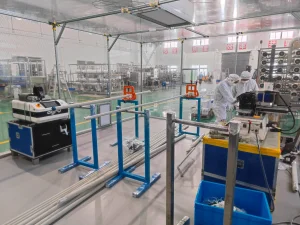
CE Certification Eco-Friendly Water Treatment Solutions - ODM Services from China Suppliers & Factory
View Specifications
Standardized modular configurations and custom-tailored industrial water infrastructure engineered for severe marine and extreme environmental conditions.
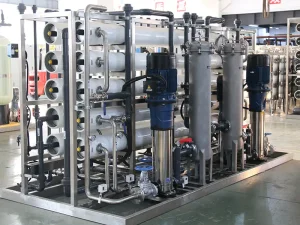
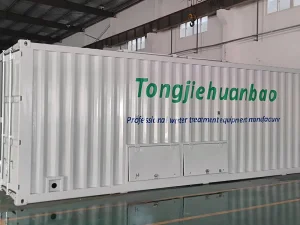
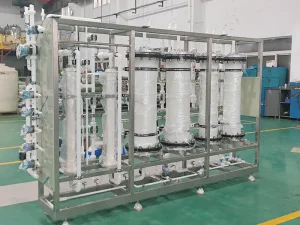
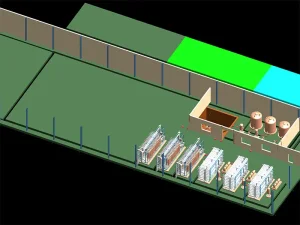
As escalating global climate volatility compromises riparian aquifers and surface freshwater reserves, seawater reverse osmosis (SWRO) has transitioned from an emergency mitigation mechanism to a baseline civil infrastructure asset. Across municipal councils, off-grid islands, green hydrogen production centers, and heavy processing complexes, the requirement for uninterrupted, high-potability water is paramount.
The historical barrier of high operational expenditure (OPEX) in SWRO has been effectively dismantled. Integration of isobaric energy recovery devices (ERD) with efficiencies exceeding 98%, paired with state-of-the-art variable frequency drive (VFD) positive displacement pumps, routinely drives SEC to less than 2.8 kWh per cubic meter of purified water.
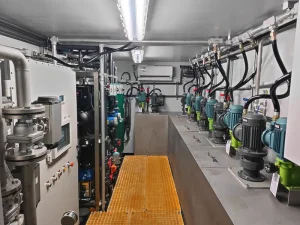
Capital asset owners are pivoting away from complex civil megaprojects requiring multi-year site works. Prefabricated containerized water filtration arrays provide a "plug-and-produce" paradigm that slashes civil lead times by up to 70%, facilitating rapid scale-up and relocatability in remote coastal developments.
By leveraging automated chemical dosing, Disc Tube Reverse Osmosis (DTRO), and advanced continuous biological suppression techniques, modern membrane longevity is extended from 3 years to over 6 years, even when operating in high-turbidity red-tide or Gulf seawater environments.
Procurement teams do not merely buy membranes and pressure vessels; they procure certainty of water purity, strict life-cycle compliance, and robust metallurgical integrity against aggressive chlorides.
Key concerns surround FAT (Factory Acceptance Testing) veracity, pre-wired instrumentation, comprehensive documentation packages (P&ID, 3D GA drawings, electrical schematics), and interface compatibility with master DCS via Profibus, Modbus, or Ethernet/IP.
Operating in hyper-arid zones such as the Atacama or Pilbara demands high availability, unassisted autonomous controls, and heavy-duty pre-filtration capables of absorbing silt surges without blinding core SWRO elements.
Prioritizing strict adherence to WHO Guidelines for Drinking-water Quality, these clients emphasize boron reduction (<0.5 mg/L), natural remineralization (calcite contactors), and near-silent operation footprints.
Shanghai Tongjie merges automated fabrication routines with rigorous quality oversight to drive unprecedented value into global water infrastructure. Here is how our production engine eliminates typical cross-border supply chain bottlenecks:
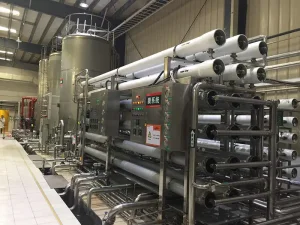
Seawater corrosion is ruthless. Tongjie enforces automated orbital TIG welding for Super Duplex Stainless Steel (UNS S32750/S31803) and 254SMO high-pressure manifolds, accompanied by 100% radiographic weld inspections and hydrostatic testing at 1.5x operating pressures.
We source core components directly through established OEM partnerships: Danfoss high-pressure pumps, Energy Recovery Inc. (ERI) Q-Series isobaric exchangers, DuPont FilmTec or Toray membranes, and Siemens/Schneider PLC hardware.
Prior to container closure, systems run full wet tests in our Shanghai staging facility. Pressure thresholds, salt rejection metrics, instrument loops, safety interlocks, and remote cloud connectivity are validated and certified before dispatch.
Years Engineering Experience
Invention & Utility Patents
Membrane Salt Rejection Rate
Projects Installed Globally
Different feedwaters impose vastly unique scaling, microbiological, and thermodynamic parameters. Tongjie custom designs the pretreatment and membrane passes according to specific chemical assays.
| Application Environment | Raw Water TDS | Primary Challenges | Recommended Process Train | Permeate Quality Target |
|---|---|---|---|---|
| Red Sea & Middle East Coastal | 42,000 – 46,000 ppm | Extreme salinity, high water temp (>35°C), boron concentrations. | Coagulation + DAF + Ultrafiltration (UF) + SWRO (2-Pass with ERD) | TDS < 200 ppm, Boron < 0.4 mg/L (WHO Potable) |
| Island Tourism & Resort Resorts | 32,000 – 36,000 ppm | Acoustic sensitivity, limited spatial footprint, seasonal peak variations. | Multi-Media Filtration (MMF) + Cartridge Microfiltration + Compact SWRO | TDS < 300 ppm, remineralized for taste (pH 7.2 - 7.6) |
| Offshore Oil/Gas & Marine Vessels | 35,000 ppm | Severe pitch/roll dynamics, high vibration, non-hazardous area zoning. | Skid-mounted anti-corrosion Duplex SWRO + Explosion-proof motors | TDS < 500 ppm boiler/drinking dual service |
| Mining & Remote Camp Facilities | Up to 40,000 ppm | Unreliable electrical grid, high sand/silt content, harsh logistics. | Solar PV hybrid container + Disc Tube RO (DTRO) + Auto-backwash | TDS < 400 ppm for human consumption & machinery wash |
Addressing the precise calculation parameters, metallurgies, and operational guidelines required by plant directors and technical buyers.
With isobaric Energy Recovery Devices (ERD) from suppliers like ERI or Danfoss, our typical power consumption ranges from 2.5 to 3.2 kWh/m³ depending on feed temperature, seawater salinity, and system recovery rates. Conventional systems without ERD consume between 6.0 and 8.0 kWh/m³.
Standard single-pass RO membranes reject approximately 85-90% of non-ionized boron at natural seawater pH (approx. 8.0-8.2). To achieve the WHO threshold (<0.5 mg/L), we design a second pass with slight pH elevation (caustic dosing up to pH 9.5-10.0), shifting boric acid to negatively charged borate ions that are rejected at >99% efficiency.
All high-pressure piping exposed to raw seawater is constructed from Super Duplex Stainless Steel (UNS S32750/S31803) or 254SMO, demonstrating a Pitting Resistance Equivalent Number (PREN) > 42. Low-pressure brine loops use non-metallic options such as schedule 80 PVC, FRP, or PVDF.
Yes. Tongjie engineers dynamic containerized plants featuring variable frequency drives that modulate high-pressure pump speeds based on direct solar array production, or integrate seamlessly with LiFePO4 battery banks and backup diesel gensets for 24/7 continuous water extraction.
Standard modular containerized systems (e.g., 100 m³/day to 1,000 m³/day) feature a factory production cycle of approximately 6 to 8 weeks. Custom engineering skids requiring exotic metallurgies or hazardous-area electrical designs are generally delivered within 10 to 14 weeks.
Every Tongjie unit features an integrated Siemens PLC paired with an industrial 4G/5G/Satellite modem. Operators monitor live trans-membrane differential pressures, normalized permeate flux, conductivity, and temperature via cloud dashboards, complete with predictive anti-scaling alarms.
Discover our specialized physical degassing membranes, oilfield fracturing flowback systems, and compact mobile desalination units ready for ODM customization.
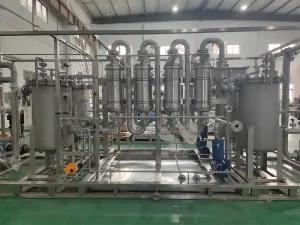
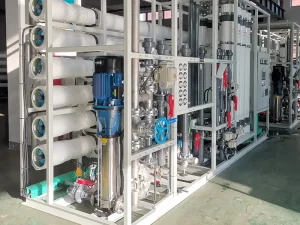
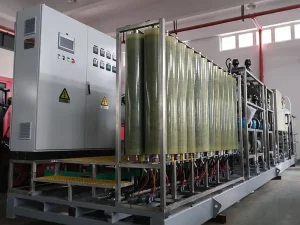
Receive a comprehensive projection document complete with ROSA/WAVE mass balance calculations, specific energy requirements, ISO container footprint layouts, and full bill-of-materials pricing within 48 business hours.