
High-Performance Membrane & Desalination Systems
Engineered and factory-commissioned at our Shanghai facility. Ready for rapid global deployment across severe coastal, offshore, and high-salinity industrial applications.
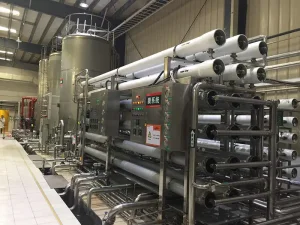
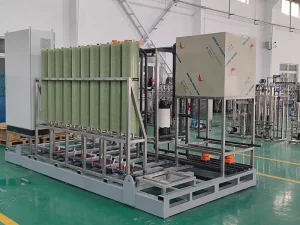
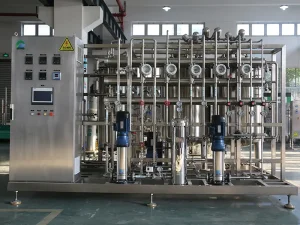
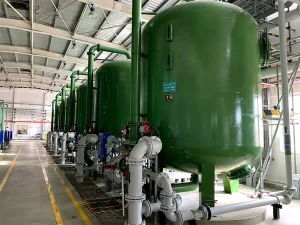
Architecting Resilient Coastal & Industrial Fresh Water Infrastructures
In an era characterized by escalating water stress, hyper-saline groundwater intrusion, and rigorous industrial environmental audits, Seawater Reverse Osmosis (SWRO) has transitioned from an emergency contingency to a baseline infrastructural asset. As a premier original design manufacturer (ODM) and engineering factory headquartered in Shanghai, Shanghai Tongjie Environmental Protection Technology Co., Ltd. (established in 2010) integrates fundamental membrane science with robust skid prefabrication. We deliver turnkey, skid-mounted, and containerized SWRO plants tailored for international EPC contractors, off-grid island utilities, marine vessels, and heavy industrial facilities.
Industrial procurement executives face complex challenges: shifting feedwater salinity (from standard 35,000 ppm marine water to 45,000+ ppm in the Arabian Gulf and Red Sea), severe seasonal biofouling (red tide dinoflagellate blooms), energy price volatility, and aggressive electrochemical corrosion. Successfully addressing these demands requires an ODM partner capable of executing advanced computational modeling, selecting metallurgy capable of resisting localized pitting (PREN ≥ 40), configuring isobaric Energy Recovery Devices (ERD) with >97% kinetic energy transfer efficiency, and ensuring stringent compliance with ISO 9001, ISO 14001, ISO 45001, and CE standards.
Feed Water Salinity Agility
Our SWRO trains are engineered to operate across broad Total Dissolved Solids (TDS) spectrums ranging from 30,000 mg/L to 55,000 mg/L. Variable frequency drives (VFD) and automated flux management counteract osmotic pressure spikes without exceeding membrane compaction thresholds.
Energy Optimization Systems
Integrating ceramic rotary isobaric pressure exchangers recovers hydraulic pressure directly from concentrated brine. By routing rejected energy back to high-pressure pump suctions, net specific energy consumption (SEC) drops below 2.8 kWh/m³, reducing OPEX across long lifecycle runs.
Premium Marine Metallurgy
All wetted high-pressure piping, manifolds, and valving utilize Super Duplex Stainless Steel (2507 / UNS S32750) or 2205 Duplex with guaranteed PREN values ≥ 42. Non-wetted structural frames receive marine-grade 3-coat epoxy systems resilient against coastal salt mist.
Engineering Standards, Metallurgy & Tender Verification
A rigorous breakdown of key parameters, chemical dosage profiles, and mechanical criteria required by tier-one EPC consultants and industrial utility managers.
Overseas procurement teams often encounter project delays due to underspecified feed-water parameters or mismatch between membrane flux assumptions and real-world fouling indices. In hot, high-turbidity regions such as the Persian Gulf or Southeast Asia, water temperature swings between 15°C and 42°C profoundly shift both permeate salt passage and net driving pressure. Shanghai Tongjie’s engineering team calculates multi-scenario projections to guarantee that the delivered system meets regulatory potable thresholds (WHO Guidelines for Drinking-water Quality, GSO 149/2014) or rigorous industrial boiler-feed standards across its entire design life.
| Process Stage | Critical Parameters | Standard Metallurgy / Material | Operational Metric & Target |
|---|---|---|---|
| Intake & Coagulation | TSS ≤ 50 ppm, Turbidity ≤ 25 NTU, SDI15 ≤ 6.5 | Non-metallic GRP / HDPE / Super Austenitic | Dosing of FeCl3 or coagulant aid; flash mixing gradient G > 800 s-1 |
| Pretreatment Filtration | Multi-Media Filtration (Sand/Anthracite) + Ultrafiltration (UF) | FRP Vessels, Polyvinylidene Fluoride (PVDF) hollow fiber | Filtrate SDI15 < 2.5; Turbidity < 0.1 NTU continuous output |
| Cartridge Polishing | 5-Micron Melt-Blown Polypropylene Depth Filter | Super Duplex 2507 (UNS S32750) or 316L (low pressure) | Differential pressure alert set at ΔP = 1.0 bar; prevents particulate breakthrough |
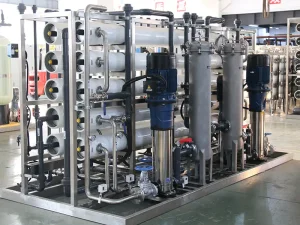
| High-Pressure Pumping | Operating Pressure: 55 to 82 bar (800 to 1200 psi) | 2507 Super Duplex fluid end, Duplex 2205 shaft | VFD-driven axial piston or multi-stage centrifugal with >82% wire-to-water efficiency |
| Membrane Separation | Polyamide Thin-Film Composite (TFC) SWRO elements | ASME Section X certified FRP pressure vessels (1000/1200 psi) | Flux: 12 - 14.5 LMH; Salt rejection 99.75% to 99.85%; Boron rejection > 92% |
| Energy Recovery (ERD) | Isobaric Pressure Exchanger / Turbocharger | High-purity Alumina Ceramic rotor & sleeve | Energy transfer efficiency 96.5% - 98.2%; hydraulic mixing rate < 3.5% |
| Post-Treatment & Remineralization | Calcite / Limestone Contactor Bed + CO2 + ClO2 | Epoxy-lined carbon steel or food-grade 316L / HDPE | Langelier Saturation Index (LSI): 0.0 to +0.3; pH adjusted to 7.8 - 8.2 |
Boron & Bromide Attenuation
Standard single-pass RO frequently passes up to 1.5 - 2.5 mg/L Boron in high-temperature seawater. Tongjie configures split-pass or double-pass partial treatment loops with caustic dosing (pH 9.5 - 10.2) to convert uncharged boric acid into borate ions, securing permeate Boron < 0.5 mg/L.
Predictive Antiscalant Delivery
Advanced digital monitoring tracks the saturation index of sparingly soluble salts (CaSO4, BaSO4, SrSO4, and Silica). Micro-metering pump arrays deliver threshold-inhibiting polymers under proportional control, avoiding premature scaling during seasonal brine concentration.
Automated CIP & Flushing
Every skid is outfitted with automated low-pressure permeate flush cycles that trigger upon shutdown, displacing saline water before osmotic draw can trigger irreversible fouling. Fully integrated Clean-In-Place (CIP) skids feature heating, neutralization, and circulation tanks.
Containerized Plug-and-Play vs. Civil Plant Engineering
Optimizing plant footprints, acoustic insulation, thermal regulation, and structural modularity for fast-track international commissioning.
Containerized Modular SWRO (100 - 3,000 m³/d)
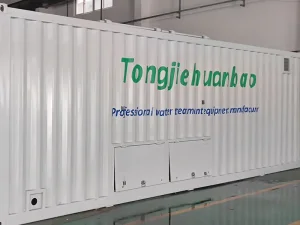
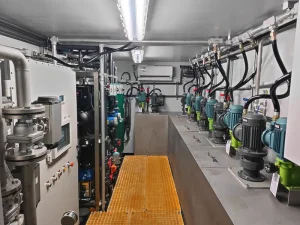
Constructed inside 20-ft or 40-ft High-Cube shipping containers reinforced with polyurethane insulation, marine air-conditioning, non-slip vinyl flooring, and interior LED lighting. Prefabricated, wired, and factory-tested (FAT) in Shanghai; requires only power and water hookups upon site arrival.
Skid-Mounted Municipal / EPC Subsystems
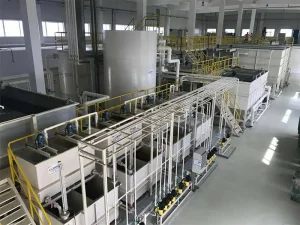
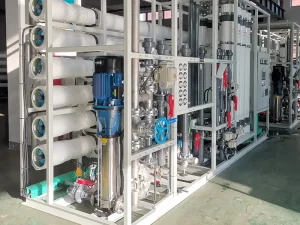
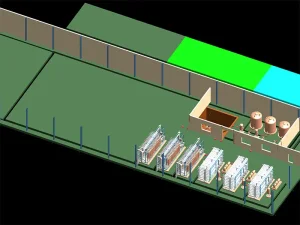
Designed for installation within pre-engineered building envelopes. Modules are built on structural stainless steel or hot-dip galvanized skids with anti-vibration spring isolators, high-pressure piping manifolds, and distributed I/O control junction boxes connecting to central plant SCADA.
Integrated ZLD & High-Salinity Hybrids
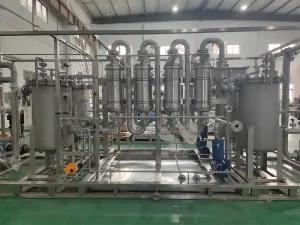
Bridging conventional desalination with zero liquid discharge (ZLD). Rejects from primary SWRO stages are concentrated using Disc Tube Reverse Osmosis (DTRO) or Osmosis-Assisted Reverse Osmosis (OARO) up to 120,000+ ppm TDS, minimizing thermal evaporator sizing and capital load.
R&D Roadmap: Next-Generation Desalination Horizons
Pushing the thermodynamic limits of reverse osmosis through smart AI control, novel membrane chemistry, and 100% renewable-powered microgrids.
Graphene & Biomimetic Membranes
Collaborating with academic research centers to test Aquaporin-inside and graphene-oxide functionalized thin films. These materials provide 2.5x greater water permeability with equal salt rejection, lowering operating pressure requirements.
Off-Grid Solar/Wind Interfacing
Dynamic variable-frequency SWRO controllers adapt dynamically to fluctuating photovoltaic and wind power outputs. Operating without battery storage banks, automated ramping buffers solar intermittency via variable feed-rate modulation.
AI Neural-Network Predictive Ops
Onboard edge controllers run neural networks trained on pressure drop (ΔP), temperature, and normalized permeability. The system predicts biofouling 14 days in advance, automating preventive chemical cleaning before membrane degradation occurs.
Brine Mining & Resource Recovery
Integrating nanofiltration fractionation with secondary RO concentration to selectively isolate calcium, magnesium, and lithium salts from SWRO brine streams, turning discharge compliance costs into valorized mineral by-products.
Commercial Adaptations Across Severe Environments
From high-temperature Arabian Gulf petrochemical hubs to remote Pacific island resorts and extreme-cold Central Asian operations.
Middle East GCC & Red Sea Petrochem
Feed waters consistently reach 45,000 - 48,000 ppm TDS with ambient temperatures reaching 50°C. Plants feature specialized heavy-duty air conditioning, solar heat-reflective exterior coatings, continuous chlorination-dechlorination loops, and ultrafiltration guards that endure severe coastal red-tide events.
Island Resorts & Off-Grid Marine Municipalities
Space constraints, noise regulations (< 65 dBA at 1 meter), and visual footprint limitations govern these deployments. Tongjie containerized systems incorporate acoustic dampening panels, low-vibration flexible Couplings, and complete calcite remineralization beds to supply water suitable for immediate culinary use.
Mining, Smelting & Coastal Heavy Industry
Supplying boiler feedwater, cooling tower make-up, and chemical formulation water in coastal mineral processing zones. Secondary RO polishing with continuous Electro-deionization (EDI) drives electrical conductivity down to < 0.1 μS/cm, replacing unreliable freshwater tankering routes.
Manufacturing Pedigree & Factory Acceptance Testing (FAT)
Comprehensive third-party certified management systems, Class II Engineering Qualifications, and rigorous pre-shipment mechanical and electrical testing protocols.
Procuring industrial water assets from an overseas factory requires verifiable proof of operational readiness. Shanghai Tongjie maintains complete production supervision under ISO 9001, ISO 14001, and ISO 45001 management systems, alongside European CE marking conformity. Before any container leaves our Shanghai factory, our hydraulic test bay runs a comprehensive 48-hour continuous Factory Acceptance Test (FAT) using synthetic or real seawater. We simulate full design operating pressures (up to 85 bar), verify automatic safety trips, log vibrational and thermal baselines, and test all automated valve actuations under live conditions.
NDT & Hydrostatic Testing
100% X-ray radiographic or dye-penetrant weld testing on high-pressure Super Duplex lines; pressure tested to 1.5x maximum allowable working pressure (MAWP).
Material Traceability 3.1
EN 10204 3.1 Material Test Reports (MTR) provided for all pressure-retaining components, documenting chemical composition, tensile strength, and PREN certification.
Electrical & Software FAT
Full PLC logic simulation (Siemens S7-1500 / Allen Bradley ControlLogix) with complete I/O loop checks, SCADA graphics review, and emergency shutdown validation.
Certifications Portfolio
CE Conformity, ISO 9001:2015, ISO 14001:2015, ISO 45001:2018, Class II Environmental Protection Engineering Contractor, 38+ national utility and invention patents.
Frequently Asked Questions by EPCs & Industrial Plant Engineers
Direct technical answers addressing system sizing, membrane lifecycles, energy recovery, delivery lead times, and global service support.
What specific water quality parameters are required to size an SWRO system accurately?
- Comprehensive ion analysis: Total Dissolved Solids (TDS), Sodium, Chloride, Calcium, Magnesium, Sulfate, Bicarbonate, Strontium, Barium, and Silica.
- Physical and biological parameters: Water temperature profile (minimum winter vs. maximum summer), pH range, Turbidity, Silt Density Index (SDI15), and potential seasonal presence of organic compounds, algae, or hydrocarbons.
- Operating conditions: Target daily product volume (m³/day or GPD), intended application (WHO potable water, industrial process, or boiler feed), available high-voltage electrical grid characteristics (voltage, frequency 50Hz/60Hz), and preferred footprint (containerized vs. open skid).
What is the typical specific energy consumption (SEC) of Tongjie SWRO plants?
How does your plant prevent pitting and crevice corrosion in marine environments?
What is the expected operating lifespan of the RO membranes and core components?
Can Tongjie provide ODM / OEM custom private labeling for international EPC contractors?
What are the standard delivery lead times and shipment configurations?
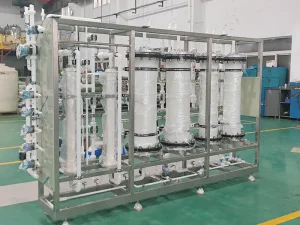
Advanced Separation, Pure Water & Resource Recovery Units
Complementary water reuse, degassing, high-concentration, and zero-liquid-discharge engineering skids built to identical quality standards.
End-to-End Project Execution for International Clients
From initial raw water data review to final site handover and lifetime consumable supply chains.
Phase 1: Process Modeling & Sizing
Our application engineers utilize proprietary projection software and hydrodynamic modeling tools to verify flux rates, osmotic pressures, and chemical balances based on your water test reports.
Phase 2: Fabrication & FAT Validation
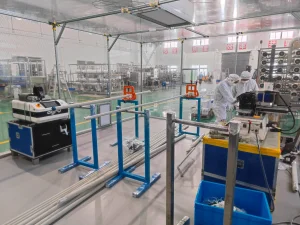
Components are precision welded, wired, and assembled at our factory. Every plant undergoes hydraulic pressure tests and automated control loop verifications before seaworthy packaging.
Phase 3: Commissioning & Handover
Tongjie offers field engineer dispatch or remote commissioning via secure industrial routers (VPN). We conduct complete operator training, verify water outputs, and hand over traceable O&M documentation.