ODM High-Pressure Membrane Concentration System for High-Salinity Wastewater | China Suppliers & Factory
View Product Specs →
Explore turnkey skids, containerized SWRO units, and advanced membrane systems engineered by Shanghai Tongjie.
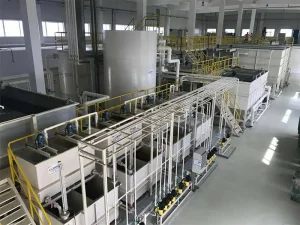
Strategic water security is no longer an ecological buzzword—it is an operational survival imperative across multi-national industries experiencing acute hydrological stress.
Over 2.4 billion people and countless industrial hubs reside in water-stressed territories. From the coastal Gulf regions of Saudi Arabia and the UAE to mining corridors in Chile and Western Australia, hyper-arid climates mandate dependable desalination infrastructure independent of municipal water grids.
Key driver: Decentralized, high-recovery SWRO infrastructure.Modern power generation, hydrogen electrolysis, and carbon capture initiatives require millions of cubic meters of demineralized feed water daily. Converting raw seawater to ultra-pure boiler feed (<1 µS/cm conductivity) protects billion-dollar turbine and electrolyzer assets from silica and salt scaling.
Standard: Dual-pass SWRO + EDI polishers.Offshore oil platforms, island resorts, marine ports, and remote semiconductor fabrication plants face astronomical water transport costs. On-site modular desalination plants decrease operational expenses by up to 74% compared to marine barge deliveries.
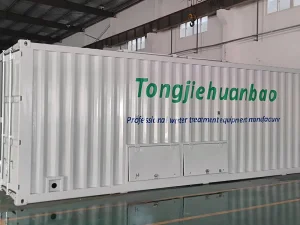
Solution: Plug-and-play ISO containerized plants.Shanghai Tongjie integrates advanced multi-barrier membrane technologies and energy recovery devices (ERD) to maximize recovery while minimizing operating expenditure.
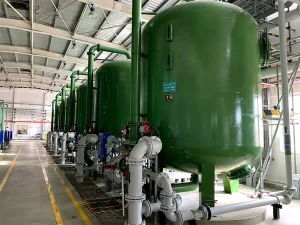
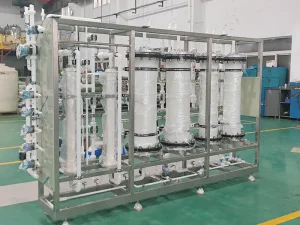
Raw seawater contains massive quantities of suspended colloids, marine organisms, and dissolved silica. Our turnkey plants feature automated DAF (Dissolved Air Flotation) paired with pressurized Ultrafiltration (UF) hollow fiber barriers (0.02 µm pore size). This maintains a Silt Density Index (SDI₁₅) below 2.5, shielding thin-film composite reverse osmosis membranes from biological irreversible fouling.
Automated dosing trains provide bisulfite dechlorination, scale inhibition, and biocide shock dosing modulated via smart PLC flow controls.
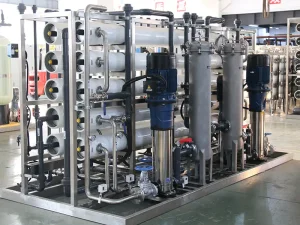
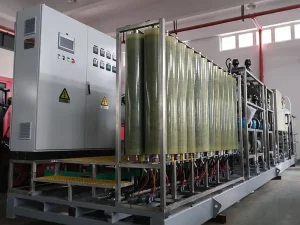
Utilizing high-pressure multi-stage duplex stainless steel pumps (producing operating pressures up to 83 bar), seawater overcomes natural osmotic gradients. Permeate passes through spiral-wound polyamide composite membranes with boron-rejection profiles exceeding 93%.
Energy consumption is radically reduced through Isobaric Energy Recovery Devices (ERI / PX), capturing up to 96% of the hydraulic pressure energy from the concentrated brine reject, dropping net power consumption below 3.0 kWh per cubic meter of clean water produced.
Permeate emerging from primary reverse osmosis is acidic (pH 5.8-6.5) and low in critical minerals. Our post-treatment trains utilize calcite contactors, dolomite limestone beds, and carbon dioxide dosing to normalize calcium hardness (50-80 mg/L as CaCO₃) and balance the Langelier Saturation Index (LSI).
Final disinfection combines low-pressure amalgam UV reactors with residual sodium hypochlorite chlorination to guarantee complete biological security in municipal storage tanks.
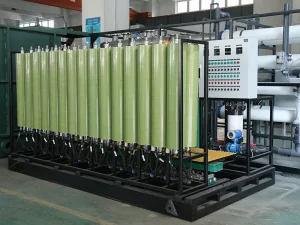
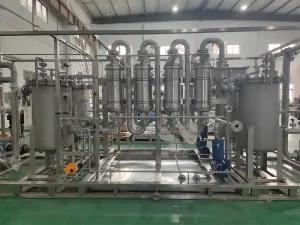
For environmentally sensitive coastal waters or landlocked industrial sites, discharge of high-salinity brine is forbidden. Tongjie’s patented DTRO (Disc Tube Reverse Osmosis) and MVR (Mechanical Vapor Recompression) systems further concentrate brine up to saturation (>180,000 ppm TDS), routing the final slurry into automatic crystallization units.
The resulting byproduct is dry, saleable industrial salt crystals alongside 98.5% total freshwater recovery.
| Performance Parameter | Tongjie ODM SWRO Plant | Conventional SWRO | Thermal Desalination (MED/MSF) |
|---|---|---|---|
| Specific Energy Consumption | 2.7 - 3.2 kWh/m³ | 4.5 - 6.0 kWh/m³ | 12 - 18 kWh-eq/m³ |
| Pretreatment SDI Reliability | SDI < 2.0 (Integrated UF) | SDI 3.5 - 5.0 (Sand Media) | High Chemical Coagulation |
| Footprint / Modularity | Standard ISO Containerized Skid | Large Concrete Civil Footprint | Massive Heavy Industry Footprint |
| Total Recovery Efficiency | 45% - 55% (Single Pass) | 35% - 40% | 15% - 25% |
| Automation & SCADA | Full Unmanned IoT / Remote Diagnostic | Manual / Semi-Automatic | Continuous Operator Supervision |
Continuous R&D at our Shanghai headquarters drives the next generation of intelligent, carbon-neutral saltwater processing plants.
Our proprietary neural algorithms evaluate real-time differential pressure, temperature fluctuations, and feed conductivity to anticipate organic scaling and mineral precipitation up to 120 hours before flux degradation occurs, auto-triggering clean-in-place (CIP) regimens.
Addressing erratic green power feeds, our variable-frequency high-pressure systems synchronize directly with DC microgrids and wind farms. Dynamic ramping control allows the plant to fluctuate output continuously between 40% and 100% capacity without membrane compaction.
Partnering with top scientific institutions, Tongjie tests next-generation biomimetic hollow fiber membranes capable of doubling water permeability while rejecting monovalent chloride ions under 35% lower operating pressures.
From metallurgical selection to electrical code harmonization, Tongjie guarantees complete export readiness for tier-1 engineering contracts.
Tongjie holds CE conformity, ISO 9001, ISO 14001, and ISO 45001 accreditations. Skid structures and pressure manifolds are built according to ASME Section VIII and ASME B31.3 piping regulations. High-pressure wet materials utilize Super Duplex Stainless Steel (UNS S32750 / 2507) and SMO 254 to prevent pitting and crevice corrosion under hot seawater environments (PREN > 42).
Our overseas service framework spans Central Asia, the Middle East, Southeast Asia, and Latin America. We provide complete Factory Acceptance Testing (FAT), Site Acceptance Testing (SAT), bilingual English/Chinese SCADA documentation, complete IQ/OQ validation protocols, and rapid emergency spare parts delivery (pumps, membranes, seals).
Key technical answers for engineering firms, EPC buyers, and facility managers looking to procure industrial-scale saltwater conversion units.
Explore our comprehensive industrial product line engineered for global chemical, oil & gas, electronic, and municipal applications.