
Industrial Seawater RO & Advanced Process Assemblies
Explore standardized containerized skids, DTRO open-channel systems, and high-purity arrays fully wet-tested and validated prior to intercontinental deployment.
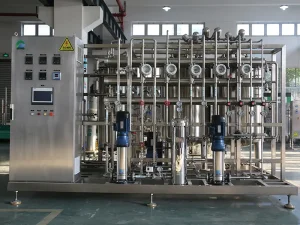
OEM China Pharmaceutical Purified Water & WFI System
View Product Details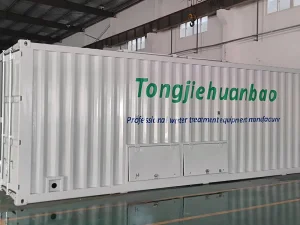
CE Certified Containerized Seawater Desalination Plants
View Product Details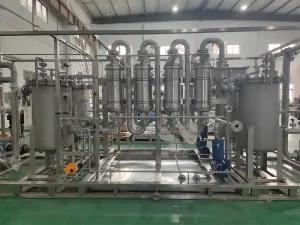
Wholesale Deoxygenation Membrane Degassing Equipment
View Product Details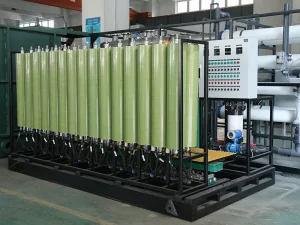
High-Pressure DTRO & STRO Membrane Concentration Skid
View Product Details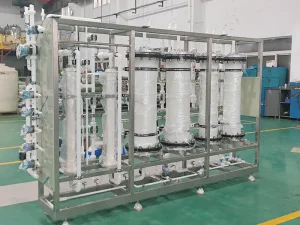
Semiconductor & Electronics Ultra-Pure Water System
View Product Details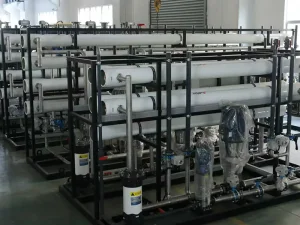
OEM High-Efficiency Brine Concentration Systems
View Product Details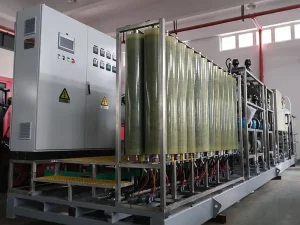
Oilfield Fracturing Flowback Fluid Treatment Skid
View Product Details
Custom WFI & Pharmaceutical Purified Water Plant
View Product DetailsGlobal Procurement Demand & Macro-Engineering Paradigms
Modern EPC contractors and multi-utility developers face stringent OPEX thresholds, shifting feed salinity, and stringent discharge permits. Here is how modern wholesale SWRO fabrication overcomes raw intake volatility.
Thermodynamic Specific Energy (SEC) Minimization
Leading seawater reverse osmosis plants demand strict energy governance. By coupling positive-displacement or split-case high-pressure feed pumps with isobaric energy recovery devices (ERDs), modern plants reclaim up to 98% of brine hydraulic kinetic power, trimming total energy consumption from historical baselines of >6.0 kWh/m³ down to 2.8–3.2 kWh/m³ across varied oceanic TDS (35,000–45,000 mg/L).
Containerized Pre-Fabrication vs. Stick-Built CAPEX
Decentralized resorts, offshore drilling platforms, and remote coastal cities no longer favor prolonged on-site civil works. Factory-integrated, skid-mounted container solutions house multimedia filtration, cartridge polishers, high-pressure duplex piping, CIP tanks, and intelligent PLC control centers inside insulated, marine-grade ISO containers—lowering field installation timeframes from months to under 14 operational days.
Super Duplex Metallurgy & Chemical Robustness
High-salinity maritime feeds containing chloride ions at concentrations exceeding 20,000 mg/L rapidly pit standard 304 or 316 stainless steels. Tongjie standardizes high-pressure wet ends using 2507 Super Duplex Stainless Steel (PREN > 42) and SMO 254 manifolds, mitigating intergranular crevice stress-corrosion cracking across operational pressures reaching 82 bar (1,200 psi).
End-to-End Desalination & High-Salinity Process Flow
A failure in pre-treatment triggers catastrophic bio-fouling and colloidal plugging on seawater membranes. Tongjie implements a multi-barrier defense train configured to incoming Silt Density Index (SDI) thresholds.
Raw Intake & DAF Pretreatment
Open sea or beach well collection with dual-media sand filters and Dissolved Air Flotation (DAF) to eliminate algae blooms and marine turbidity.
UF & Cartridge Guard Filtration
Pressurized hollow-fiber PVDF Ultrafiltration modules delivering continuous SDI₁₅ < 2.5, followed by 1-5 micron absolute melt-blown polishers.
High-Pressure SWRO Core
Positive-displacement pump feeding spiral-wound polyamide composite membranes with isobaric rotor energy recovery, achieving 40–50% recovery.
Second-Pass Polishing & Boron Extraction
Secondary brackish RO pass combined with selective ion-exchange resins to reduce permeate boron levels below WHO guidelines (<0.5 mg/L).
Remineralization & Safe Discharge
Calcite/dolomite contactor re-hardening, chlorine dioxide disinfection, and automated dilution diffusion for ocean brine reject manifolds.
Engineering Design Envelope for Industrial SWRO Plants
Review standard wholesale plant sizing boundaries, hydraulic recovery benchmarks, and materials of construction across our custom and containerized series.
| System Architecture | Feed Salinity (TDS) | Recovery Rate | Permeate Quality | Core Wetted Metallurgy | Primary Industrial Use |
|---|---|---|---|---|---|
| Standard Containerized SWRO | 32,000 – 45,000 ppm | 40% – 48% | < 400 ppm (WHO Standard) | Super Duplex 2507 / 2205 | Islands, Coastal Camps, Marine Resorts |
| Two-Pass High-Purity SWRO | 35,000 – 48,000 ppm | 38% – 45% | < 10 ppm (Conductivity < 20 µS/cm) | 2507 / SS316L / Sanitary PVDF | Power Generation, Boiler Make-up, Pharma |
| Off-Grid Solar Hybrid SWRO | 28,000 – 42,000 ppm | 35% – 42% | < 350 ppm | Duplex 2205 / Titanium Gr. 2 | Remote Mining, Off-Grid Utilities, Disaster Relief |
| High-Pressure DTRO Brine Unit | 50,000 – 120,000 ppm | 60% – 85% | < 1,500 ppm Permeate | 1.4539 (904L) / Hastelloy C-276 | ZLD Brine Concentration, Oilfield Produced Water |
| Ultra-Pure Water Semiconductor Skid | Tap / RO Permeate | 85% – 92% | 18.2 MΩ·cm, TOC < 1 ppb | PVDF / PFA Ultra-Pure Piping | Semiconductor Rinsing, Silicon Wafer Fabs |
Geographical Industrial Challenges & Customized Solutions
Raw marine conditions are not uniform across the globe. Tongjie tailors internal membrane array hydraulics, anti-scaling dosing, and thermal insulation to localized oceanic regimes.
Middle East & Arabian Gulf (High Salinity & Heat)
The Arabian Gulf and Red Sea present elevated water temperatures (>35°C) and hypersalinity (>45,000 mg/L TDS) accompanied by seasonal red tide algae. Tongjie equips installations with heavy-duty air cooling for electrical cabinets, customized anti-scalants targeting barium and strontium sulfates, and advanced continuous UF backwash mechanisms to safeguard membrane integrity.
Central Asia & Caspian Basins (Produced Water Reuse)
Oilfields throughout Kazakhstan and Western China generate complex fracturing flowback waters with heavy emulsified hydrocarbons and suspended solids. Tongjie applies hybrid Disc Tube RO (DTRO) systems with pre-coagulation softening to achieve ≤5 mg/L residual oil content and zero liquid discharge reuse for reinjection operations.
Southeast Asia & Pacific Island Micro-Grids
Island resorts and decentralized communities frequently lack stable electrical grid infrastructure. Tongjie integrates variable-frequency drive (VFD) pressure boosters directly with PV arrays and battery banks, optimizing production during peak solar irradiation hours to generate potable freshwater without fuel-reliant diesel gen-sets.
Next-Generation Membrane Science & Autonomous Operation
How Shanghai Tongjie drives forward innovation in mineral recovery, low-fouling surface chemistry, and IoT digital twin platforms for global fleet oversight.
AI-Powered Cloud Telemetry & Digital Twins
Tongjie integrates real-time cloud SCADA monitoring into every containerized installation. By evaluating normalized flux decay, delta pressure (dP) spikes, and salt rejection gradients using neural network inference, our systems predict membrane fouling 72 hours before irreversible scaling occurs, automatically adjusting chemical dosing schedules.
Brine Valorization & Critical Mineral Extraction
Desalination reject brine is transitioning from an environmental liability to an industrial revenue stream. Tongjie R&D is collaborating on electrodialysis metathesis (EDM) and high-recovery nanofiltration stages to concentrate lithium, rubidium, calcium, and magnesium from reject reject liquor prior to zero liquid discharge (ZLD) crystallization.
Nanocomposite & Aquaporin Biomimetic Membranes
Next-generation thin-film nanocomposite (TFN) chemistry incorporating functionalized graphene oxide and synthetic water channels (aquaporins) elevates pure water permeability by 25–40% without compromising monovalent salt rejection, driving energy demands below the historical 2.5 kWh/m³ threshold.
Certifications, Factory FAT, and On-Site Compliance
Procuring industrial equipment internationally requires verified engineering standards, non-destructive testing (NDT), and traceable documentation.
ISO & CE Quality Certifications
Shanghai Tongjie holds accredited ISO 9001:2015, ISO 14001:2015, and ISO 45001:2018 management systems, complemented by CE conformity marks across Low Voltage and Machinery Directives, satisfying international import compliance for the European Union, the Americas, and Australasia.
Stringent Factory FAT Protocol
Every skid and container undergoes full hydrostatic pressure testing, dynamic simulation of electrical interlocks, instrument calibration, and simulated brine wet testing before dispatch. Overseas clients receive complete Factory Acceptance Testing (FAT) video dossiers and sensor logs, avoiding site commissioning delays.
Engineering Qualifications & Field Support
Holding Class II Contracting Qualifications in Environmental Protection Engineering and M&E Installation, Tongjie deploys multidisciplinary field commissioning engineers globally to oversee raw water hookups, membrane loading, operator hands-on training, and localized SCADA handover.
Engineering & Procurement Inquiries
Technical clarifications addressing water chemistry analysis, recovery ratios, materials specification, and delivery logistics.
What specific raw water parameters are mandatory for an accurate SWRO quotation?
To deliver an optimized membrane layout and lifecycle OPEX projection, provide a full ion breakdown including TDS, total suspended solids (TSS), silica, iron, manganese, barium, strontium, SDI₁₅, pH, and water temperature fluctuations across summer and winter cycles. If the intake is subject to seasonal hydrocarbons or algal blooms, indicate TOC and chlorophyll levels.
How does Tongjie address boron removal to satisfy drinking and agricultural standards?
Standard single-pass seawater RO elements typically reject 85% to 92% of uncharged boric acid at ambient seawater pH (around 8.0). To comply with stringent WHO guidelines (≤0.5 mg/L), Tongjie employs a cascaded two-pass design wherein the second pass operates at an elevated pH (>9.5) to convert boric acid into charged borate ions rejected at >99%, or integrates selective chelating ion-exchange resin polishers.
What prevents severe corrosion on high-pressure manifold piping and fittings?
We prohibit standard 304 and 316 stainless steels in all high-pressure saline fluid pathways. All components upstream of and inside the membrane vessels operating above 16 bar utilize 2507 Super Duplex Stainless Steel (UNS S32750) or 254 SMO (UNS S31254). Low-pressure intake lines incorporate high-density polyethylene (HDPE) or FRP to eliminate galvanic oxidation.
What is the expected operating lifespan of your RO membrane modules?
Under disciplined operational conditions maintaining feed SDI₁₅ < 3.0, continuous anti-scalant dosing, and regular Clean-in-Place (CIP) regimes upon a 10–15% normalized flux drop, high-rejection polyamide SWRO elements deliver 3 to 5 years of operational service. In ultrafiltration pretreatment stages, PVDF fibers regularly surpass 5 to 7 years.
Can containerized desalination systems integrate directly into isolated off-grid solar micro-grids?
Yes. Tongjie containerized units can be configured with dual-input VFD control systems capable of accommodating direct solar DC bus supplies or fluctuating AC power from hybrid PV/inverter systems. Automated ramping routines prevent hydraulic shock on membranes when solar irradiance varies across morning and afternoon conditions.
What are standard manufacturing and logistics lead times for custom containerized plants?
Standard capacity skids (250 m³/day to 1,000 m³/day) require 6 to 10 weeks for complete structural assembly, piping fabrication, instrumentation wiring, and FAT testing in our Shanghai factory. High-capacity or custom-engineered alloys (such as Hastelloy C-276 DTRO arrays) generally range from 12 to 16 weeks prior to maritime container dispatch.
Specialized Wastewater, Pharmaceutical & Industrial Systems
Browse our full range of zero-liquid discharge crystallizers, fracturing fluid reclaimers, sanitary WFI systems, and tertiary effluent recycling skids.
CE Certified Fracturing Flowback Fluid Treatment System
View Product Details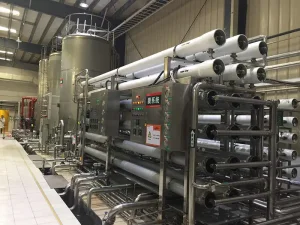
OEM Food & Beverage Process Water Treatment System
View Product Details
ODM Pharmaceutical Purified Water & WFI Generation Skid
View Product Details
Turnkey Pharmaceutical Water Solutions & WFI Loops
View Product Details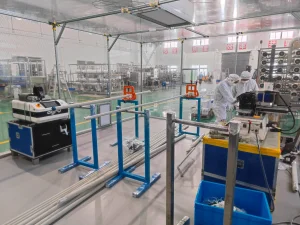
Wholesale Eco-Friendly Commercial Water Treatment Units
View Product Details
High-Efficiency API Pharmaceutical Water Treatment Skid
View Product Details
OEM Modular High-Purity Sanitary Water Skid
View Product Details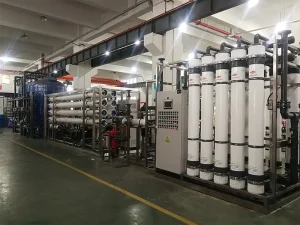
China High-Ratio Water Reuse & Reclamation Plant
View Product DetailsRequest a Process Simulation & Equipment Scope
Connect directly with our Shanghai engineering headquarters. Forward your raw water chemistry profile, target capacity in m³/day or GPD, and site elevation constraints for a comprehensive mass balance and equipment list.