
Engineered Reverse Osmosis & High-Salinity Desalination Systems
Factory-fabricated, skid-mounted, and containerized membrane treatment modules subjected to 100% full Factory Acceptance Testing (FAT) prior to global dispatch. Designed for harsh oceanic, oilfield, and chemical wastewater duty cycles.
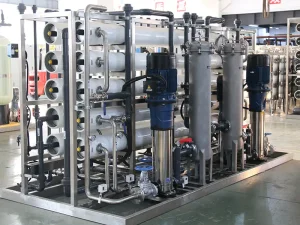
CE Certification Osmosis-Assisted Reverse Osmosis System for High Salinity Wastewater
View Technical Specs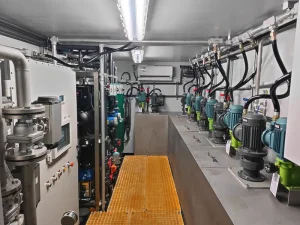
CE Certification Fracturing Flowback Water Reuse Treatment Equipment for Oil & Gas
View Technical Specs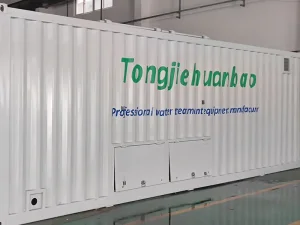
OEM Modular Seawater Desalination Equipment Prefabricated for Rapid Deployment
View Technical Specs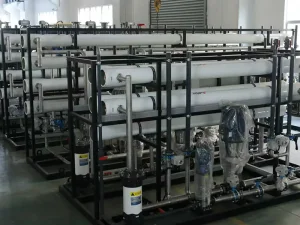
High-Efficiency Brine Concentration Systems for Industrial Wastewater Recovery
View Technical Specs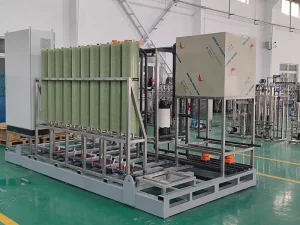
High-Salinity Wastewater Volume Reduction System for Zero Liquid Discharge (ZLD)
View Technical Specs
Industrial High-Salinity Wastewater Treatment System for ZLD Infrastructure
View Technical Specs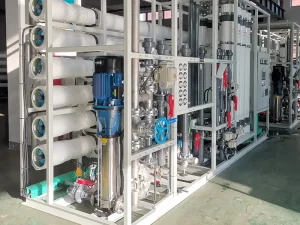
Wholesale Compact Seawater Desalination System for Island & Marine Operations
View Technical Specs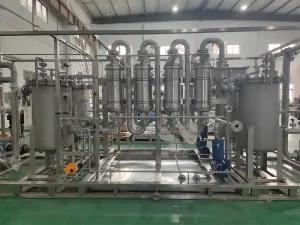
CE Certified Deoxygenation Membrane Equipment for Physical Water Degassing
View Technical SpecsDesalination Reverse Osmosis Membrane Engineering: Global Sourcing & Compliance Guide
Global industrial water security has entered a transformative era driven by increasing water stress, stringent regional wastewater discharge mandates, and elevated total dissolved solids (TDS) in traditional intake sources. Seawater Reverse Osmosis (SWRO) and Brackish Water Reverse Osmosis (BWRO) membranes represent the critical core of modern separation processes. For EPC contractors, utility operators, and industrial procurement managers, selecting CE-certified desalination reverse osmosis membrane suppliers and manufacturers requires evaluating not merely nominal salt rejection rates, but fundamental membrane morphology, spacer fluid dynamics, compaction resistance, boron transport coefficients, and long-term operating expenditures (OPEX).
1. Enterprise Procurement Dynamics & Membrane Sizing Criteria
Procurement teams evaluating membrane elements for utility-scale SWRO plants or industrial zero liquid discharge (ZLD) concentrations face complex multi-variable optimization. Feedwater variability—particularly across seasonal variations in temperature (4°C to 38°C) and fluctuating silt density index (SDI15)—directly alters membrane permeability, flux decline curves, and biofouling acceleration rates.
When executing global procurement contracts, technical directors must establish verification protocols based on standardized ASTM D4516 normalization equations. Essential membrane specification thresholds include:
| Membrane Classification | Active Chemistry & Geometry | Design Flux (LMH) | Stabilized Salt Rejection | Standard Operating Pressure |
|---|---|---|---|---|
| Standard Seawater (SWRO) | Polyamide Thin-Film Composite (TFC) / Spiral-Wound 8040 | 12.0 – 16.5 LMH | 99.75% – 99.85% | 55 – 70 bar (800 – 1015 psi) |
| Ultra-Low Energy SWRO | High-Permeability Nanocomposite / 34 mil Feed Spacer | 14.0 – 18.0 LMH | 99.65% – 99.75% | 45 – 55 bar (650 – 800 psi) |
| Brine Concentration (DTRO) | Disc Tube Cushion Module / Open Channel Flow | 8.0 – 12.0 LMH | 99.20% – 99.60% | 90 – 120 bar (1300 – 1740 psi) |
| Osmosis-Assisted RO (OARO) | Counter-Current Dual-Skin Polyamide Membrane Assembly | 6.0 – 10.5 LMH | 99.00% – 99.50% | 65 – 85 bar (Dynamic Osmotic Balance) |
Boron Rejection & Potable Water Standards
For municipal drinking water applications, WHO guidelines enforce a strict boron limit of ≤ 0.5 mg/L. Because boric acid ($B(OH)_3$) exists as an uncharged planar molecule at neutral pH, conventional RO membranes exhibit standard boron rejection of only 85%–90% at seawater pH 7.8–8.2. Tongjie's high-crosslinked aromatic polyamide elements achieve > 93% boron rejection at seawater standard baseline, and > 97% under secondary stage pH-adjusted (pH 9.5) conditions without exceeding energy envelopes.
2. Macro-Industry Engineered Separation Architectures
State-of-the-art water treatment systems transcend single-stage membrane filtration. Industrial resiliency demands integrated membrane process trains customized according to feedwater mineral saturation indexes (LSI, S&DSI) and organic foulant loadings:
A. Seawater Desalination Plants (SWRO): Modern multi-train SWRO platforms integrate continuous microfiltration/ultrafiltration (UF) pretreatment, duplex stainless steel (2205/2507) high-pressure booster pumps, positive displacement or isobaric energy recovery devices (ERD), and energy-optimized 8-inch or 16-inch spiral-wound membrane pressure vessels. By transferring hydrostatic pressure directly from the concentrated reject stream to the incoming raw seawater, ERD devices reduce specific power draw from > 6.5 kWh/m³ to below 2.6–3.0 kWh/m³.
B. Zero Liquid Discharge (ZLD) Brine Concentration: In petrochemical, coal-chemical, and semiconductor manufacturing, environmental zero-discharge mandates restrict wastewater dumping. Tongjie's integrated Disc Tube Reverse Osmosis (DTRO) and Osmosis-Assisted Reverse Osmosis (OARO) concentrate high-salinity brines up to 120,000–180,000 mg/L TDS before mechanical vapor recompression (MVR) evaporators. This membrane-driven volume reduction lowers overall capital expenditure by shrinking thermal evaporation capacities by up to 75%.
C. Oil & Gas Produced and Fracturing Water Reuse: Hydraulic fracturing flowback carries complex mixtures of free hydrocarbons, emulsified oils, barium/strontium scale formers, and extreme salinities. Tongjie incorporates physical coalescing separation, catalytic oxidation, deoxygenation membrane contactors, and high-shear DTRO membranes to reduce chemical oxygen demand (COD), achieve oil content ≤ 5 mg/L, and suppress suspended solids to ≤ 1 mg/L for formation reinjection.
3. Technical Roadmap: Thin-Film Nanocomposite (TFN) & AI Integration
The reverse osmosis membrane landscape is shifting toward engineered molecular selectivity. Next-generation thin-film nanocomposite (TFN) membranes synthesize functional nanomaterials—including metal-organic frameworks (MOFs), covalent organic frameworks (COFs), and functionalized graphene oxide (GO)—directly into the polyamide reaction during interfacial polymerization.
These structural modifications increase water vapor permeability by creating preferential nano-channels for $H_2O$ transport while simultaneously increasing surface negative zeta-potential. The resultant negative charge and hydrophilic barrier lower bacterial adhesion, resist colloidal protein foulants, and widen operational Cleaning-in-Place (CIP) intervals from weeks to months.
Concurrently, Tongjie's containerized plants incorporate cloud-linked SCADA telemetry coupled with artificial intelligence predictive analytics. By comparing live normalized differential pressures (ΔP), normalized permeate flow (NPF), and salt passage (SP) against calibrated digital twins, the AI system issues early fouling alerts, pinpoints chemical scaling precipitation (such as $CaSO_4$ or silica), and optimizes CIP chemical dosing automatically.
CE Certification, Pressure Equipment Directive (PED) & Global Reliability
Rigorous factory testing, material traceability according to EN 10204 3.1, and adherence to EU directives ensure seamless mechanical integration, structural safety, and rapid permitting in international territories.
CE-PED (2014/68/EU) Compliance
All membrane pressure vessels, high-pressure manifold piping, and accumulator dampeners adhere to European Pressure Equipment Directive Category III/IV design rules, verified with 1.5x hydrostatic proof tests.
- Vessel Material:ASME Section X / FRP
- High-Pressure Piping:Super Duplex 2507 (1.4410)
- NDT Verification:100% Radiographic / Penetrant
Machinery Directive (2006/42/EC)
Complete electrical switchboards, automated interlocks, and low-voltage electrical skids conform to CE-LVD (2014/35/EU) and CE-EMC (2014/30/EU), utilizing Schneider or Siemens PLC platforms.
- Control Topology:Siemens S7-1500 / Allen-Bradley
- Enclosure Class:IP55 / NEMA 4X Marine Grade
- Safety Standard:SIL 2 / Cat 3 Emergency E-Stop
Global Localization & Support
Standard ISO container foot-print (20ft and 40ft High Cube) ready for intermodal freight. Rapid plug-and-play field hookup with complete technical documentation, P&ID, 3D CAD, and remote VPN commissioning support.
- Pre-Commissioning:100% Factory Wet Tested
- Lead Times:4 – 8 Weeks for Skid Units
- Warranty Support:Comprehensive 24-Month Cover
High-Pressure Modules, Degasification & Turnkey Concentration Solutions
Explore specialized deoxygenation, DTRO/STRO high-pressure recovery, and sustainable ODM/OEM manufacturing capabilities produced to exacting international standards.
Wholesale Deoxygenation Membrane Equipment for Dissolved Oxygen Removal
View Technical Specs
Physical Degassing Membrane Contactors for Boiler Feed & Ultrapure Systems
View Technical Specs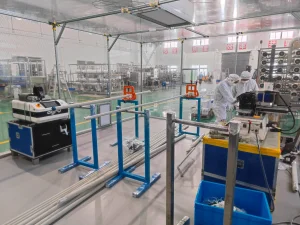
Eco-Friendly Industrial Water Treatment Plants from Certified ODM Factory
View Technical Specs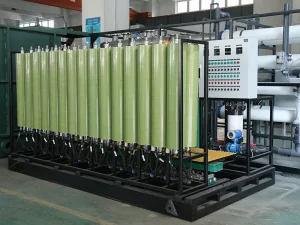
DTRO & STRO High-Pressure Membrane Concentration System for Mining & Leachate
View Technical Specs
High-Efficiency Water Deoxygenation & Decarbonation Membrane Modules
View Technical Specs
OEM & ODM Custom Desalination Skids for Global Municipal & Industrial EPCs
View Technical Specs
High-Salinity OARO Membrane System for Cost-Effective Zero Liquid Discharge
View Technical Specs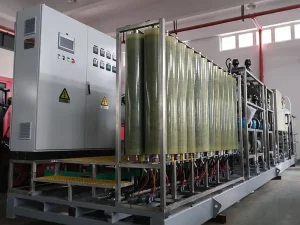
CE Certified Fracturing Flowback Fluid Treatment System for Zero-Discharge Reuse
View Technical SpecsFrequently Asked Questions: Technical Sizing, Standards & Operations
Key considerations for engineering project leads, procurement authorities, and plant operators evaluating CE-certified desalination RO equipment.
What specific CE directives apply to Tongjie desalination RO skids?
Our systems fully comply with the European Union Pressure Equipment Directive (PED 2014/68/EU) for high-pressure membrane housings and stainless-steel manifolds, the Machinery Directive (2006/42/EC) for skid mechanical assemblies, the Low Voltage Directive (LVD 2014/35/EU), and the Electromagnetic Compatibility Directive (EMC 2014/30/EU) for PLC cabinets. Full CE Declarations of Conformity and technical construction files (TCF) accompany all European shipments.
How does Tongjie solve membrane scaling in high-salinity ZLD applications?
We utilize a tandem approach combining upstream catalytic softening/coagulation with open-channel Disc Tube Reverse Osmosis (DTRO) or Osmosis-Assisted Reverse Osmosis (OARO). The DTRO disc-cushion geometry produces controlled turbulence that continuously scours boundary layers, suppressing concentration polarization and raising hydrodynamic shear across the membrane surface to prevent silica and barium scale adhesion up to 120 bar.
What minimum data is required to generate a turnkey SWRO engineering projection?
To generate a comprehensive mass balance, P&ID, and membrane projection, we require: (1) Complete ionic feedwater analysis ($Na^+$, $Cl^-$, $Ca^{2+}$, $Mg^{2+}$, $SO_4^{2-}$, $HCO_3^-$, $SiO_2$, Boron, and heavy metals), (2) Feedwater temperature range and SDI15 index, (3) Desired daily permeate output capacity ($m^3/\text{day}$ or GPD), (4) Target product water conductivity/TDS, and (5) Local electrical supply frequency (50Hz / 60Hz) and available voltage.
What is the typical operational lifespan of Tongjie RO membrane elements?
In standard seawater desalination facilities operating under recommended flux rates (13–15 LMH) with SDI < 3 pretreatment, our polyamide composite membranes achieve an average service life of 3 to 5 years. In severe wastewater or oilfield flowback operations, DTRO cushions typically maintain stable performance for 1.5 to 3 years before scheduled module refurbishment.
How does an Energy Recovery Device (ERD) lower operational expenditure?
In seawater desalination, the high-pressure concentrate stream retains approximately 55% to 60% of the hydraulic energy imparted by the high-pressure pump. Our integrated isobaric rotary pressure exchangers transfer this energy directly into the low-pressure feedwater with > 97% mechanical efficiency, lowering total power consumption down to 2.6 – 3.0 kWh/m³, translating directly into millions of dollars in lifecycle OPEX savings.
Can Tongjie support private-label OEM manufacturing for global distributors?
Yes. As an authorized National High-Tech Enterprise and specialized manufacturer, Tongjie supplies extensive OEM and ODM membrane assemblies, custom-engineered skid frameworks, private-label containerization, tailored SCADA user interfaces, and custom operation and maintenance manuals formatted to distributor brand standards.