High-Purity Water Treatment & Desalination Systems Showcase
Explore our core pre-treatment, membrane separation, and industrial demineralization units engineered for turnkey pharmaceutical, produced water, and extreme-salinity applications.
Global Procurement Architecture for Water for Injection (WFI) Generation
Strategic analysis of critical quality attributes (CQA), regulatory harmonizations across EP/USP/ChP, and systemic total cost of ownership (TCO) benchmarks for pharmaceutical engineering teams.
Harmonized Pharmacopeia Compliance
Navigating the convergence of European Pharmacopoeia (Monograph 0169), US Pharmacopeia (USP <1231>), and Chinese Pharmacopoeia (ChP 2020). Engineering focus on endotoxin limits (< 0.25 EU/ml), bioburden control (< 10 CFU/100ml), TOC levels (< 500 ppb), and offline/online conductivity thresholds at 20°C and 85°C.
Thermal vs. Cold Membrane Generation
Systemic engineering evaluation between Multiple-Effect Water Stills (MEWS), Vapor Compression Distillation (VCD), and Ambient Membrane WFI (double-pass RO + CEDI + Ultrafiltration). Comparative energy consumption, microbial resilience, rouging vulnerability, and capital depreciation profiles.
GAMP 5 & 21 CFR Part 11 Validation
Complete traceability and computerized system validation (CSV). Integrated Siemens S7-1500 or Allen-Bradley GuardLogix systems equipped with tamper-proof audit trails, multi-level electronic signatures, dynamic batch reporting, and automated alarm matrix archiving for seamless FDA inspections.
Engineering Architecture: Thermal and Membrane WFI Evolution
A granular breakdown of modern thermodynamic columns, separation mechanisms, and materials science powering sterile injectable manufacturing across global biologics and parenterals facilities.
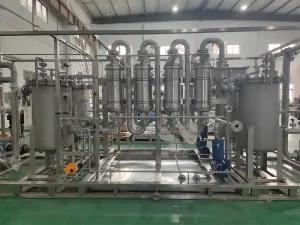
Multiple-Effect Stills (MEWS)
Equipped with falling-film evaporation columns designed to optimize energy recovery across sequential pressure cascades. Incorporates 180° centrifugal separation baffles that eliminate pyrogens and droplets at critical velocities without moving components, guaranteeing sterile, pyrogen-free distillate.
Vapor Compression Stills (VCS)
Thermodynamic recompression driven by high-efficiency mechanical blowers, operating at atmospheric or slight positive pressure. VCS dramatically cuts plant cooling water consumption by over 90% and primary steam demand by 85%, serving as the premier low-OPEX solution for high-capacity facilities.
Membrane-Based "Cold" WFI
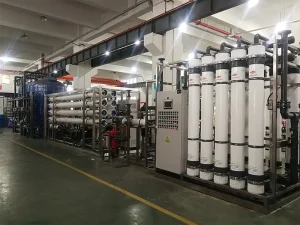
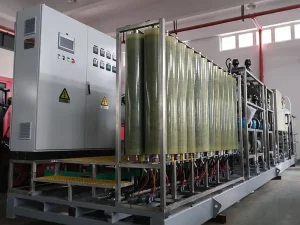
Validated non-thermal trains combining Double-Pass RO, Continuous Electro-Deionization (CEDI), and Endotoxin-retentive Ultrafiltration (UF, 6000-10000 Dalton cut-off). Features routine hot water sanitization (85°C-90°C) cycles, reducing capital outlay and carbon footprint.
| Performance Parameter | Multiple-Effect (MEWS) | Vapor Compression (VCS) | Cold Membrane WFI (RO+CEDI+UF) |
|---|---|---|---|
| Bacterial Endotoxins | < 0.025 EU/mL (High margin) | < 0.05 EU/mL | < 0.10 EU/mL (Compliant with EP/USP) |
| Conductivity @ 20°C | < 0.8 µS/cm (Typical < 0.5) | < 0.9 µS/cm | < 0.6 µS/cm |
| Total Organic Carbon (TOC) | < 20 ppb (Ultra-low) | < 30 ppb | < 100 ppb (Monitored in-line) |
| Primary Utility Need | Plant Steam (3-8 bar) + Chilled Water | Electricity / Low Steam | Electricity only (Clean utilities) |
| CE PED Classification | Category III / IV (Module H1) | Category II / III (Module H) | Sound Engineering Practice / Cat I |
Localized Engineering Commissioning & Statutory CE Assurance
Ensuring end-to-end regulatory compliance from factory acceptance testing (FAT) to on-site validation (SAT, IQ, OQ, PQ) across North America, the European Union, Southeast Asia, and the Middle East.
Full DQ/IQ/OQ/PQ Dossiers
Every WFI generation unit arrives with comprehensive cGMP turnover documentation, isometric drawings, 100% weld log records, borescope inspection videos, and material test certificates (MTR 3.1).
CE PED & Machinery Directives
Statutory compliance under the Pressure Equipment Directive 2014/68/EU and Machinery Directive 2006/42/EC. Certified burst disc calculations, safety relief valves, and third-party notified body verification.
Orbital Welding & Passivation
Fabrication using automated orbital TIG welding in a controlled clean environment. Comprehensive chemical pickling and electropolishing procedures passivate surfaces to prevent chromium depletion and rouging.
Fast Rapid Commissioning
Factory-tested, skid-mounted modular architecture enables rapid on-site hookup, reducing field assembly schedules down to under 15 days for mission-critical pharmaceutical facilities.
Engineering FAQ: Critical Considerations for WFI Procurement
Authoritative, data-backed answers addressing the complex technical and regulatory questions frequently raised by global pharmaceutical procurement engineers.
What documentation is required to pass FDA and EMA audits for WFI stills?
Auditors mandate a complete traceability matrix including Design Qualification (DQ), Installation Qualification (IQ), Operational Qualification (OQ), and Performance Qualification (PQ). Key artifacts include 100% weld mapping with borescopic video records, calibrated instrument certificates traceable to national standards, 3.1 material test reports for all AISI 316L contact metallurgy, surface roughness profilometer certifications (Ra ≤ 0.4 µm), and GAMP 5 software validation reports supporting 21 CFR Part 11 audit trails.
How does EP Monograph 0169 impact non-distillation membrane WFI selection?
Since the revision of EP 0169 permitting non-distillation methods for WFI generation, membrane systems (Double-Pass RO + CEDI + UF) have gained traction due to lower capital requirements. However, EP mandates that non-thermal systems implement equivalent microbiological safety barriers. This demands continuous online microbial indicators (rapid bioburden analyzers or stringent continuous TOC and conductivity tracking) coupled with automated thermal sanitization capability (≥ 85°C) executed periodically across the entire membrane train.
What is the standard procedure to manage rouging in high-temperature WFI systems?
Rouging (ferric oxide deposition) occurs predominantly in high-temperature hot WFI storage and distribution loops (> 80°C). We mitigate Class I, II, and III rouging through low-ferrite AISI 316L metallurgy, chemical passivation (nitric acid or citric acid formulations), and periodic chemical de-rouging cycles utilizing neutral-pH chelating agents. Furthermore, optional low-temperature distribution designs or continuous ozone sanitization loops can be engineered to mitigate rouge accumulation.
Why is CE PED 2014/68/EU certification mandatory for imported WFI stills in Europe?
Multiple-effect and vapor compression stills operate under pressurized conditions with steam pressures typically ranging between 3 to 8 barg, placing them squarely within Category II, III, or IV of the European Pressure Equipment Directive (PED). Systems must undergo rigorous design examination, non-destructive testing (NDT/radiography on pressure welds), hydrostatic pressure tests witnessed by an EU-notified body, and bear the official CE mark with the notified body identification number before legal entry into EU member states.
Modular Desalination & Advanced Separation Machinery
Discover our containerized seawater RO units, ZLD evaporators, and physical degassing membrane arrays deployed across global energy and industrial infrastructure.