High-Performance Seawater & Industrial Membrane Skids
Pre-engineered, factory-assembled, and skid-mounted water purification systems ready for expedited worldwide deployment.
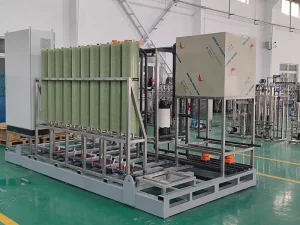
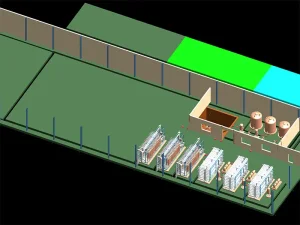
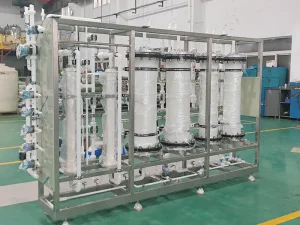
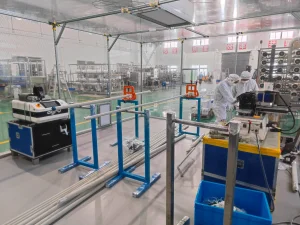
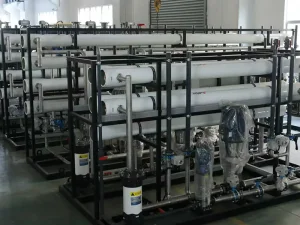
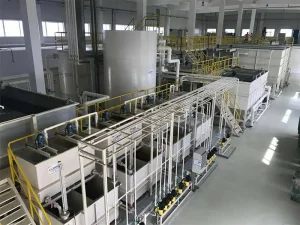
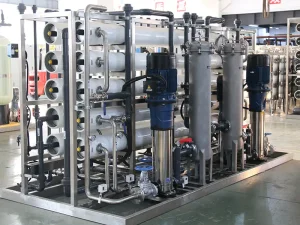
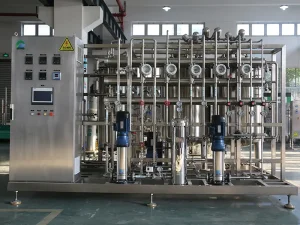
The Global Seawater RO Landscape: Paradigm Shift in Industrial Desalination
Navigating energy optimization, stringent brine discharge limitations, and life-cycle CAPEX/OPEX parity in hyper-arid coastal economics.
Energy Intensiveness & ERD Convergence
Modern SWRO plants have evolved past the legacy isobaric barriers. Operating with seawater total dissolved solids (TDS) ranging from 35,000 ppm to 45,000 ppm in regions like the Arabian Gulf, specific energy consumption (SEC) has historically exceeded 4.5 kWh/m³.
By engineering advanced isobaric pressure exchanger energy recovery devices (PX ERDs) that achieve >97% energy transfer efficiency directly into the high-pressure feed stream, Shanghai Tongjie plants systematically reduce SEC below 2.8 kWh/m³, mitigating global carbon penalties and baseline OPEX.
Stringent Boron & Bromide Limits
Industrial off-takers across microelectronics, petrochemical processing, and agricultural greenhouses demand stringent single-digit permeate parameters. Standard seawater reverse osmosis systems often struggle with uncharged boric acid molecules (H&sub3;BO&sub3;) at standard seawater pH levels.
Tongjie engineers deploy a multi-pass process with second-pass caustic dosing (raising pH to 9.5-10.0), shifting boric acid to ionized borate (H&sub2;BO&sub3;¯), realizing final permeate boron concentrations below 0.3 mg/L, exceeding WHO drinking standards and pharmaceutical water requirements.
Containerized Modular Decentralization
Global project development dynamics are rapidly shifting from centralized municipal mega-plants with multi-year construction schedules toward skid-mounted, containerized SWRO units that offer plug-and-play simplicity and swift commissioning.
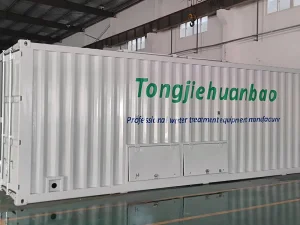
Decentralized mining installations in Atacama, offshore exploration rigs in Southeast Asia, and island resort infrastructure require turnkey, ISO-standard shipping container layouts equipped with climate control, automated Clean-In-Place (CIP), and integrated telemetry to produce fresh water on arrival.
China Factory Precision: Supply Chain Resilience & Fabrication Rigor
Uncompromising metallurgy, automated orbital welding, and integrated vertical manufacturing establish the benchmark for reliable desalination assets.
Advanced Metallurgy: 2507 Super Duplex & SMO 254
The aggressive salinity, elevated chloride ion concentrations, and elevated operating pressures (up to 82 bar / 1,200 psi) in seawater RO mandate zero compromise on material integrity. Pitting Resistance Equivalent Number (PREN ≥ 42) is enforced across all wet-end high-pressure piping assemblies.
- Material Grade Control: Direct mill-certified 2507 Super Duplex Stainless Steel (UNS S32750) and 254 SMO for all high-pressure manifolds, high-pressure pump fluid ends, and membrane vessel feed ports.
- Non-Destructive Testing (NDT): 100% radiographic weld testing, dye-penetrant inspection, and hydrostatic factory acceptance pressure testing at 1.5× design pressure for 4 hours.
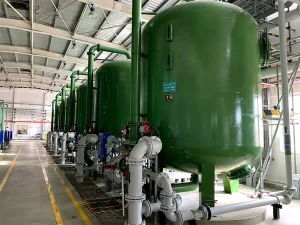
- Low-Pressure Piping: Schedule 80 industrial-grade CPVC, Polypropylene Random (PP-R), or Vinylester Glass-Reinforced Plastic (FRP) eliminate galvanic corrosion along the pretreatment and permeate paths.
Factory Acceptance Testing (FAT) & Modular Skid Pre-Commissioning
As a Shanghai Specialized & Sophisticated Enterprise operating from a high-tech manufacturing campus in Jiading District, Shanghai Tongjie eliminates unexpected project site costs by carrying out complete mechanical and electrical run-tests prior to crating.
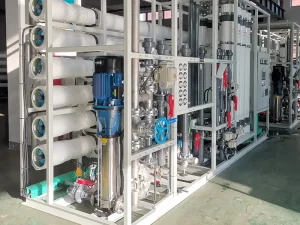
- Wet FAT Verification: Every skid is connected to simulated high-salinity water reservoirs to confirm membrane flux, seal integrity, and pressure damping under full hydraulic load.
- Automation & Instrumentation: Complete Siemens S7-1500 or Allen-Bradley PLC architecture with factory-calibrated inductive conductivity, pH, ORP, differential pressure, and electromagnetic flowmeters.
- Turnkey Containerized Housing: Specialized 20-foot and 40-foot High-Cube ISO sea containers fully insulated with rockwool, polyurethane anti-corrosion flooring, marine split HVAC, and LED illumination.
| System Architecture Parameter | Standard Tongjie SWRO Skid | High-Recovery SWRO + DTRO | Offshore Marine Containerized |
|---|---|---|---|
| Operating Feed Salinity (TDS) | 15,000 – 42,000 ppm | 35,000 – 65,000 ppm | 28,000 – 38,000 ppm |
| Product Water Quality (Permeate TDS) | < 350 ppm (Single Pass) | < 150 ppm (Double Pass / ZLD Feed) | < 500 ppm (WHO Potable Standard) |
| Membrane Element Architecture | 8040 Polyamide Thin-Film Composite | High-Pressure SWRO + Disc Tube (DTRO) | 8040 / 4040 Marine-Grade Antifouling |
| High-Pressure Pumping Unit | Danfoss APP / Cat Pumps Duplex | Kamat / High-Pressure Triplex Plunger | Danfoss / FEDCO Multi-Stage Centrifugal |
| Energy Recovery Device (ERD) | ERI PX / Danfoss iSave (Up to 97%) | Integrated Pressure Exchanger | Hydraulic Turbocharger / Dual Work PX |
| Automation Platform | Siemens S7-1200/1500 + 10" HMI SCADA | Distributed DCS + Cloud Telemetry | Class-Approved PLC with Fail-Safe Alarms |
Engineered Application Scenarios: Demanding Real-World Use Cases
From fragile island ecologies to deep-inland coal chemical ZLD complexes, Tongjie membrane arrays provide predictable, reliable performance.
Island Resorts & Municipal Grids
Remote tropical islands face harsh microclimates, high grid tariffs, and restricted real estate. Tongjie containerized SWRO units operate with compact footprints and low noise signatures, featuring automated chemical dosing, solar photovoltaic hybrid couplings, and self-flushing cycles that prevent biological biofouling during intermittent downtime.
Petrochemical & Refinery Complexes
Coastal petrochemical facilities use seawater desalination to feed high-pressure boilers, cooling loops, and cracking units. Tongjie supplies automated double-pass SWRO followed by Continuous Electrodeionization (EDI), delivering boiler feedwater with silica < 10 ppb and electrical conductivity < 0.1 μS/cm.
Mining Operations & Lithium Extraction
Operating in arid highlands and coastal salars across South America and Western Australia, our heavy-duty Disc Tube Reverse Osmosis (DTRO) and high-salinity brine concentrators withstand severe scaling, silica saturation, and variable feed parameters, ensuring critical continuous ore beneficiation.
Green Hydrogen Electrolysis Feedwater
Next-generation green hydrogen electrolyzers (PEM and Alkaline) require ultra-pure, chloride-free water from coastal seawater. Our dual-barrier ultrafiltration and two-pass SWRO-EDI trains reliably provide demineralized water that protects precious metal catalytic anodes from chloride poisoning.
Membrane Technology Roadmap: Pushing the Thermodynamic Limit
Bridging conventional reverse osmosis with emerging thermal and electro-membrane hybrid systems for next-generation brine minimization.
Osmosis-Assisted Reverse Osmosis (OARO)
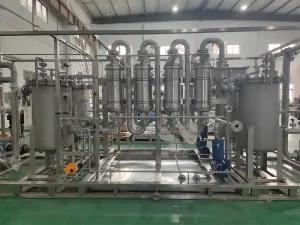
To overcome hydraulic pressure limits of spiral wound membranes (typically 85 bar), Tongjie’s patented OARO trains use counter-current sweep solutions to reduce net osmotic pressure. This enables concentration of high-salinity industrial brines up to 130,000+ mg/L TDS before thermal evaporation, cutting mechanical vapor recompression (MVR) power draw by up to 40%.
AI Digital Twins & Dynamic Antiscalant Modulation
All factory-shipped Tongjie skids integrate neural network inference modules running on edge compute hardware. The software continuously calculates Silt Density Index (SDI), Langelier Saturation Index (LSI), and real-time membrane flux decline to dynamically modulate high-pressure pump speeds, backwash frequency, and antiscalant metering to prolong membrane operational life.
Ceramic Ultrafiltration (CUF) Pretreatment
To address volatile coastal red tides, extreme algae blooms, and high suspended solids, Tongjie integrates inorganic Silicon Carbide (SiC) and alumina ceramic ultrafiltration membranes upstream of the RO elements. With continuous tolerance to free chlorine (>1,000 ppm) and abrasive solids, CUF reliably maintains downstream feed SDI < 2.5.
Global Compliance, Quality Assurance & Field Engineering Support
Stringent compliance engineering backed by Shanghai Tongjie’s Class II qualifications, ISO systems, and worldwide logistics coordination.
Certifications & Pressure Safety
Every system is manufactured in accordance with strict international industrial pressure equipment guidelines, including CE Pressure Equipment Directive (PED 2014/68/EU), ASME Section X for fiber-reinforced plastic pressure vessels, and ISO 9001, ISO 14001, and ISO 45001 audited production workflows.
Installation & Commissioning
Tongjie maintains seasoned field service engineering teams holding offshore safety certifications (BOSIET) and heavy industrial site clearance. We provide on-site supervisions, commissioning oversight, distributed SCADA client integration, and hands-on operational training across the Middle East, Central Asia, Latin America, and Africa.
Life-Cycle Spares & Membrane Stewardship
Long-term operational security is backed by warehouse stocks of standard spiral-wound membranes, high-pressure pump cartridge seals, solenoid valves, and proprietary antiscalants. Through cloud telemetry, our Shanghai operations center provides remote diagnostics, warranty assistance, and performance optimization for plants worldwide.
Frequently Asked Questions: Seawater RO Procurement & Engineering
Direct engineering answers addressing critical design choices, metallurgical selection, recovery boundaries, and delivery schedules.
What essential raw water parameters are required to size an industrial SWRO plant?
How do you ensure high-pressure manifold piping resists crevice and pitting corrosion?
What energy recovery device (ERD) configurations are integrated into Tongjie SWRO skids?
How does Shanghai Tongjie protect SWRO membranes against rapid biological and organic fouling?
Can containerized desalination systems be deployed in extreme ambient desert climates?
What lead time is standard for a 500 m³/day to 2,000 m³/day containerized SWRO system?
Specialized Brine Treatment, SWRO Plants & Demineralizers
Explore our zero-liquid-discharge concentrators, mobile seawater plants, and specialized high-salinity separation equipment.