
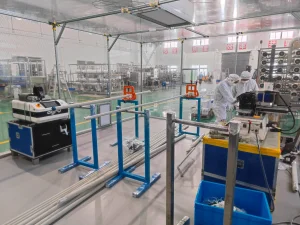
CE Certification Eco-Friendly Water Treatment Solutions - ODM Services from China Suppliers & Factory for Global Brands Suppliers, Manufacturer
View Specifications
Engineered for mission-critical municipal, energy, marine, and semiconductor operations.
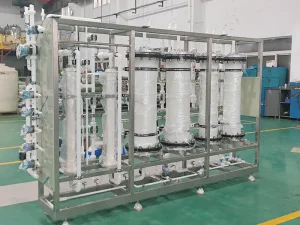
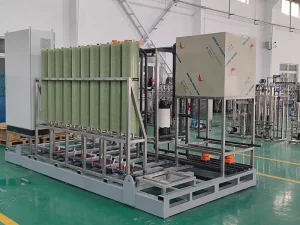
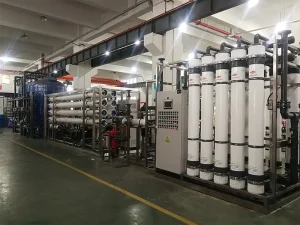
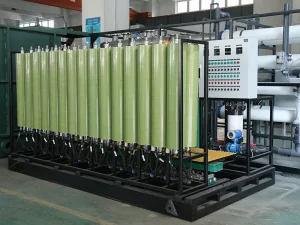
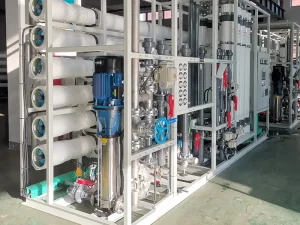
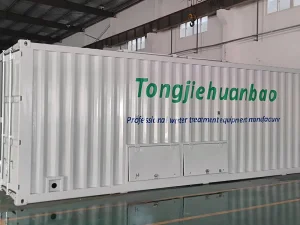
Addressing the paradigm shift from traditional thermal evaporation to ultra-low energy isobaric membrane separation and intelligent recovery trains.
Modern turning-salt-water-into-fresh-water installations rely fundamentally on Isobaric Energy Recovery Devices (PX). By transferring pressure directly from high-salinity brine waste streams to incoming seawater without intermediate electrical conversion, our plants achieve up to 98% hydraulic pressure recovery, limiting specific energy consumption (SEC) strictly between 2.2 and 2.8 kWh/m³.
Unplanned membrane autopsies confirm silt and biofouling as the primary vectors of premature membrane degradation. Tongjie integrates dissolved air flotation (DAF), ultrafiltration (UF) hollow-fiber membranes, and automated chemical dosing skid packages, ensuring continuous feed Silt Density Index (SDI₁₅) < 2.5, even during severe red-tide or coastal storm conditions.
The transition toward high-flux, thin-film nanocomposite (TFN) membranes featuring embedded metal-organic frameworks (MOFs) allows dramatic salt rejection (>99.8%) with minimized feed pressure requirements. Furthermore, our systems incorporate multi-stage boron rejection passes to comfortably meet WHO potable standards (<0.5 mg/L) across high-temperature sea zones.
| Desalination Parameter | Conventional Thermal (MSF / MED) | Standard Skid SWRO | Tongjie Engineered Large-Scale ODM SWRO |
|---|---|---|---|
| Specific Energy (SEC) | 12 - 25 kWh/m³ (Thermal + Electric) | 3.8 - 4.5 kWh/m³ | 2.4 - 2.8 kWh/m³ (Isobaric PX) |
| Footprint & Installation | Massive civil structures, 24+ mos build | Dispersed skids, site interconnects | Factory containerized / Modular, plug-in |
| Boron Removal Integrity | Moderate (Depends on steam carryover) | Single-pass baseline (<1.5 mg/L) | Multi-stage pH adjustment (<0.5 mg/L WHO) |
| Automation Level | Labor intensive, boiler monitoring | Semi-automated PLC | Fully unmanned SCADA, IoT remote diagnostic |
From deep-sea resource extraction to high-density coastal urban centers, our large-scale systems deliver water resilience.
Providing independent water grids for arid coastal cities, island hotels, and port complexes with daily production reaching 10,000 to 50,000+ cubic meters per train.
Treating highly corrosive, oil-contaminated fracturing fluids using heavy-duty DTRO disc-tube configurations to reach oil content ≤5 mg/L and suspended solids ≤1 mg/L.
Pre-desalinated water polished through multi-pass reverse osmosis and continuous electrodeionization (RO+EDI) delivers ultrapure water meeting SEMI E1.1 requirements.
Overcoming zero discharge regulations by transforming hyper-saline metallurgical process bleed into crystallized commercial-grade cake while recovering 95%+ water for reuse.
Combining world-class component supply chains, automated orbital welding, and integrated factory acceptance testing (FAT).
High-chloride seawater systems demand flawless metallurgy. Tongjie utilizes automated CNC orbital welding with full argon back-purging for all 2507 super duplex stainless steel high-pressure pipework, eliminating pitting and crevice corrosion across high-pressure runs up to 85 bar.
Rather than risky field installation in remote geographies, our systems are pre-assembled inside marine-grade ISO standard containers (corrosion protection C5-M). Piping, pumps, electrical cabinets, and instrumentation are fully plumbed and wired within our Shanghai facility.
Every industrial desalination unit undergoes comprehensive hydraulic wet testing prior to packing. Clients and independent inspectors monitor live flow rate, conductivity, temperature, and pump vibration data via high-definition cloud-streamed factory acceptance testing (FAT).
A rigorous five-stage delivery roadmap designed to derisk capital investment from raw water testing to multi-year O&M.
Global engineers provide raw water ionic matrices (TDS, silica, barium, strontium, COD, TSS). We utilize ROSA, IMSDesign, and custom projection engines to map out scaling potentials and verify critical recovery boundaries.
We deliver preliminary process flows, P&ID blueprints, equipment BOMs, power requirement estimations, and hydraulic mass balances prior to any formal contractual commitment, giving EPC contractors complete design transparency.
Skids are constructed under strict ISO 9001 quality supervision. Major components (Toray, DuPont, Hydranautics membranes; Danfoss, Grundfos, Cat high-pressure pumps) are matched precisely to engineering specifications.
Full-scale water testing in our factory eliminates on-site integration friction. Control loops, safety relief interlocks, emergency shutdowns, and instrument calibrations are proven compliant before container loading.
Our multilingual commissioning engineers deploy on-site to direct intake connection, high-pressure line purging, and final parameter stabilization, followed by comprehensive on-site operator training.
Through our dedicated Global Service framework, operators receive secure real-time operational advice, scheduled membrane replacement packs, anti-scalant supplies, and remote firmware optimization.
Ensuring frictionless site permitting, electrical grid compatibility, and regulatory alignment in North America, Europe, MENA, and APAC.
Electrical control enclosures are custom-configured for 380V/50Hz, 440V/60Hz, 480V/60Hz, or specialized voltages. Components comply strictly with CE Low Voltage (LVD) & EMC directives, with optional UL/CSA panel build certifications.
High-pressure membrane housings (FRP, up to 1200 PSI) and pressure relief manifolds conform to ASME Section X and ASME B31.3 chemical plant piping codes, assuring complete operational safety under maximum hydraulic pressure.
All wetted post-treatment materials, food-grade epoxy coatings, remineralization calcite media, and permeate pipe lines comply with NSF/ANSI 61 and WHO potability regulations for human consumption safety.
Custom ODM solutions engineered for difficult brines, offshore deployments, and sub-micron purity requirements.
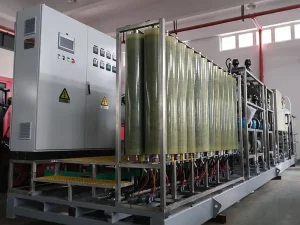
In-depth responses covering process feasibility, recovery limits, metallurgy, and turn-key logistics.