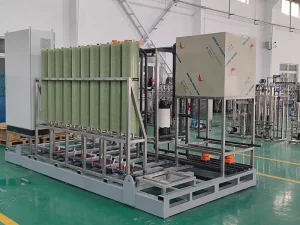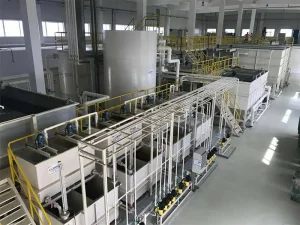
OEM High-Ratio Water Reuse Equipment - Multi-Stage Process
Explore Specifications
Pre-engineered containerized seawater reverse osmosis equipment and specialized membrane separation trains ready for rapid overseas deployment.
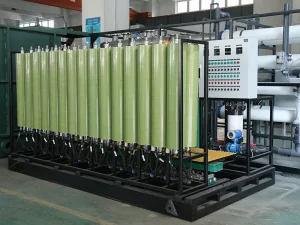
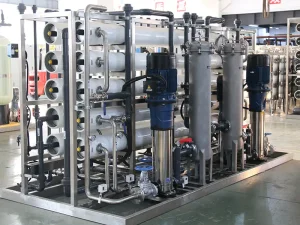
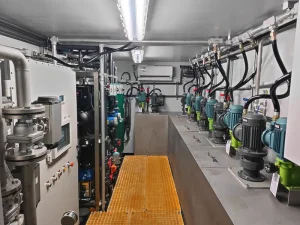
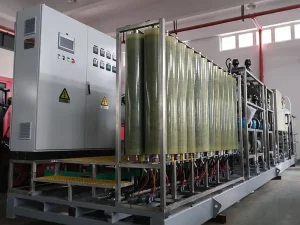
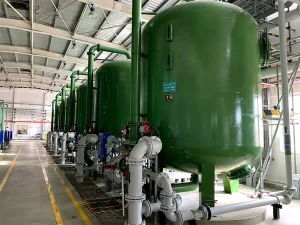
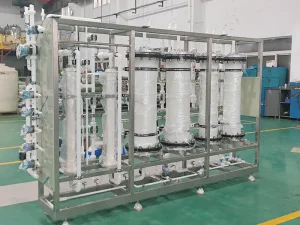
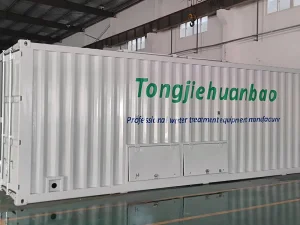
Addressing structural water deficits through high-recovery membrane trains, energy isobaric recovery devices, and zero-carbon modular architecture.
Modern SWRO plants have decoupled from obsolete thermal distillation (MSF/MED). State-of-the-art systems leverage positive displacement ceramic isobaric energy recovery devices, capturing up to 98% of the hydraulic energy within the concentrated brine stream and recycling it directly back to the high-pressure membrane feed.
Raw oceanic water quality fluctuates drastically due to harmful algal blooms (red tides) and total suspended solids. Industrial suppliers now standardize on pressurized Ultrafiltration (UF) pre-treatment membranes with an SDI (Silt Density Index) < 2.5, paired with smart biocide dosing and continuous ORP feedback loops.
Pitting and crevice corrosion under high chloride exposure (>35,000 mg/L TDS) present major system failure risks. Certified manufacturers engineer all high-pressure manifolds, valves, and pump housings using 2507 Super Duplex Stainless Steel (PREN ≥ 42), guaranteeing structural integrity under 70–85 bar continuous cyclic pressures.
Analyzing how complete industrial cluster vertical integration empowers EPC contractors with up to 40% capital reduction and cutover lead times within 60 days.
| Evaluation Parameter | Chinese Tier-1 Manufacturers (e.g., Shanghai Tongjie) | Traditional Western EPC Fabricators |
|---|---|---|
| Pre-Shipment Factory Acceptance (FAT) | 100% full-hydraulic, wet pressure and sensor loop testing in-factory prior to crating. | Partial mechanical skid assembly; hydraulic and control loops calibrated on-site. |
| Average Delivery Lead Time | 45–75 calendar days for standard 500–5,000 m³/day containerized configurations. | 180–240 calendar days subject to multi-vendor component procurement cycles. |
| Bespoke Skid Tailoring (OEM/ODM) | Native customized PLC architectures (Siemens, Allen-Bradley), dual-skid layouts, and tropical/desert thermal insulation. | Rigid standardized catalogue builds with heavy price premiums for engineering change orders (ECOs). |
| Lifecycle Capital Expenditure (CAPEX) | Uncompromised ASME/CE component integration at 30%–45% lower capital barrier due to supply chain density. | High baseline engineering overhead and logistics-added intermediary margins. |
From precision pressure vessel filament winding to high-pressure triplex plunger pump machining, China’s industrial Yangtze River Delta corridor hosts every component tier within a 100km radius, eliminating cross-border logistics hold-ups during critical assembly phases.
Every modular seawater unit manufactured undergoes non-destructive hydrostatic testing at 1.5x design operating pressure, automated laser dimension verification, and exhaustive simulation runs on pure saline mixes to ensure zero field delays upon port arrival.
International procurement compliance is supported by ISO 9001/14001/45001 accreditations, CE pressure equipment directives (PED 2014/68/EU), detailed P&ID blueprints, electrical schematics, and bilingual O&M manuals suited for local engineers.
Engineered to perform in hyper-arid coastlines, offshore exploration clusters, remote mining concessions, and specialized coastal chemical complexes.
Addressing the extreme salinities of the Arabian Gulf (45,000–50,000 mg/L TDS) alongside surface ambient temperatures exceeding 50°C. Configurations integrate automated heavy-duty seawater chlorination, active chemical cooling systems, dual-stage boron rejection passes, and robust anti-scaling chemistries.
Targeting zero-footprint utility installations across Southeast Asia, the Caribbean, and Pacific islands. Standardized 20-foot and 40-foot insulated shipping containers feature acoustic dampening, marine-grade epoxy coatings (C5-M specification), integrated chlorination units, and remote satellite SCADA telemetry.
Supplying water injection infrastructure and high-purity boiler feedwater for offshore jack-up rigs and coastal mineral processing facilities. Systems feature explosion-proof motor controls (ATEX/IECEx compliance), heavy-duty titanium heat exchangers, and Disc Tube Reverse Osmosis (DTRO) modules.
How cutting-edge separation approaches are pushing extraction boundaries from traditional potable tap streams to circular brine resource valorization.
By using counter-current saline sweep streams to balance trans-membrane osmotic pressure differentials, OARO enables brine concentration up to 120,000–180,000 mg/L TDS without requiring thermal mechanical vapor recompression (MVR), cutting terminal brine dewatering energy costs by over 40%.
Next-gen plants directly integrate variable-frequency drive (VFD) pressure pumps with distributed photovoltaic arrays and micro-hydro recovery turbines, allowing plants to dynamically ramp production up or down based on solar radiance curves without causing membrane hydraulic shocks.
Rather than discharging high-salinity reject brine back into marine ecosystems, ZLD flows undergo fractional crystallization to harvest commercial purity sodium sulfate, refined sodium chloride, magnesium compounds, and industrial-grade lithium feedstocks for green chemical manufacturing.
A standardized baseline guide for project directors, procurement engineers, and water authority teams preparing tenders.
Provide laboratory-certified water analyses detailing: TDS, seasonal temperatures, seasonal turbidity/SDI, Silica (SiO₂), Total Organic Carbon (TOC), Iron/Manganese ions, Hardness (Ca²⁺, Mg²⁺, Ba²⁺, Sr²⁺), and biological activity indicators.
Define operational constraints: Daily production (m³/24hr), permeate quality targets (WHO potable water TDS < 500 ppm or industrial boiler make-up < 5 µS/cm), site power availability (380V/415V/480V at 50/60 Hz), and modular container vs. skid-mounted floor layout.
Specify metallurgy for high-pressure stages (Super Duplex 2507 or Super Austenitic 254SMO vs. low-pressure Duplex 2205/SS316L), pump configurations (Danfoss, Cat, FEDCO, or Tier-1 domestic equivalents), and control architectures (Siemens S7-1500 or Rockwell Allen-Bradley).
Detailed technical, commercial, and operational guidance from experienced water treatment engineers.
To produce an accurate simulation and process guarantee, our engineering team requires: (1) Full ionic feed water composition including TDS, Ca²⁺, Mg²⁺, SO₄²⁻, Cl⁻, HCO₃⁻, and reactive Silica; (2) Ambient and water temperature ranges across seasonal peaks (crucial for flux sizing); (3) Target daily permeate capacity in m³/day or gallons per minute; (4) End-use permeate criteria (e.g., WHO drinking water, irrigation boron limits <0.5 mg/L, or high-pressure boiler demin specifications); and (5) Local site electrical metrics (voltage, frequency, and transformer stability parameters).
Under correct operating parameters, industrial SWRO membranes provide an operating life of 3 to 5 years. Foul mitigation relies on multi-barrier pretreatment: dual-media sand/anthracite depth filters or pressurized Ultrafiltration (UF) skids keep Silt Density Index (SDI₁₅) strictly under 3. Continuous dosing of NSF-certified threshold antiscalants prevents gypsum and calcium carbonate crystallization, while automated fresh permeate flushing cycles protect membranes during shutdowns.
Seawater reverse osmosis operates under high pressures (typically 55 to 80 bar). Approximately 55% to 60% of the feed flow exits as high-pressure brine. Isobaric ceramic rotor devices transfer this hydraulic energy straight to an incoming low-pressure seawater stream with over 97% mechanical efficiency. This reduces overall high-pressure pumping power by 40% to 60%, bringing overall specific power consumption down to 2.5–3.2 kWh/m³.
Standard 304 or 316L stainless steel quickly succumbs to pitting and crevice corrosion when chloride concentrations exceed 20,000 mg/L under aeration. For high-pressure piping manifolds, we engineer in Super Duplex Stainless Steel UNS S32750 (2507) or 254SMO (PREN > 42). For low-pressure seawater handling, we utilize Duplex 2205 (UNS S31803), heavy-gauge Schedule 80 UPVC, or glass-reinforced epoxy (FRP/GRP) piping systems.
All skids undergo a multi-point FAT at our Shanghai facility prior to packing. This covers pressure vessel hydrostatic checks, sensor calibrations, simulated PLC trip logic, and variable flow tests. For installation, we provide two deployment models: full dispatch of commissioning engineers to the site, or turnkey remote guidance supported by an industrial IoT modem integrated into the main control cabinet.
Spiral-wound SWRO membranes use narrow feed spacer channels susceptible to particulate plugging, requiring feed water with low turbidity and SDI < 3. DTRO features an open-channel hydraulic geometry with disc-supported flat-sheet membranes, allowing direct treatment of high-turbidity, high-COD wastewater, oilfield flowback, and extreme high-salinity brines up to 160 bar operating pressure with minimal pretreatment.
Explore fully customized mobile water solutions, low-energy demineralization modules, and zero liquid discharge systems engineered for global supply.